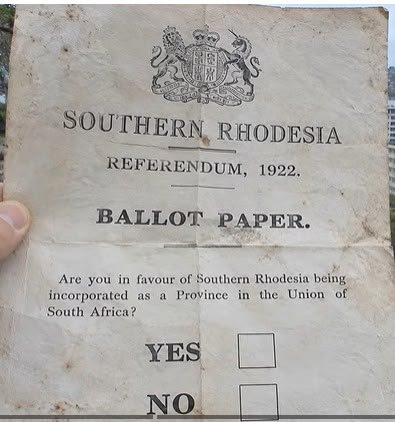
THE HISTORICAL BACKGROUND OF THE 1922 REFERENDUM WHICH VOTERS HAD TO CHOOSE BETWEEN SOUTHERN RHODESIA AS A SEPARATE STATE OR BEING A PROVINCE OF THE UNION OF SOUTH AFRICA
1/2. The 1922 Southern Rhodesian government referendum (held on October 27, 1922) was the culmination of over three decades of tension between white settlers, the British South Africa Company (BSAC), the British Colonial Office, and the Union of South Africa over who would govern Southern Rhodesia once Company rule ended.
Core Historical Drivers
The End of British South Africa Company (BSAC) Rule
Southern Rhodesia had been administered since 1890 under a Royal Charter granted to Cecil Rhodes’s BSAC. The Company never paid a dividend to its shareholders during its administrative rule, and by the 1910s, the cost of governing the territory outweighed its commercial returns. Settlers increasingly resented Company control over land, mineral rights, and railways, demanding a transition to direct political representation.
The 1918 Privy Council Land Ruling
A decisive turning point came in July 1918, when the Judicial Committee of the Privy Council in London ruled that unalienated land in Southern Rhodesia belonged not to the BSAC, nor to the indigenous African population, but to the British Crown. Stripped of its most valuable asset for recouping administrative deficits, the BSAC lost all financial incentive to continue governing and pushed for a quick exit and compensation.
South African Expansionism (Smuts’s Vision)
When the Union of South Africa was formed in 1910, Section 150 of the South Africa Act explicitly provided for the eventual admission of territories administered by the BSAC. South African Prime Minister Jan Smuts actively campaigned for Southern Rhodesia to join as the Union’s fifth province. Incorporating Rhodesia offered South Africa vast land for poor white farmers, mineral wealth, and—crucially for Smuts—a loyal block of predominantly English-speaking voters to counterbalance rising Afrikaner nationalism under J.B.M. Hertzog.
The "Responsible Government" Movement
Led by Sir Charles Coghlan and the Responsible Government Association (RGA), a large faction of settlers opposed joining South Africa. Their primary fears were:
Loss of British identity: Anxiety over Afrikaner political dominance and compulsory bilingualism (English and Afrikaans/Dutch) in schools and civil service.
Economic marginalization: Fear that Southern Rhodesia would become an economic hinterland subordinated to Johannesburg and Cape Town, losing protective tariffs and control over its own railways and taxes.
Labor competition: Concern that South Africa would use Rhodesia to offload its "poor white" unemployed population, threatening local settler wages.
British Imperial Strategy
The British Colonial Office—particularly Colonial Secretary Winston Churchill—initially favored Southern Rhodesia joining the Union of South Africa. Britain wanted to avoid the financial burden of taking over a bankrupt territory and hoped Rhodesian voters would bolster pro-British sentiment inside South Africa. However, London refused to force the territory into the Union against settler wishes, leading to the Buxton Committee (1921) recommendation that the electorate decide via referendum.
Road to the Ballot
Royal Charter Granted to the BSAC
October 1889
Cecil Rhodes secures a 25-year Royal Charter empowering the British South Africa Company to administer and exploit territories north of the Limpopo River.
Formation of the Union of South Africa
May 1910
The British-ruled colonies unite; Section 150 of the South Africa Act includes a constitutional mechanism for Southern Rhodesia's future incorporation.
Supplemental Charter & Land Dispute
1914–1918
The BSAC Charter is extended for 10 years, but the July 1918 Privy Council ruling strips the Company of ownership of unalienated land, prompting the BSAC to seek an end to its administrative role.
If you are struggling with anxiety, listen to this piece. Within about 30 seconds, your breathing will begin to change. It is the silence between the notes that calms the body.