I think the largest strategic failure of EU over the last decades was its failure to include Turkey - mainly based on fears about a rapidly growing muslim population. This excellent piece by @JesusFerna7026 illustrate that Turkey is rapidly converting to the European average.
Yesterday, I argued that Turkey’s TFR was 1.48 in 2024, well below replacement level, and has been falling fast since 2014.
Today, I want to highlight a few additional points.
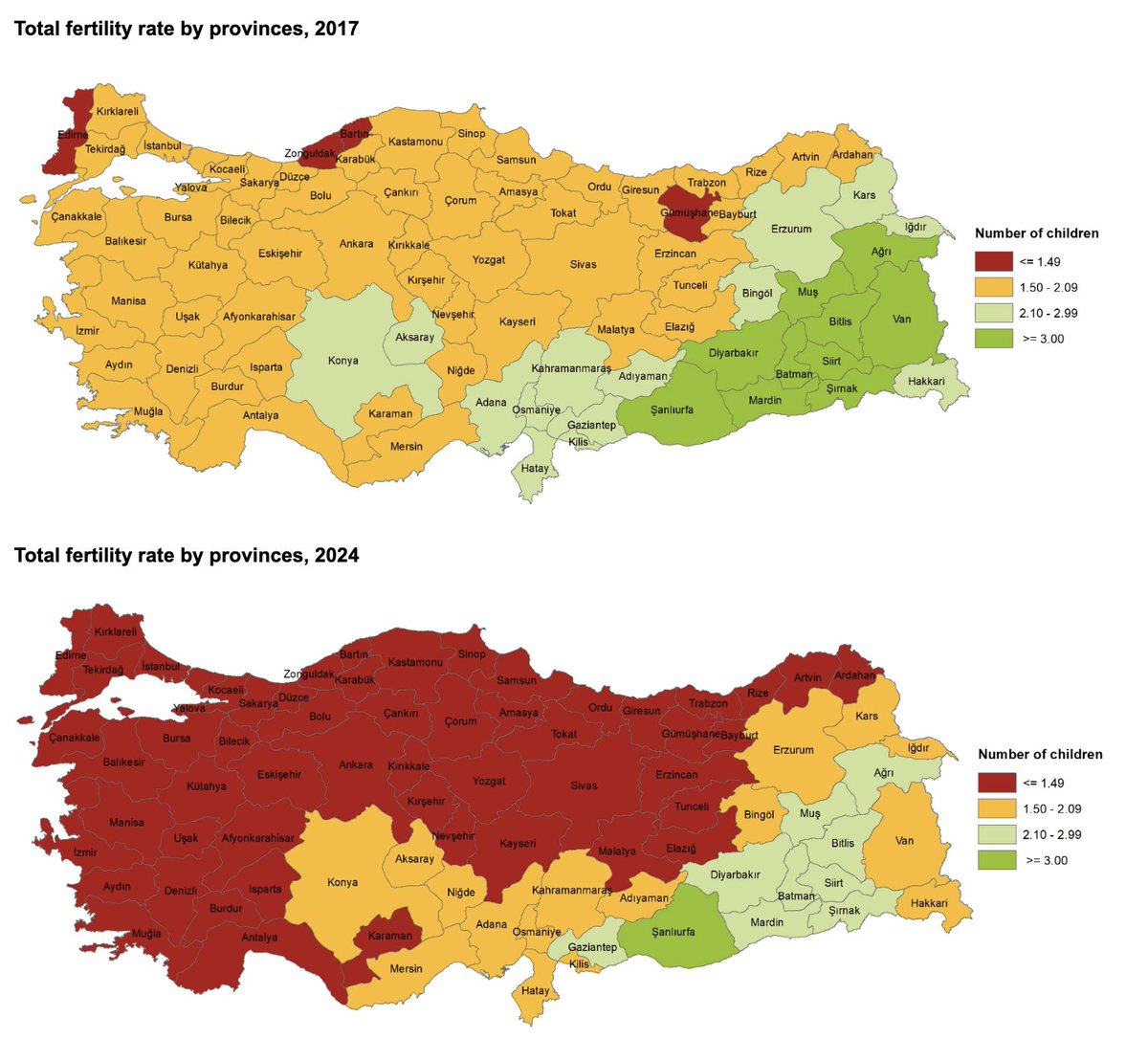
First: Turkey has the highest within-country TFR variance I’m aware of.
In Şanlıurfa, TFR was 3.28 in 2024 (comparable to Kenya). In Bartın and Eskişehir, it was 1.12 (comparable to Spain). The ratio between them is nearly 3 to 1.
By comparison, in the U.S., the highest TFR is in South Dakota (2.0), the lowest in Vermont (1.3), a ratio of 1.5.
These differences in TFR reflect significant differences between Eastern and Western Turkey (in terms of economy, society, culture, and ethnicity) and will impact Turkey’s future. Yet even with those divides, TFR is falling everywhere.
TFR in 2014:
Şanlıurfa: 4.57.
Bartın: 1.69.
Eskişehir: 1.57.
Even more striking is Şırnak. In 2000, it had a TFR of 7.06, comparable to Chad or Mali, and among the highest in the world. In 2024, it dropped to 2.62, roughly Turkey’s national level in 1998. That’s a 63% drop in 24 years. I struggle to find any other example in global demographic history of such a rapid decline in fertility.
And remember: TFR is not the crude birth rate. TFR = expected births per woman, not per population. Migration flows don’t affect it (unless those who migrate are the most fertile per woman, which would increase TFRs in the destination provinces).
As a whole, TFR in Southeast Anatolia went from 3.63 (2014) to 2.87 (2024). At this pace, the region will fall below replacement by 2030.
In other words, Turkey’s national TFR still has much room to fall, as the east continues to decline from high levels, and we may soon see Turkey’s TFR fall below the EU average, something I wouldn’t have predicted even a decade ago.
Second: Turkey is a textbook case of what @NezihGuner, @mattd_econ, and I have called “demographic contagion”:
📄 https://t.co/sVkLjYGy9a
The fall in TFR in one region is strongly influenced by previous declines in adjacent regions, even controlling for income.
In Turkey, if you map provincial TFRs over time, you see an unstoppable tidal wave moving eastward, rarely skipping or leaving provinces untouched. That dynamic, to me, is crucial.
Third: there’s little evidence this drop in TFR is driven by timing. Yes, completed fertility may end up a bit higher than current TFR estimates, but that’s a second-order difference.
Fourth (and finally): as in many countries, the 2024 UN WPP numbers for Turkey are hard to reconcile with national data.
Turkish Statistical Institute: TFR = 1.48, Births = 937,559.
UN WPP 2024: TFR = 1.85, Births = 1,196,000.
The UN does not project Turkey’s TFR to fall to 1.48 at any point before 2100 (the end of its projections). And yet it already has, according to the Turkish Statistical Institute.
This is a serious issue. Many rely on the 2024 UN WPP, but the numbers diverge massively from national statistical agencies and almost always in the same direction: UN projections show much higher TFRs and births. Why?
I could discuss the demographic future of Turkey in much more detail, but I will stop here.
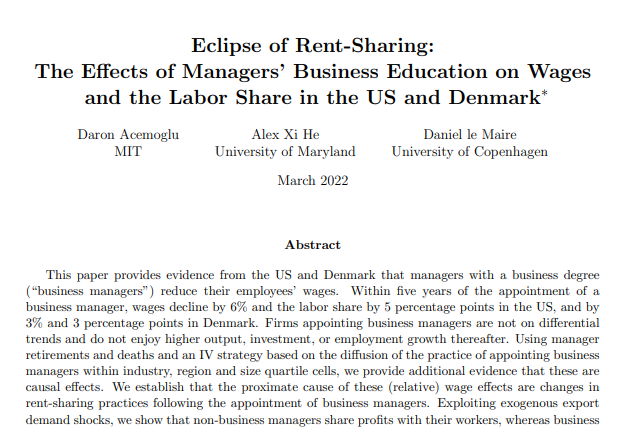
Interessant lesning - en av de nye nobelprisvinnerne i Økonomi har funnet ut at når et selskap ansetter økonomer så faller lønningene for de ansatte med 6% både i USA og Danmark. Kanskje også i Norge?
Interessant at LO er ute og pusher kredittkort nå på sommeren - og å en måte som gjør det uklart om LO nå har begynt med kredittkort dispute handling. Eller har bare LO gitt helt frie hender til bankene de samarbeider med?
@MacroAlf Switzerland is the riskiest? Switzerland? Makes no sense to look at debt levels in isolation without considering also the asset side of the balance sheet.
Stopp å henvise bankkunder til å prute på boligrenten, men rydd heller opp i prisdiskrimineringen hvor samme bank gir like kunder ulik rente - enten basert på om de pruter, eller basert på hvilke app de bruker https://t.co/bSUEc2MCzf via @LinkedIn
@Michael_Balle TPS is a huge inspiration and one of the biggest inventions last century. Many are applying TPS thinking in services without reflecting on the difference in processing physical goods and processing data. Data can be reused and repurposed in ways which physical goods can’t.
Another common question I’m answering working with scaling tech companies is…
Q. What’s the worst leadership advice you’ve heard?
A. By far the worst is “Hire great people and get out of their way”.
Let me explain… 🧵 (1/32)
If you need a heavyweight framework to manage complexity, perhaps you have too much complexity. Better bandaids won't stop the bleeding if you really need stitches.
@Giljen@singstaen@Statnett @NVE @EnergiNorge Prisen blir ikke satt av produsentene, i et fritt marked blir prisen satt av de konsumentene som er villig til å betale mest sk 'marginalprising'. Ved at vi har koblet sør Norge til UK så setter de marginalprisen også for oss.
@kariekas @EnergiNorge Helt enige med @kariekas - @energinorge må uttale seg mot bedre vitende - eller rett og slett at de ikke vet hva de snakker om. Dette er ikke et IT problem - det er en beslutningsproblem. Tid for å ta en pause og gjøre noe smartere. #nettleie#strømpris