Qué decir.
Conocí al Indio en 1984. Fui a hacerle una entrevista a Los Redondos (también estaban Skay y la Negra Poli) para El Porteño. Enrique Symns me había hecho el contacto. Era un sábado a eso de las 7 de la tarde. Llegué y la negra Poli me preguntó si prefería fernet puro o cerveza con vodka, los únicos alcoholes que tenían en el departamento.
Así comenzó una amistad que duró unos 6 años (se distanció cuando pasaron a los estadios y la fama absoluta y yo ya no pude seguirles el paso por esa locura; aunque lo vi al Indio a comienzos de este siglo en el Centro porteño, de casualidad -iba muy camuflado pero lo reconocí, lo llamé y nos fuimos a tomar un café- y también vi a Poli y Skay varias veces en Palermo y ellos están igual que en mi recuerdo de hace 40 años).
Esa entrevista (que apareció en el número de diciembre de 1984 en El Porteño) terminó antes de una hora, pero nos quedamos charlando hasta las 8 o 9 de la mañana del domingo. Desde entonces y por varios años nos vimos con mucha frecuencia. Me subí a la camioneta con la que íbamos a los recitales de los amigos (por ejemplo, a ver al pelado Luca en algún show de Sumo).
En 1987 y 1988 llevé a Symns a Fin de Siglo y el Indio venía seguido a la redacción (Vera Land lo entrevistó ahí alguna vez, también escribió una columna, le gustaba lo que hacía El Monstro Punk en la revista).
Los Redonditos de Ricota fueron desde el comienzo una familia "mafiosa" (en el sentido cariñoso, sí, cariñoso del término). Uno entraba ahí y ya era parte de una cofradía, era un mundo que te integraba y te abrazaba y te enloquecía y te enriquecía.
Fueron 6 años vertiginosos de mi vida. Recién pude comprender algo de lo que había pasado ahí cuando me bajé de la furgoneta y miré desde afuera: a pesar de la lucidez descarnada había esperanza. Fue hermoso (mientras duró).
El Indio hablaba como escribía. No es que cada frase fuera como las letras de sus canciones, pero sí que esas frases cotidianas tenían el fraseo, el ritmo de sus poemas. Los neologismos en los que ensamblaba partes del inglés con el castellano estaban en su habla cotidiana, en cada ocurrencia.
El Indio era cariñoso y sonreía. El Indio que yo conocí era esencialmente un hombre bueno, muy dado a sus amigos.
El Indio era un hijo de la educación pública, de las instituciones del siglo XX (su padre había sido jefe de correos en La Plata). Criado en una casa de clase media con los libros que tenían la clase media a mitad del siglo XX y con los sueños de un joven rebelde de los 60: los beatnik (ante todo Kerouac y Burroughs, pero en poesía Ginsberg) y Rimbaud, el eterno joven de la poesía infinita.
Vamos a brillar Indio.
Al menos entre mis lágrimas te veo brillando. Sonriendo feliz de haber transitado el arduo camino a la nada.
#مرجان_ساتراپی رفت، اما شاید هیچوقت ندانست که این سکانس از «پرسپولیس» چه تأثیری روی منِ نوجوان بعد از دیدن این انیمیشن گذاشت.
در سختترین روزها، میان تبعیضها و فشارهایی که بهعنوان یک زن ایرانی و متولدشده در یک خانواده بهایی تجربه کردم، میان افسردگیها و روزهای سنگین زندگی، آهنگ Eye of the Tiger را پخش میکردم و آن سکانس را زندگی میکردم؛ تا یادم نرود که باید ادامه بدهم و کم نیاورم.
این کار کمکم به یک رسم تبدیل شد؛ رسمی که در تمام این سالها با من ماند و هنوز هم ادامه دارد...
In January, at the World Economic Forum, Jared Kushner presented a “Master Plan” for the future of Gaza. Kushner’s slideshow featured glossy images of coastal skyscrapers, a new tourism district with 180 towers, an airport, a seaport, and industrial complex zones. A phased reconstruction timeline promised to transform “New Rafah” and “New Gaza” into modern metropolises. The Master Plan was shared as part of the establishment of President Donald Trump’s so-called Board of Peace.
“Tellingly, the Davos slideshow just briefly mentioned basic services like water, electricity, and sewage for Palestinians in war-decimated Gaza,” writes Mohammed R. Mhawish. “Kushner’s presentation mentions Palestinians in the context of ‘demilitarization principles,’ claiming this process will be ‘led by Palestinians, internationally verified.’ The Palestinian public were not involved, not even consulted, in the drafting of these visions. Almost every decision about where they will live, how they will move, and what kind of life they may rebuild was made without them.”
From the perspective of Nour Alsaqqa, a media and communications officer in Gaza, it’s obvious that the Board of Peace’s proposals aren’t meant to restore life in Gaza. Rather, they serve interests that are mostly American, Israeli, and Gulf in character.
Over the past several months, Mhawish spoke with U.S. officials, legal scholars, and political analysts to understand the hierarchy of power within the Board of Peace and how its decisions are being made. Read his full report on what the proposals really mean for the future of Palestine: https://t.co/Pyi1e20q9h
🎙️🔴| A mediados de 2019, en un operativo en Chihuahua, 21 hombres fueron rescatados de un campo de trabajo forzado para el cultivo de amapola y marihuana en la Sierra Tarahumara, donde los tenían viviendo en cuevas.
Las periodistas @marcelaturati y @Thelmagomezdura hablan con @AristeguiOnline sobre #EsclavosEnLaSiera, nuestra investigación más reciente.
Sigue la conversación aquí:
➡️ https://t.co/ejvPkTHDWQ
My first year working as a sports journalist coincided with the arrival of a player roughly my age at Barcelona. Her name was Alexia Putellas.
She is now leaving the club as a legend after 14 years. She has won 4 CL titles, 10 leagues and 2 Ballon d'Or.
https://t.co/J9w7D3oZBJ
“I think when the creative person ends, he continues in the next existence. I’m a person who believes this life isn’t the be-all and end-all of everything. A spiritual person doesn’t feel like that.” –S.R. (2009) 2/2
Han pasado 15 años desde la última vez que Pumas fue campeón del futbol mexicano.
Ahora que se encuentran a un paso de una nueva final, recordamos el equipo que alguna vez fue: https://t.co/nnvt8K69In
Me parece una buena explicación de por qué ha bajado la fertilidad humana y de lo poco que en realidad influyen los celulares y las redes sociales (aunque algo influyen).
Hasta ahora es lo que mejor explica la nueva demografía planetaria.
Cuando los medios replican sin dudar ni un poco, minan su credibilidad. En estos tiempos de viralidad y de IA, nosotras decidimos seguir haciendo periodismo, seguir dudando y preguntando. Aquí un ejemplo de esto 👇🏽
https://t.co/XQ2YqWj5RM
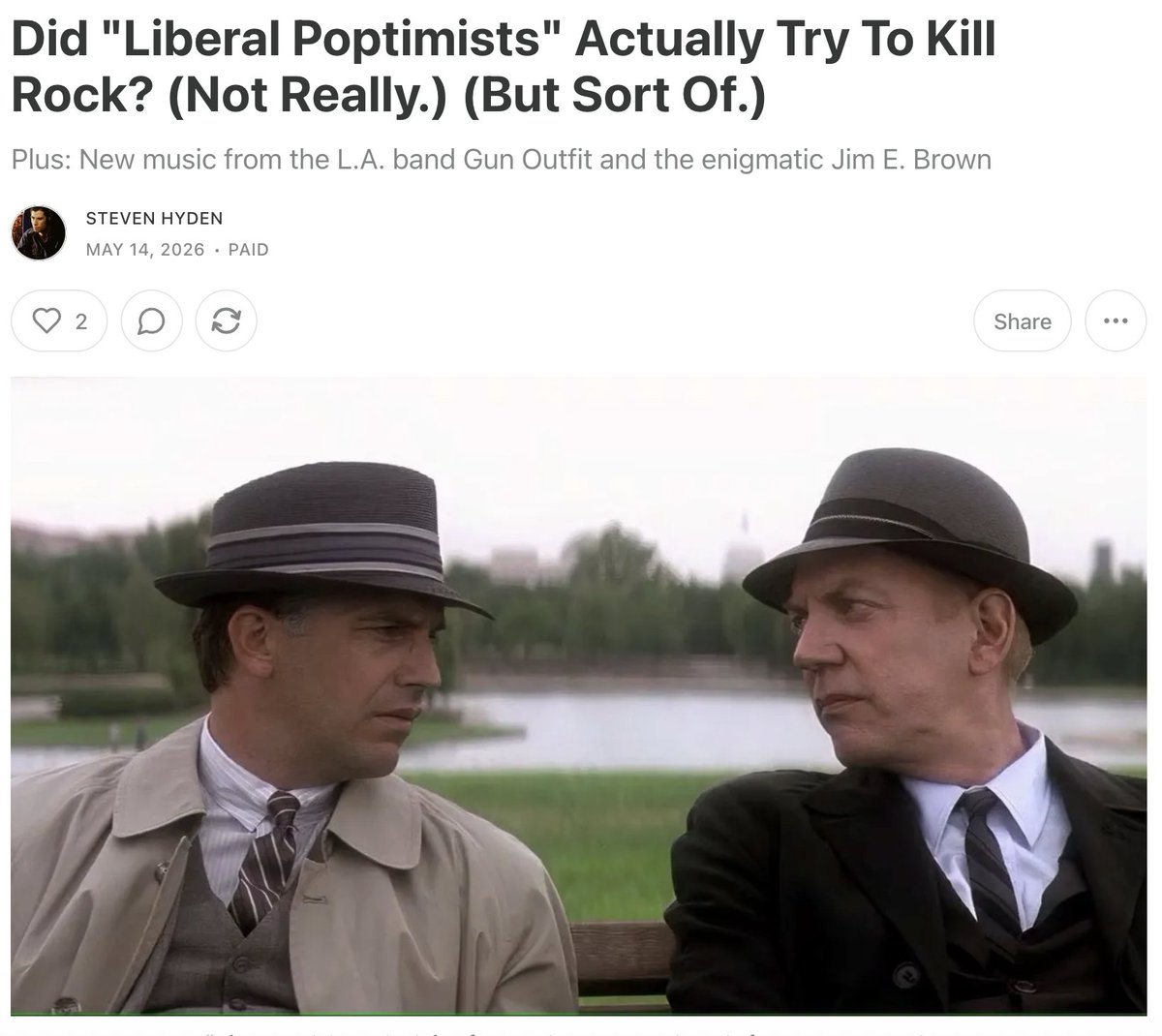
I wrote a (long) response to a recent Jacobin article about whether “liberal poptimists tried to kill rock.” I also addressed that viral NYT video about their songwriters list. A “state of rock music” AND a “state of music criticism” piece combined!
https://t.co/DLukpzSodF
Annus Mirabilis
Philip Larkin
Sexual intercourse began
In nineteen sixty-three
(which was rather late for me) —
Between the end of the "Chatterley" ban
And the Beatles' first LP.
Up to then there'd only been
A sort of bargaining,
A wrangle for the ring,
A shame that started at sixteen
And spread to everything.
Then all at once the quarrel sank:
Everyone felt the same,
And every life became
A brilliant breaking of the bank,
A quite unlosable game.
So life was never better than
In nineteen sixty-three
(Though just too late for me) —
Between the end of the "Chatterley" ban
And the Beatles' first LP.
Philip Larkin: 'Annus Mirabilis' read by Harold Pinter
https://t.co/kknRjtBkxW
Encontramos a Ester y a Luis. Juntos. Permanecieron juntos en ese campo infinito. Pese a tanto esfuerzo por desaparecerlos para siempre, la tierra los guardó y nosotres les encontramos. Hoy regresan.
https://t.co/ps9j2uHBVV
https://t.co/BafnCobGSq