Learning to fly is difficult in gusty winds! Not bad for his first day out in the big wide world. @UoLperegrine ZBJ filmed in slow motion at the University of Leeds today. @BBCPaulMurphy@BBCSpringwatch@BBCLookNorth https://t.co/9rzIlFG2Tg
“Animals are not here for us to do as we please with. We are not their superiors, we are their equals. We are their family. Be kind to them.” - Ricky Gervais
Could this legendary gentleman please get in touch.
A future Reform government would like to give him a peerage for this outstanding public service.
He can do similar to all the crooks currently sitting in the House of Lords!
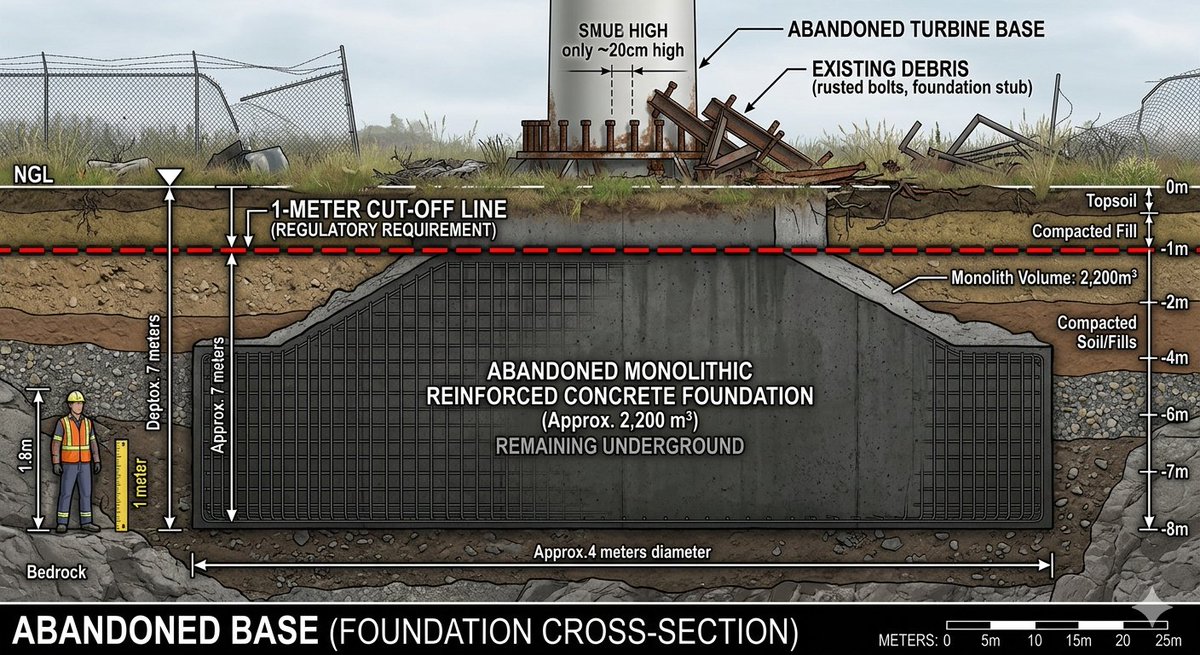
Tens of thousands of slabs of reinforced concrete weighing up to 1,000 tonnes are being abandoned in the ground as turbines hit the end of their working lives.
The reinforced concrete base of a typical 2-3 MW wind turbine can weigh anywhere from 400 to 800 tonnes. But the concrete foundations of even bigger turbines (5 MW+) can exceed 1,000 tonnes. As lifespans end these massive concrete monoliths are abandoned where they lie. This is an issue of significant contention.
In many jurisdictions, including Australia and the US, decommissioning regulations only require the operator to ensure the concrete foundation stays at a depth of 1 meter (approx. 3.3 feet) below the surface.
The remaining 3-plus metres of these steel-reinforced concrete fossils are typically left in the ground indefinitely. Over the decades, they can interfere with deep-soil hydrology or remain as a permanent industrial remnant in rural landscapes.
Contracts usually say operators are responsible for decommissioning. But the financial reality is complex. Bank guarantees or bonds set aside for removal (around €50,000 or $100,000 per turbine) are frequently far too low. Real-world estimates for total removal and site restoration can exceed $200,000 to $400,000 per unit.
If the cost of total removal ($200k–$400k) exceeds the bond set aside by the operator ($50k–$100k), there is a strong financial incentive for companies to declare bankruptcy . Or they sell the asset to a shell company as the turbine nears its end-of-life, leaving a landowner with the bill.
While the steel towers are more easily recyclable, their triple fibreglass blades are notoriously difficult to process and often end up in turbines blade graveyards.
The theoretical benefits from renewable technology are meaningless compared with the staggering environmental costs.
Just imagine the fear and torment of being thrown alive to a pack of hounds.
This is what we're fighting to end. This hunt claimed to be a 'trail hunt'. We need a proper ban on this vile pastime.
Take 15 seconds to act now.
Please Be Kind To Moles.
They are beneficial to soil health, acting as natural aerators and pest control by consuming lawn-damaging grubs, beetles, and larvae.
They do not eat plants, and their removal often leads to new moles occupying the vacant tunnel system, making it a futile effort.
Apart from that, it is CRUEL!