💡 Why would a firm spend millions training workers it doesn’t even employ?
From open-sourcing to certifications, superstar firms often train the workforce of their customers.
My JMP explains why. 🧵
“It’s fantastic, Peter, isn’t that great? Yes! Yes!”
Listen to the moment Philippe Aghion shares his joy with his friend and co-laureate Peter Howitt, captured as part of this call made shortly after the public announcement of the 2025 economic sciences prize. In this interview, Aghion also discusses the implications of their ‘creative destruction’ model of sustained economic growth – and reveals his surprise at the news.
BREAKING NEWS
The Royal Swedish Academy of Sciences has decided to award the 2025 Sveriges Riksbank Prize in Economic Sciences in Memory of Alfred Nobel to Joel Mokyr, Philippe Aghion and Peter Howitt “for having explained innovation-driven economic growth” with one half to Mokyr “for having identified the prerequisites for sustained growth through technological progress” and the other half jointly to Aghion and Howitt “for the theory of sustained growth through creative destruction.”
#NobelPrize
I am looking for one or two pre-docs to work with me at HEC Paris on historical patent data. Hopefully an exciting opportunity to develop quantitative skills in a nice research environment. See the position here https://t.co/vtYZmenAq7
Thanks for sharing !
Congratulations to @simon_margolin and @nikolakoudisg who defended their outstanding thesis today in front of many classmates and friends. They both have a bright future ahead as research economists!
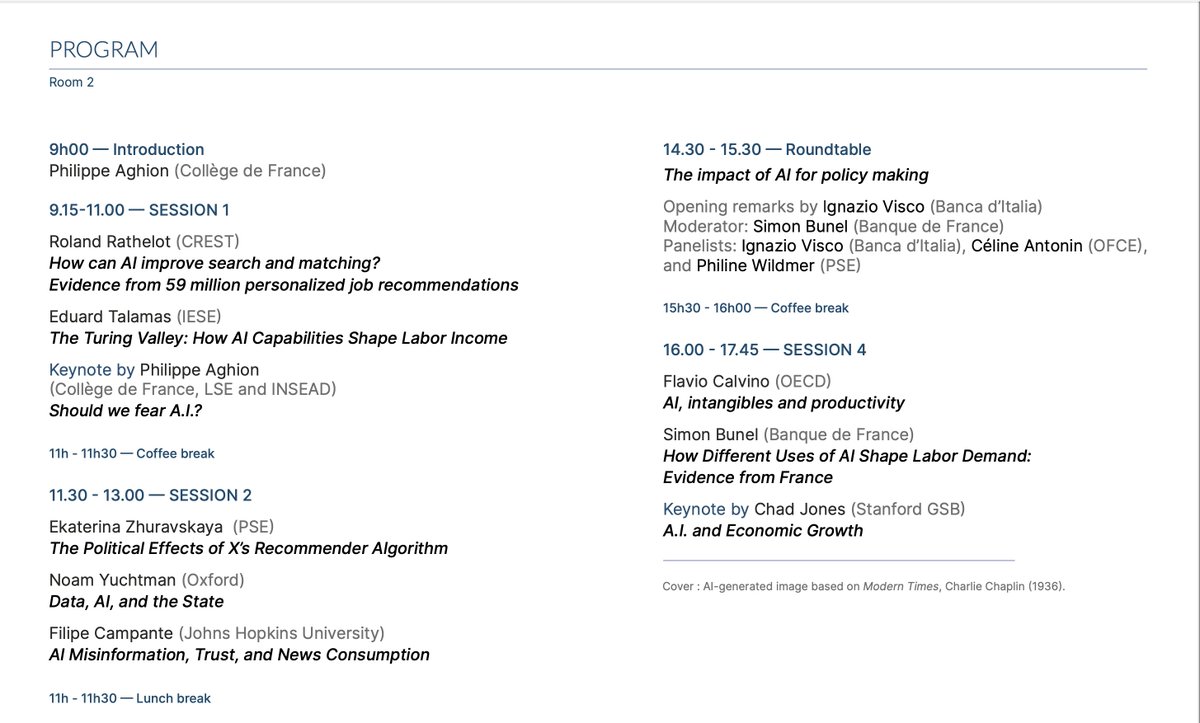
A new workshop on the economic of AI organized at @cdf1530 on June 10th. Featuring keynote by Philippe Aghion and @ChadJonesEcon (remotely) and a set of wonderful speakers (program below). Entry is free and without registration. More information https://t.co/Tk2gsShDiA
Francesco Fabbri's (@francesc_fabbri) job market paper shows that a novel holdup problem emerges in markets where consumers invest in acquiring information about product quality. https://t.co/X2kt3PRJeE
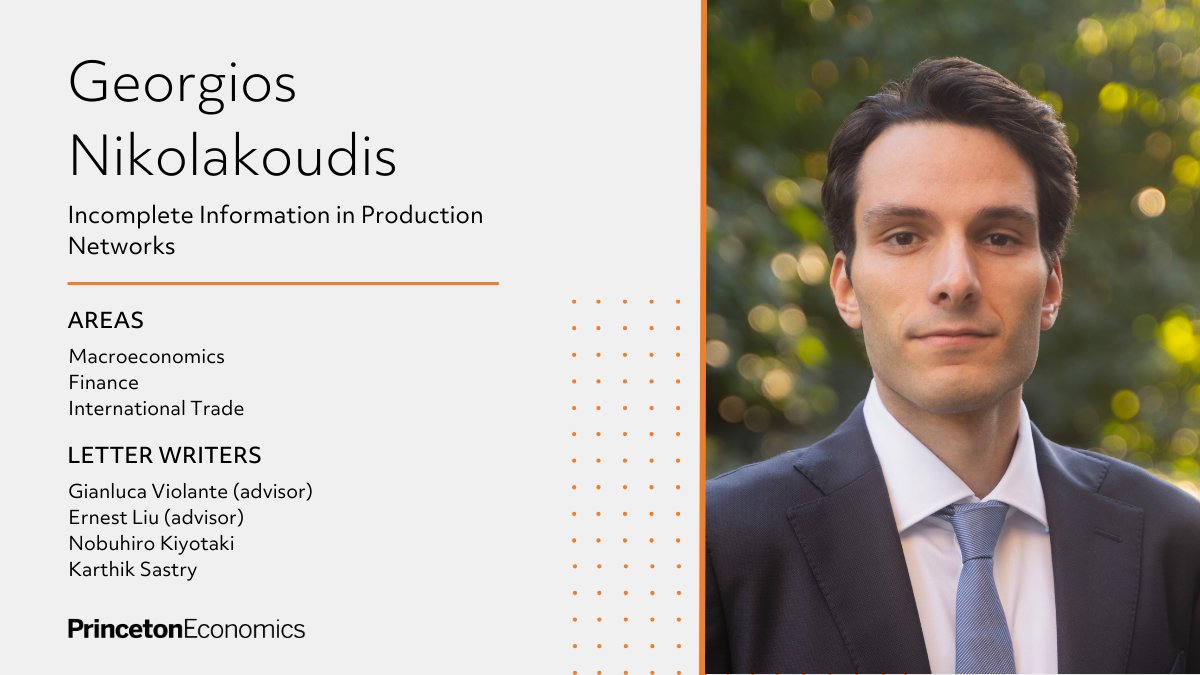
Georgios Nikolakoudis's (@nikolakoudisg) job market paper examines how production networks create macroeconomic risk when firms operate under incomplete information.
https://t.co/0C5MaUUFmK
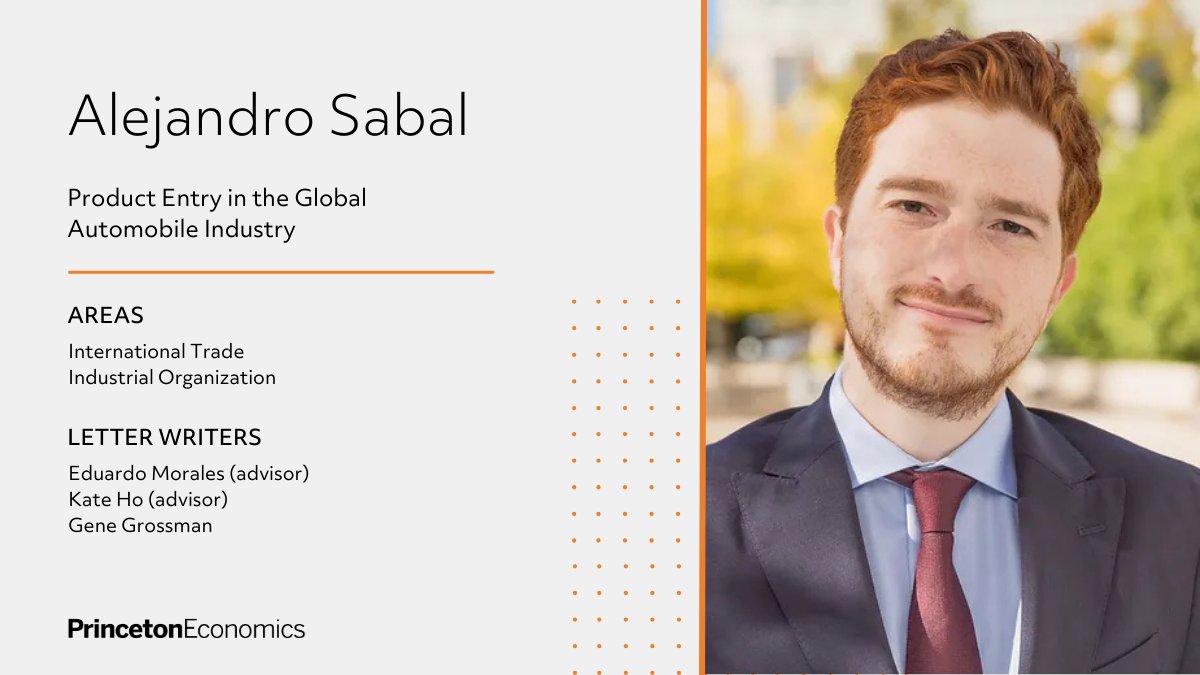
Alejandro Sabal's (@sabalalejandro) job market paper explores how product entry shapes the impact of national protectionist subsidies on global market outcomes in the automobile industry.
https://t.co/jhl1iqaV8V
Martin Vaeth's (@MartinVaeth) job market paper shows how rational voter learning explains both issue alignment and polarization of voter ideology. https://t.co/mlOweWOy7I
Chansik Yoon's (@yoon_chansik) job market paper analyzes the rise in Chinese development loans, finding that recipient country corruption is linked to more loans and larger projects in hard-to-monitor sectors. https://t.co/VjvNgjG8Hs
Very excited to see my paper with @genemgrossman and Elhanan Helpman forthcoming in the @QJEHarvard. Have a look if you want to learn about optimal resilience in multi-tier supply chains!
https://t.co/9GuUcX3aqh
My student @CabezonFran has a very interesting job market paper that investigates how the presence of a large informal sector affects optimal pension design https://t.co/d4HdTcNbCA
I am very happy and excited to share my job market paper joint with @AntoineMyrwtz and Sonja Dobkowitz.
The punchline: firms care about the environmental concerns of their consumers!
A (very) brief 🧵 below:
#EconTwitter#EconJMC
I had the privilege to advise two brilliant students on the market from @PrincetonEcon this year, Hugo Lhuillier and Lukas Mann. They both work at the intersection of macro, labor and spatial economics. Short 🧵on both, in alphabetic order.
How does the concentration of skilled workers in a handful of cities affect human capital accumulation? You can find out the answer in in my job market paper!