It is also possible that the amendment might be postponed until September, to allow the government coalition to secure the majority it needs to pass the amendment. Even if the amendment is just postponed, this would be a major win for the opposition.
The vote will be close. 🗳️ The government coalition needs 90 votes to adopt the amendment, but it commands only 78 votes. The Christian Democratic party can supply nine more votes (because two of its members are opposing the amendment).
The Slovak Parliament will vote on the amendment tomorrow. There seems to be an agreement on the bill between Christian Democrats and the government coalition to reach the constitutional amendment threshold of 90 MPs. The second reading is scheduled for tomorrow.
The Parliament has been in session since yesterday and will likely vote at 17:00. Major civil society organisations have called on the Parliament not to pass the amendment. In contrast, the Slovak Catholic bishop organisation supports the amendment.
Council of Europe Commissioner for Human Rights, Michael O’Flaherty has urged Slovakia not to adopt the amendment. He has warned that such a move risks weakening human rights and violating the European Convention on Human Rights. https://t.co/qLFaV48gPa
The Slovak Parliament will vote on the amendment tomorrow. There seems to be an agreement on the bill between Christian Democrats and the government coalition to reach the constitutional amendment threshold of 90 MPs. The second reading is scheduled for tomorrow.
Slovak Parliament is discussing five proposed constitutional changes:
1) Constitutional supremacy against EU law
2) A binary definition of gender
3) Curricular constraints/parental rights
4) Restriction of adoption to heterosexual spouses
5) Constitutional guarantee of equal pay
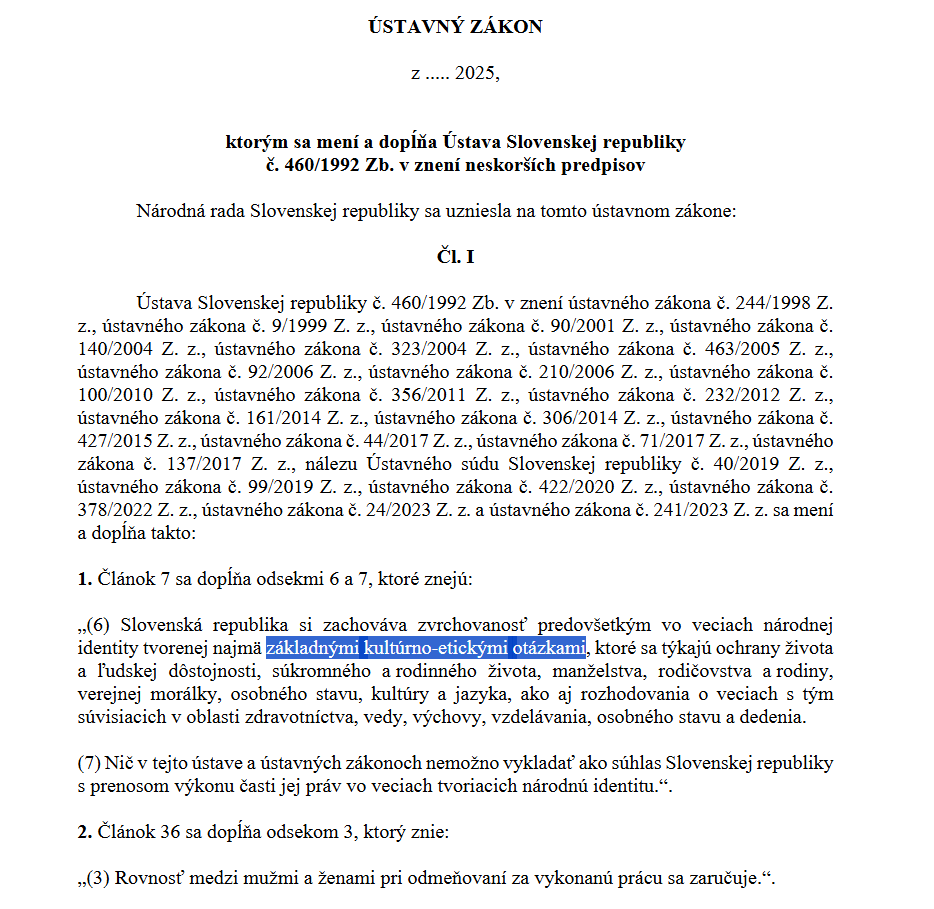
Precise contents of the bill are unknown beyond the original proposal + what has been reported by the media. But the main point is the assertion of const sovereignty against EU law, based on the concept of national identity, especially in "fundamental cultural-ethical questions."
Observing and taking part at the fællesmøde in my co-housing community in Denmark—the smallest scale of democratic practice, yet often the most direct and participatory.
In a situation where the government is not certain it can select its preferred candidate for the Court because of an unstable majority, the second-best strategy is then to do nothing. The President of the Court has pleaded with the politicians to remedy the situation asap.
Here are the votes for/against in all three rounds of selection for the one open seat on the Slovak ConCourt. In the first round, there was a repeat vote on the candidates. In the 2nd-3rd, only one vote was held each time, because there was only one candidate for the position.
The Parliament, however, does not have an incentive to fill the vacancy or select a candidate. If even one candidate was selected by the Parliament, the President could break the deadlock and pick the one available candidate (by law, there should be two for each vacancy).
The President has now signed the NGO Act into law despite the civil sector’s pleas not to. The Act will likely be immediately challenged in the Constitutional Court by the Opposition. The Ombudman has also declared that they will fight the Act in Court. https://t.co/H5rNBl3r4q
Slovakia passed a controversial NGO law in April that limits civic space, raising concerns over the right to association, democratic backsliding, and compliance with supraregional human rights treaties. https://t.co/3rDr7iWNUQ
Slovakia passed a controversial NGO law in April that limits civic space, raising concerns over the right to association, democratic backsliding, and compliance with supraregional human rights treaties. https://t.co/3rDr7iWNUQ
5) Finally, the constitution would guarantee “equal pay for equal work.” This aligns with international and EU standards on gender equality, potentially strengthening enforcement in Slovak courts.
Link to the legislative process: https://t.co/SfBiDpUjTw
Slovak Parliament is discussing five proposed constitutional changes:
1) Constitutional supremacy against EU law
2) A binary definition of gender
3) Curricular constraints/parental rights
4) Restriction of adoption to heterosexual spouses
5) Constitutional guarantee of equal pay
4) Adoption is reaffirmed for married couples only (hence heterosexual couples), although single individuals remain eligible if it serves the child’s best interests. From a comparative perspective, many European states have broadened adoption rights.