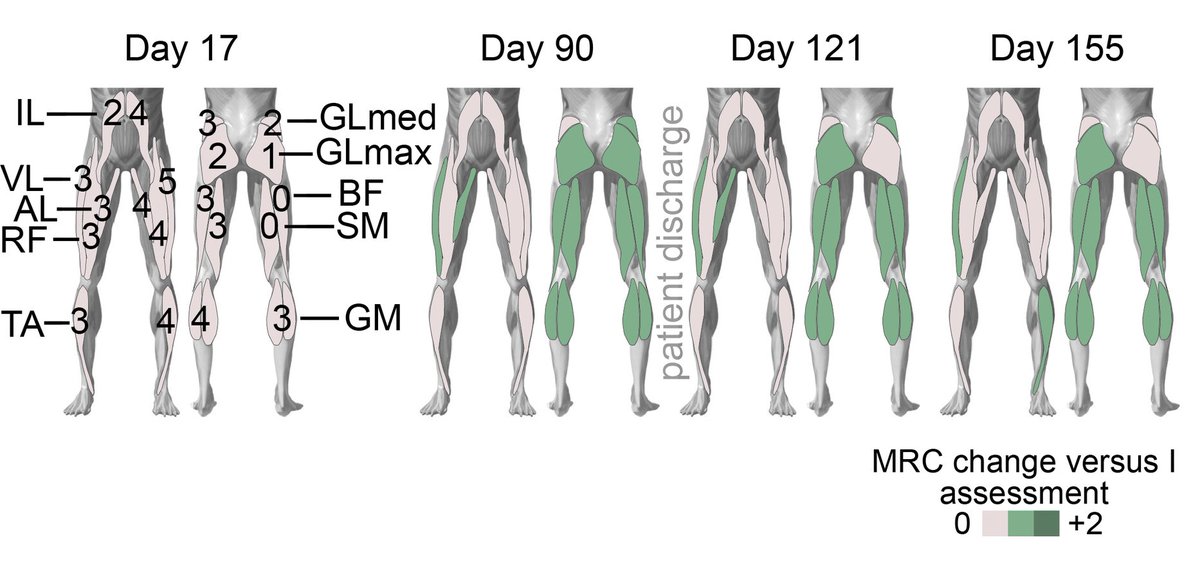
Harnessing both low- and high-frequency epidural electrical stimulation, researchers devise personalized protocols that foster rehabilitation and walking recovery in two #SpinalCordInjury patients while reducing spasticity. @_smicera@MINE_Neurotech https://t.co/7srDKw8VCL
Of course, this is a huge team work carried on with co-first authors Elena Losanno, @Daniele20590, Luigi Albano, Filippo Agnesi and with many many other great researchers. Special thanks go to dr Sandro Iannaccone, in whose rehab unit the patients underwent an incredible path 8/8
Check out our last work in @ScienceTM!
https://t.co/dfYrKH6sVv
We introduce and characterize a new epidural electrical stimulation protocol helping to reduce spastic muscle co-contractions while using traditional stimulation to strengthen residual functions
A thread 1/8
The work was carried in a collaboration between @SanRaffaeleMI, @MyUniSR, @SantAnnaPisa, and @EPFL_en, which gave birth to the @MINE_Neurotech, co-led by prof @_smicera and prof Pietro Mortini. My deepest thanks go to them for setting up an incredible research environment 7/8
And thanks to @saramoccia for the patient help and supervision about how deep learning could help optic nerve prostheses, and to @_smicera for helping all of us become better translational neuro-engineers every day! 12/12
I would like to thank all co-authors (@lauratoni98, Gabriele), and particularly first authors @d_danieladeluca for her work on deep learning and experiments, and Luca Pierantoni for developing much of the cleverness behind our geometrical model during his master thesis! 11/12