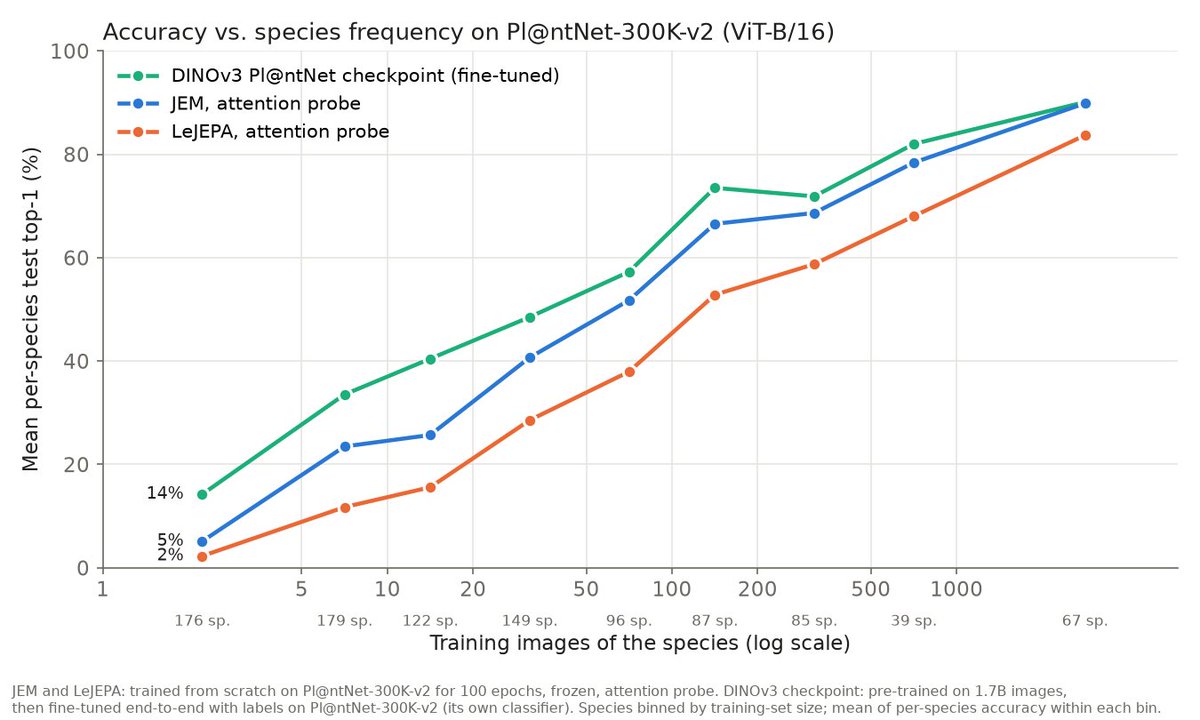
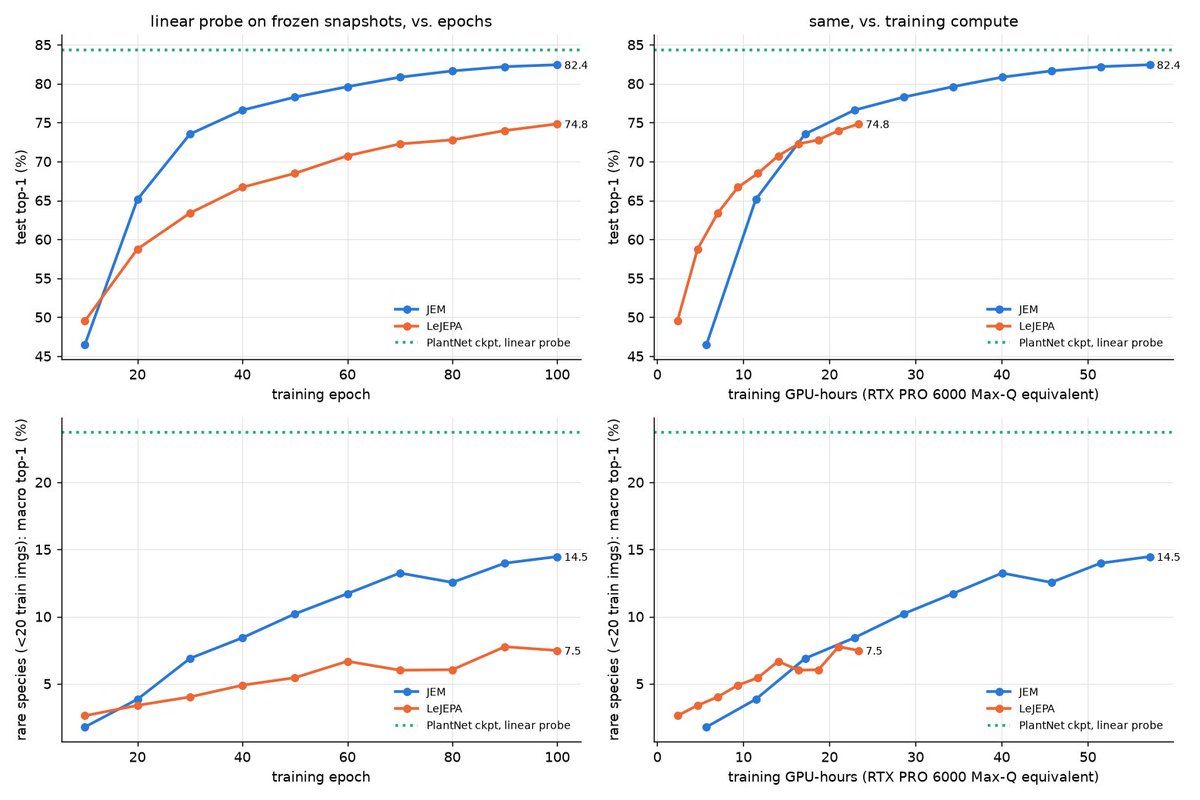
I finished training JEM for 100 epochs, and the results are actually better than I expected. It's only 1 point away from a fine-tuned DINOv3 (which has seen WAY more data). I'm pretty sure it could beat it with more training.
It took a bit more than 20 H100 hours to train for 100 epochs on the dataset (~250k training images), and as you can see, my LeJEPA is still undertuned (Claude is currently working on it to get a better baseline).
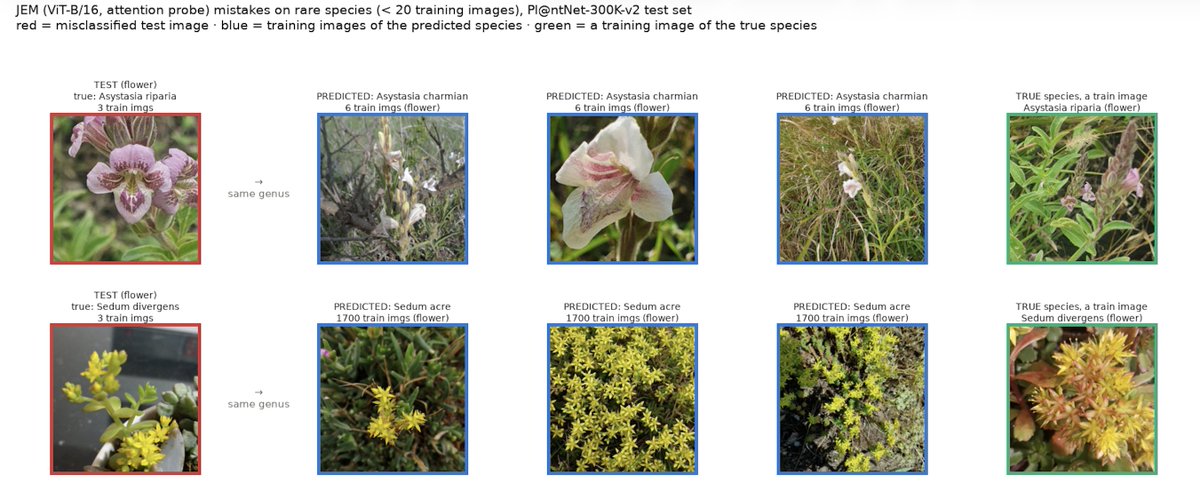
The main problem, though, is with rare classes, but that's expected. It might be a sampling issue. For example, I could continue training while oversampling rare classes, but that's not really what I want.
All plants kind of look the same, so I'm wondering if we could make the algorithm better at capturing fine-grained details and the patch-level loss already helps a lot imo. But tbh, the dataset is so hard that I'm not even sure there's much room for improvement on rare classes.
I'm running a small experiment to see how they compare for species classification.
I'm training both methods from scratch on a fairly small dataset, Pl@ntNet-300K (https://t.co/keWu8wyc7q): 244k training images of 1,000 plant species with a heavy long tail. I want to see which SSL method best separates rare classes.
For LeJEPA I used the official minimal implementation (MINIMAL.md). For JEM I reimplemented the paper myself and try to match its settings as closely as I could. I use opus and astra to triple check but there's still a possibility that I did something wrong
I used a ViT-B/16 backbone as the best dataset baseline for now is a fine-tuned DinoV3 ViT-B. So far JEM beats LeJEPA but it's looking too good to be true and I'm pretty sure my LeJEPA is under-tuned. But it's still better than nothing I guess, I'll have to retrain a new LeJEPA
Also comparing at equal epochs is unfair because JEM uses ~2x more compute per image (due to teacher pass). But JEM is still ahead at equal compute: LeJEPA's 100 epochs took ~23h on one RTX PRO 6000, the same as ~40 epochs of JEM, and at that point JEM's linear probe is already higher (76.6% vs 73.1% top-1). On rare species (<20 training images) they're close at equal compute (10.1% vs 9.2%).
Furthermore this task probably suits JEM better due to its patch-level objective that helps capture the small details separating species.
For reference, the released Pl@ntNet-300K-v2 ViT-B checkpoint (DINOv3 pre-trained on 1.7B images, then fine-tuned) reaches 84.5% top-1, but only ~32% on those rare species.
So it's not the end of the story, I'll continue the experiments and see if the results change with better tuning. For rare species I obvly don't expected any of them to beat a fine tuned dinoV3 as it has a better feature space, but I'm curious to see how far SSL can get from scratch with this "little" data.
@noahatwhere What if our CVPR supplementary was ready in advance and we bought QQQ call on friday night after selling our QQQ put 650 that we bought when it was over 700 and thus made a shit ton of money ?
@giffmana that's what I was thinking too. I'll need to think about the data first though because I'd like it to work in really complex environments, if it could distinguish individual wheat heads in field images without that ugly gradient that would be super cool and actually useful
I'm a bit tired of polishing my supplementary knowing very well that no reviewer will ever read it and that they'll still point out things I've already addressed in it.
but at I the same time I kind of like writing "AS MENTIONNED IN THE SUPPLEMENTARY SECTION B..." in the rebuttal
@sfofgalaxy Rio might not be the safest city on earth but tbh it can happen anywhere. I've also heard of people getting attacked by crackheads at CVPR in Denver