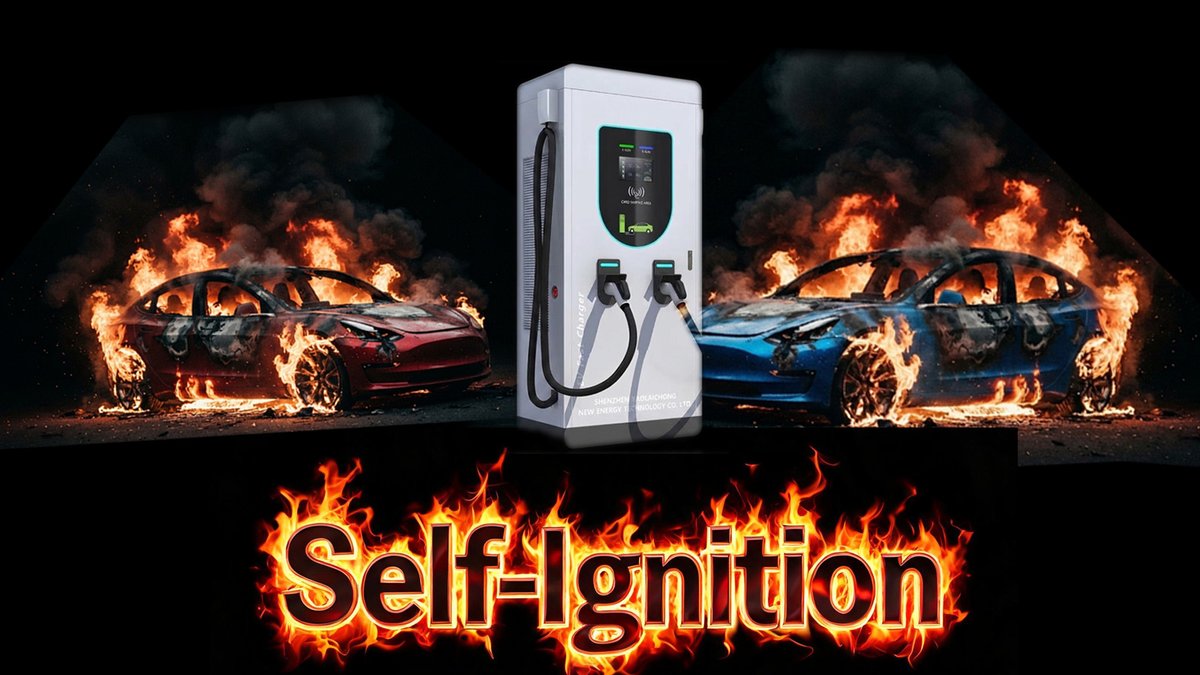
『An Open Letter to the Tesla Engineering and Safety Team』——Key Personal Findings Regarding Electric Vehicle Spontaneous Combustion Incidents
*************************************************************
Dear Tesla Engineering and Safety Team:
I am writing this letter not to question Tesla’s remarkable achievements in electric vehicle safety. On the contrary, it is precisely because Tesla leads the global EV industry in technology and safety that I believe your team has both the capability and the responsibility to lead the way in examining and addressing a long-overlooked physical issue.
This issue lies hidden within the EMI filters of every charging station, as well as under the "compliant" designs meeting the X-capacitor discharge requirements of IEC 62368-1, Clause 5.5.2.2.
In 2020, Professor Mingxing Zhu’s team at Hefei University of Technology published the research paper “Interaction Analysis of Three-Phase AC Charging Station LCL Filters under Grid Conditions.” Through modeling and experimental validation, the team pointed out that LCL filters often fail to achieve ideal filtering performance after commissioning, and the filter capacitors can even suffer severe damage. While the paper's data and conclusions are rigorous, a key question remains: why would a filter designed and certified according to international standards exhibit such vulnerability under normal grid conditions?
The answer directly relates to a compromise built into current standards. IEC 62368-1 requires X-capacitors to discharge to a safe voltage level within 5 seconds of power disconnection. To satisfy this static safety test while simultaneously meeting energy efficiency certifications, the industry generally selects very high values for discharge resistors. A 5-second discharge time equals roughly 500 times the half-cycle duration of mains power. The cost of this design choice is that the damping ratio ($\zeta$) is pushed extremely low, turning the system into an underdamped, high-voltage spring with virtually no buffering.
In this weakly damped state, dynamic conditions—such as power-on arcing, grid fluctuations, brownouts, and heavy load switching—easily excite high-frequency, high-voltage ringing spikes within the EMI filter circuit. Even with an inductance as small as $100\,\mu\text{H}$, a rate of current change on the order of $1\,\text{A}/10\,\text{ns}$ can generate significant high-voltage spikes. If recurring, these spikes subject not only the charging pile itself but also the vehicle’s BMS, communication chips, and insulation monitoring systems to cumulative electrical stress. Under specific circumstances, I infer that this could even produce a momentary, catastrophic impact that the entire system is ill-equipped to withstand.
I can reproduce this phenomenon using a simplified experiment: when a $0.47\,\mu\text{F}$ X-capacitor paired with a $10\,\text{M}\Omega$ discharge resistor is repeatedly plugged into and unplugged from a $230\,\text{V}$ AC outlet, a peak voltmeter captures spikes exceeding $554\,\text{V}$. Reducing the resistor value to $100\,\text{k}\Omega$ immediately and effectively suppresses these spikes. The underlying physics is straightforward.
Tesla’s fire and thermal runaway rates are significantly lower than the industry average, thanks to your team’s world-class BMS engineering in fault early-warning, pre-screening, and active intervention. In essence, Tesla uses a top-tier system to buffer the physical stresses originating from the charging side. However, even the most advanced BMS primarily detects and intercepts damage after it begins; it cannot stop uncontrolled ringing spikes from continuously generating at the source inside the charging station.
As an independent engineer with limited experimental resources, I cannot complete a full-chain attribution analysis connecting EMI uncontrolled ringing spikes to EV thermal runaway. Therefore, I offer here only the core, independently reproducible facts: EMI/X-capacitor circuits using large discharge resistors to meet current IEC standards do produce significant high-voltage ringing spikes during normal plugging/unplugging and grid transients (refer to the simplified experiment above and Prof. Zhu’s 2020 paper).
As to whether these spikes represent a significant or core contributing factor to EV thermal runaway, and whether it is necessary to supplement IEC 62368-1 with "dynamic damping safety" requirements, I respectfully ask the Tesla Engineering and Safety Team to reproduce these spike phenomena and evaluate the risks based on your fleet data, BMS logs, and root-cause analysis.
If Tesla is willing to confront this dynamic issue—long masked by static safety clauses—and drive standard setting bodies to add transient damping and spike suppression requirements alongside disconnection discharge safety, the entire industry will have the opportunity to mitigate risks at the charging interface and advance toward a higher level of safety. I look forward to seeing Tesla, as an industry leader, take the initiative to break this decades-old design paradigm.
Allow me to conclude with my personal perspective: As long as the physical conditions that trigger uncontrolled high-voltage ringing spikes exist, the possibility of related catastrophic events can never be entirely ruled out.
Sincerely,
SIMON MENG 2026.08.17
@elonmusk Hey, Mr. Elon, I’m not one to spout nonsense: you can certainly have Tesla’s technical team verify this fact:--Conclusive evidence indicates that charging stations for electric vehicles pose potential hazards, and Tesla is no exception
We once again earnestly urge the Tesla team to pay close attention to this hidden detail: the EMI filter within the charging station contains a component with a defect characterized by extremely low damping. Under sudden fluctuations, this component generates high-peak ringing disturbances, causing irreversible, cumulative damage to both the charging station and the vehicle. A more detailed article can be found here:
📯🌸The true technical root cause of spontaneous combustion risks in electric vehicles lies neither in the battery itself nor in the BMS, but rather in the charging station's EMI filter. Charging stations worldwide almost universally adhere strictly to Clause 5.5.2.2 of the IEC 62368-1 standard, which mandates that X-capacitors discharge to a safe voltage level within five seconds of power disconnection.
To meet this static requirement while simultaneously passing energy-efficiency certification, the discharge resistor (R) is selected at its maximum possible value. Consequently, the damping ratio (ζ) of the EMI filter is driven close to zero.
In a system with virtually no damping, events such as arcing during power-up, grid brownouts, or sudden large-load switching can generate voltage spikes and ringing reaching the order of ten thousand volts—far exceeding design safety margins. This is the physical "black hole" that subjects the BMS to repeated stress, ultimately leading to spontaneous combustion.
Are Tesla's Superchargers an exception to this?
Hace 50 años, terroristas palestinos masacraron a 582 civiles cristianos en laciudad de Damour, en Libano.
Un sacerdote que sobrevivió a la masacre explicó: "Llegaban por miles gritando “¡Allahu Akbar! Mataron a todos: hombres, mujeres y niños".
Los hombres eran alineados contra las paredes de sus casas y fusilados. Las mujeres eran torturadas y violadas en grupo. Los bebés eran asesinados de un disparo en la nuca. A las mujeres embarazadas les extraían a sus bebés del vientre.
Así fue como los musulmanes pasaron a ser mayoría en el Líbano.