I don’t understand why we keep having this ethos to make things work for other people and not for the Kenyans. Do we not deserve good things?
Let’s do all these things across Nairobi. Jogoo road. Langata road. Mombasa road. Waiyaki way. Outer-ring. Etc. In fact, so them across Kenya!
This new study highlights how adoptive parents in Kiambu county use communication to counter stigma. They employ strategies such as concealment or disclosure of adoption information, reframing & use of positive narratives & advocacy.
https://t.co/3eCF3m51Mp
@SingoeiAKorir Why can't the Government of Kenya establish formal diplomatic ties with Laikipia?? We should at least have a high commissioner to handle the interests of Kenyan citizens here.
@DismasWaTabu I'm a bit lost here. What you have described is the problem of the system not of education. Unless you're saying the media picks comedians because they're better equipped than trained journalists.
Is there any country that can say that it officially and deliberately invited an epidemic, rather than that the disease spread through normal human activity? I don't think so. Kenya will be making history with this. I don't know a regime that can be more of a sell out than this one.
"‘Lived-experience’ isn’t same as a personal story that serves the self. It’s a selective set of epiphanies that fits into a jigsaw of dominant global discourses of what being you should feel and look like."
A Technical Guide to Becoming an Adoptee https://t.co/h4z58Gdt84
In my new 'Research Watch' segment, I'll be highlighting and breaking down research in childcare reform on a weekly basis.
Research Watch #01: Kinship Care as Living Law https://t.co/EEJAu5Kj3Q
In my address titled "The Political Economy of Obedience," delivered last month at the Josef Korbel School of Global Affairs at the University of Denver, I identified five key mechanisms through which African populations have been trained into political compliance. I am sharing a summary here because they explain precisely what we are watching play out in real time every day on this continent.
The first is colonial education. The curriculum inherited from the French, the Brits or the Portugese administration was not designed to produce critical citizens. It was designed to produce a particular kind of political subject. one who understood authority as something to be respected rather than questioned, and who experienced his own political traditions as a source of shame rather than institutional possibility. As I said in Denver, the most effective political prisons are not made of concrete. They are made of curriculum. The Togolese school I attended taught us the genealogy of French kings with more precision than the history of the governance systems that predated French colonial presence on our territory.
The second is the economy of obedience itself. Authoritarian systems endure not primarily through permanent terror but because they structure the relationship between political compliance and material survival so that obedience becomes, for most people most of the time, the rational choice. Access to employment, scholarships, market licenses, import authorizations, health clinic access: none of it politically neutral, all of it conditioned on loyalty. People in these systems do not collaborate with power because they are morally deficient. They collaborate because the scaffolding of their daily lives has been designed to make non-collaboration economically catastrophic.
The third is the family as a site of control. In conditions of economic precarity, the individual who considers a dissident act must calculate not only her own risk but the risk she imposes on her parents, her siblings, her children, her cousins etc. I have watched people of intelligence and moral clarity retreat from political engagement not because they were afraid for themselves but because they could not justify the devastating exposure their activism would bring to their families. The authoritarian state does not need to threaten everyone. It only needs to ensure that the threat to one is visible and comprehensible to all.
The fourth is religion. In many parts of Africa, religious institutions have been deployed, not by their most honest practitioners but by their most politically convenient ones, to transmit a theology of earthly resignation and otherworldly reward that discourages political engagement. The pastoral instruction to render unto Caesar what is Caesar's sits very comfortably with the interests of Caesars who have no intention of rendering anything to anyone. Liberation theology, which in Latin America produced an extraordinary tradition of religiously grounded political resistance, has had a far more contested reception in much of African Christianity and Islam, partly because of the direct entanglement of many religious institutions with state power, which has made spiritual authority and political compliance structurally allied.
The fifth is media. In authoritarian African contexts, state and privately owned media aligned with power do not typically practice crude propaganda. They practice something more subtle and more durable: the selection of what is visible and what is invisible; the framing of social problems as natural phenomena rather than political choices; and the treatment of opposition voices as marginal or foreign-funded. The film industry participates in this discipline in its own way, through the systematic promotion of narratives that depict poverty and wealth as conditions of fate or personal failure, stories in which the distance between the poor and the rich has everything to do with luck, talent or divine favour and nothing to do with power, policy or the deliberate engineering of inequality.
The cumulative effect, over decades, is a population whose political imagination has been narrowed to the point where alternatives are genuinely difficult to conceive, not because the alternatives do not exist, but because the political ecosystem has ensured they remain invisible.
These are the operating manual of authoritarian systems on this continent. And authoritarianism today is not limited to regimes with a known dictator who has held power for decades. It extends equally to regimes that perform a change of leadership through placebo elections conducted every four to five years, producing a new face every eight to ten years while the same system of impunity, patronage and repression remains structurally intact.
I would argue that these are in fact the more dangerous form of authoritarianism because their citizens are deceived into believing they are living under a democracy when they are in reality governed by plutocrats. The citizen under an obvious dictatorship at least knows what he is fighting. The citizen under a rotating plutocracy has been convinced there is nothing to fight at all. He votes, he watches a new face take the oath, and he mistakes the performance of transition for the substance of change. He ends up with no voice, no justice, no agency, and worse, no drive to fight for his own dignity. For one can only fight for liberation after acknowledging one's condition of oppression.
There is something I have been observing for a long time now and the more I watch society evolve, the more the pattern keeps revealing itself.
We once lived in a world where paper was central to knowledge. Libraries existed everywhere, shelves were filled with books, newspapers circulated freely, and people physically owned information.
You could hold knowledge in your hands, store it in your house, pass it down to your children, underline pages, revisit ideas decades later, and no one could alter what was written on your copy unless they physically took it from you.
Then industries like Pan Paper collapsed and slowly, the foundation of paper culture began weakening.
Next came the rapid rise of technology. Audiobooks emerged. PDFs became common. Soft copies became the norm. Social media shortened attention spans. Video replaced reading. Entire generations began consuming information in fragments rather than in depth.
Today, many people barely read complete books anymore. A headline, a short clip, or a summarized thread is enough to shape opinions.
Technology then pushed deeper into schools. Notes became digital. Assignments moved online. Tablets and screens started replacing exercise books in some places. And if you remember in Kenya we were even scammed under the laptop project. Saitan! Cloud storage has become more important than physical archives. Step by step, society is normalizing the idea that knowledge no longer needs to physically exist.
Then came the global climate change push. Save trees. Reduce paper usage. Digitize systems. Go green. And while environmental conservation is important, I cannot ignore the direction this pattern seems to be taking.
What happens when environmental arguments, technological dependence, and policy-making eventually merge into one?
I believe a time may come when governments and institutions will begin pushing directives, much like the Type C charger transition for iPhone, where physical books are gradually phased out in the name of efficiency, modernization, and environmental conservation. It will sound progressive. It will sound necessary. It will sound responsible.
At first, people will celebrate the convenience.
“Why carry books when everything is online?”
“Why cut trees for paper?”
“Why print when a tablet can store thousands of books?”
But convenience often hides dependency. Because once society fully depends on digital access for knowledge, ownership of information changes completely. You no longer truly own knowledge. You merely access it through systems controlled by corporations, governments, internet providers, and digital platforms.
A physical book in your house cannot suddenly disappear because someone changed a server policy. A printed page cannot be remotely edited overnight. But digital information can be altered silently, restricted instantly, or erased completely without most people even noticing.
And that is where my concern deepens.
A future where hard-copy books become rare is also a future where access to information becomes conditional. To read, you may need subscriptions. To research, you may need internet access. To learn history, you may need approval from centralized platforms. Knowledge slowly stops being a right and starts becoming a controlled service.
Then comes the most dangerous part of all: the rewriting of history.
History has always been shaped by those with power, but physical archives created resistance against total manipulation because old books, newspapers, and documents remained scattered across homes, libraries, and institutions worldwide. They became evidence that could not easily be erased.
But in a fully digital world, information becomes fluid. Edits become invisible. Narratives can be adjusted gradually. Uncomfortable truths can disappear from search engines. Entire generations may grow up only knowing the version of reality that algorithms choose to prioritize.
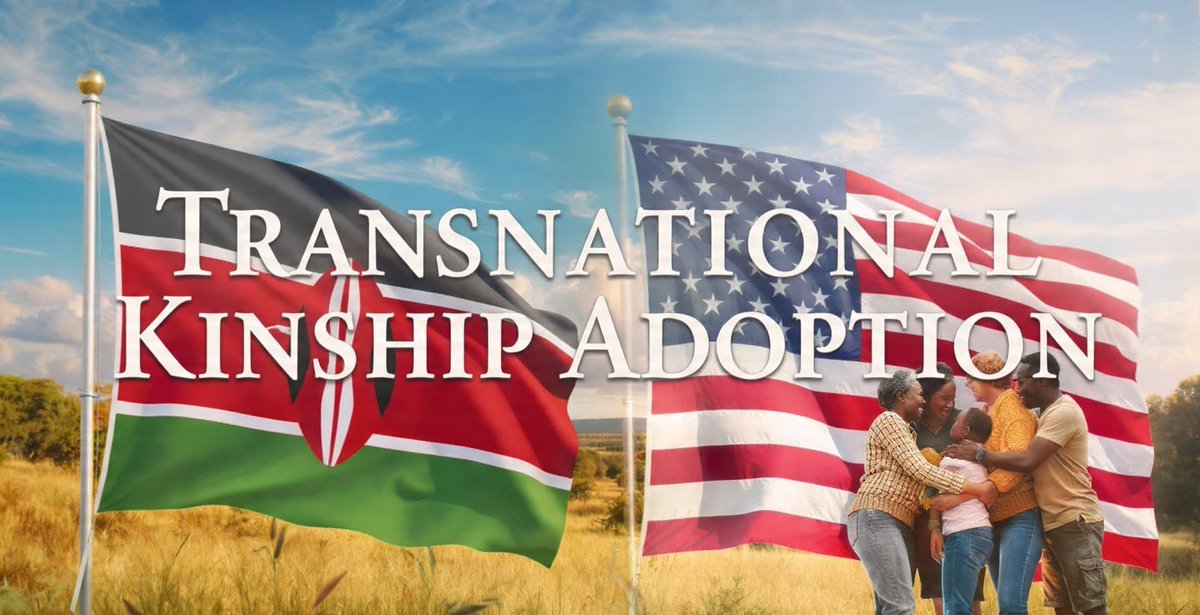
In this essay I make a proposition that Transnational Kinship Adoption in Kenya should be conceptualized & analyzed as a form of kinship care not ICA by situating it within the context of transnational labor migration.
https://t.co/QQD4xZWQ3P
The nation that arranged the poisoning of Toussaint Louverture of St Domingue ( Haïti) for demanding the end of slavery and the liberation of his people in 1803; that assassinated Ruben Um Nyobe, the Cameroonian independence leader hunted down and killed in 1958 by French forces before independence was even formally granted, that had Felix Moumie of Cameroon, poisoned in Geneva by his intelligence in 1960, that orchestrated the assassination of Sylvanus Olympio of Togo by soldiers of his colonial army in 1963, that armed and protected the man who murdered Thomas Sankara in 1987 and sheltered him for decades, that supported the destabilisation that led to the overthrow and death of Modibo Keita of Mali, that printed millions of fake currency to destroy the Guinean Franc after 8 failed assassination attempts at Sekou Toure because he stood his grounds and demanded independence, that stood behind the forces that removed and destroyed Patrice Lumumba, coordinating with Belgium and the CIA to ensure Congo’s most visionary independence leader did not survive his own government, that massacred at least 100,000 Malagasy people, 250,000 Cameroonians, 1.2 million Algerians between 1955 and 1962 simply because they demanded their independence.
The president of that nation, less than half a century after committing such atrocities stood before a room full of African heads of state in 2026 and declared itself the true Pan-Africanist. And not one of them stood up. Not one said: you cannot use that word: not here, not with that history on this continent. Not a single one had the dignity to say what any person with an elementary knowledge of what Pan-Africanism means and what France has done to those who practiced it would have said immediately and without hesitation.
It is the equivalent of a Nazi leader standing before a Jewish assembly and announcing that Germany is the true defender of the Jewish people. There are words that carry such historical mass that no political convenience, no diplomatic ambition, no funding arrangement justifies allowing them to be stolen and worn by those who spent generations trying to destroy what those words represent; Pan-Africanism is one of those words. And it was surrendered in that room without a fight, by men who were supposed to be there representing us.
France is not even a formidable power anymore. It cannot impose its will on its own European neighbourhood. Its economy is strained, its global influence is null, its African military presence has been expelled. It intimidates no one who has chosen not to be intimidated. And yet these boneless, prideless, senseless humans we call Africa leaders sat and applauded this humiliation ritual.
What breaks me is knowing that every generation, without fail, produces its quota of leaders who will trade the dignity of their people for a photograph with a western head of state, for a seat at a table that was never set for them. They dress it up as pragmatism and call it diplomacy. But it is the oldest and most contemptible transaction in the postcolonial playbook: the surrender of collective dignity for personal visibility.
And these are days, I will not pretend otherwise, where I genuinely wonder if we will ever be free. Not because the struggle is not real or the people are not capable, but because freedom requires leaders at the decisive moment, and every decisive moment seems to find us represented by spineless, glory-hunting, photograph-chasing men who would sell the graves of their own predecessors for a handshake with those that tried to erase their people. Every generation inherits the fight for freedom but also produces the cowards who auction it.
There are days I envy those who carry no political consciousness whatsoever. Those who move through the world unburdened by the knowledge of the systems producing their suffering, indifferent to the past, unconcerned with the future, existing in the simple present of their own lives. There must be a peace in that innocence that I recognise from a distance and will never again be able to reach.
And there are days, more than I care to admit, when I wish I could unlearn everything I have learned, unsee what I have seen and return to the person I was before the knowledge settled into my bones and made indifference permanently impossible.
Because what nobody tells you about political consciousness is that it is not a gift but a weight. It does not liberate you from suffering. Rather, it adds to your suffering the particular anguish of understanding exactly why you are suffering and watching the vast majority of those around you remain unreachable, not out of malice but out of an exposure they never had, an experience they never lived, a set of doors that were never opened for them. You cannot share what you carry with people who do not have the vocabulary to receive it.
And so you carry it largely alone, in public spaces that mistake your urgency for performance and in private moments that offer no relief. There are days I genuinely want to go back to not knowing. I understand why that is impossible but I want it anyway.
"‘Lived-experience’ isn’t same as a personal story that serves the self. It’s a selective set of epiphanies that fits into a jigsaw of dominant global discourses of what being you should feel and look like."
A Technical Guide to Becoming an Adoptee https://t.co/h4z58Gdt84