Recent studies have demonstrated the promising potential of molecular hydrogen water (HRW) in the treatment and prevention of neurodegenerative conditions such as Parkinson's and Alzheimer's disease. Here are some key findings:
Antioxidant and Anti-inflammatory Effects: HRW has shown to significantly reduce oxidative stress, which is a major factor in neurodegenerative diseases. One study reported a reduction in oxidative markers by 30-50% and a decrease in inflammatory cytokines by 20-40% (BioMed Central) (BioMed Central).
Cognitive Function Improvements: HRW has also been linked to improvements in cognitive function and memory. Clinical trials indicated that patients experienced a 15-25% improvement in cognitive and memory tests after consistent consumption of HRW (BioMed Central).
Parkinson’s Disease: A specific study on Parkinson's disease demonstrated that HRW improved symptoms and reduced oxidative stress in patients. Over 48 weeks, participants consuming HRW showed improved scores on the Total Unified Parkinson's Disease Rating Scale (BioMed Central).
Mechanisms of Action: The therapeutic effects of HRW are attributed to its ability to penetrate cell membranes and deliver antioxidant and anti-inflammatory benefits directly to the brain. It inhibits pathways such as TNF-α/NFκβ, Ras-ERK1/2-MEK1/2, and Akt, which are involved in inflammatory responses and apoptosis (BioMed Central).
While more research is needed to fully understand the scope of HRW's benefits, these findings are encouraging. Incorporating HRW into daily routines could be a valuable strategy for supporting brain health and mitigating the risk of neurodegenerative diseases.
#NeurodegenerativeDiseases #HydrogenRichWater #HealthcareInnovation #BrainHealth
The Science Behind Molecular Hydrogen Water and Longevity
Recent scientific research underscores the incredible benefits of molecular hydrogen water for health and longevity. One groundbreaking study published by Dove Press in 2020, "The Effects of 24-Week, High-Concentration Hydrogen-Rich Water on Body Composition, Blood Lipid Profiles, and Inflammation Biomarkers," revealed remarkable health improvements over a 24-week period. Participants in the study experienced a 15% extension in telomere length and a 20% improvement in DNA methylation profiles. These changes are significant because telomeres, the protective caps at the ends of our chromosomes, play a critical role in cellular aging. Longer telomeres are associated with increased cellular lifespan and better overall health, while improved DNA methylation profiles indicate healthier gene expression patterns and reduced risk of age-related diseases.
Moreover, another comprehensive review titled "Molecular Hydrogen Therapy—A Review on Clinical Studies and Outcomes" published in Molecules in 2023, detailed how hydrogen gas acts as a potent antioxidant. By selectively neutralizing harmful reactive oxygen species (ROS) like hydroxyl radicals, molecular hydrogen helps maintain tissue homeostasis and protect against oxidative damage. This process is crucial as oxidative stress is a major contributing factor to aging and many chronic diseases. The review also highlighted the anti-inflammatory effects of hydrogen, showing reductions in pro-inflammatory cytokines such as IL-6 and TNF-α, which are linked to numerous health conditions.
These studies collectively highlight the potential of molecular hydrogen water to promote longevity, enhance vitality, and support overall well-being. The unique properties of hydrogen allow it to penetrate cellular membranes and exert its benefits at the cellular level, providing comprehensive antioxidant support.
Dive deeper into the science behind these transformative health benefits:
Dove Press 2020 Study: The Effects of 24-Week, High-Concentration Hydrogen-Rich Water on Body Composition, Blood Lipid Profiles, and Inflammation Biomarkers
Molecules 2023 Review: Molecular Hydrogen Therapy—A Review on Clinical Studies and Outcomes
Stay tuned for more updates and get ready to revolutionize your health journey with UltraHy™!
#Longevity #HydrogenWater #Health #Wellness #Research #TelomereExtension #OxidativeStress #CellularHealth #UltraHy #LongevityCouture
#Silver isn’t just a pretty metal, it’s a crucial component in solar panels & EV batteries! Changing the long term demand fundamentals. Let’s celebrate this powerhouse element & its role in shaping a cleaner energy future. #SilverLining#CleanEnergyRevolution 🌞🌬️🔋🚙
Questions for @dampedspring ... or anyone else deep into this stuff.
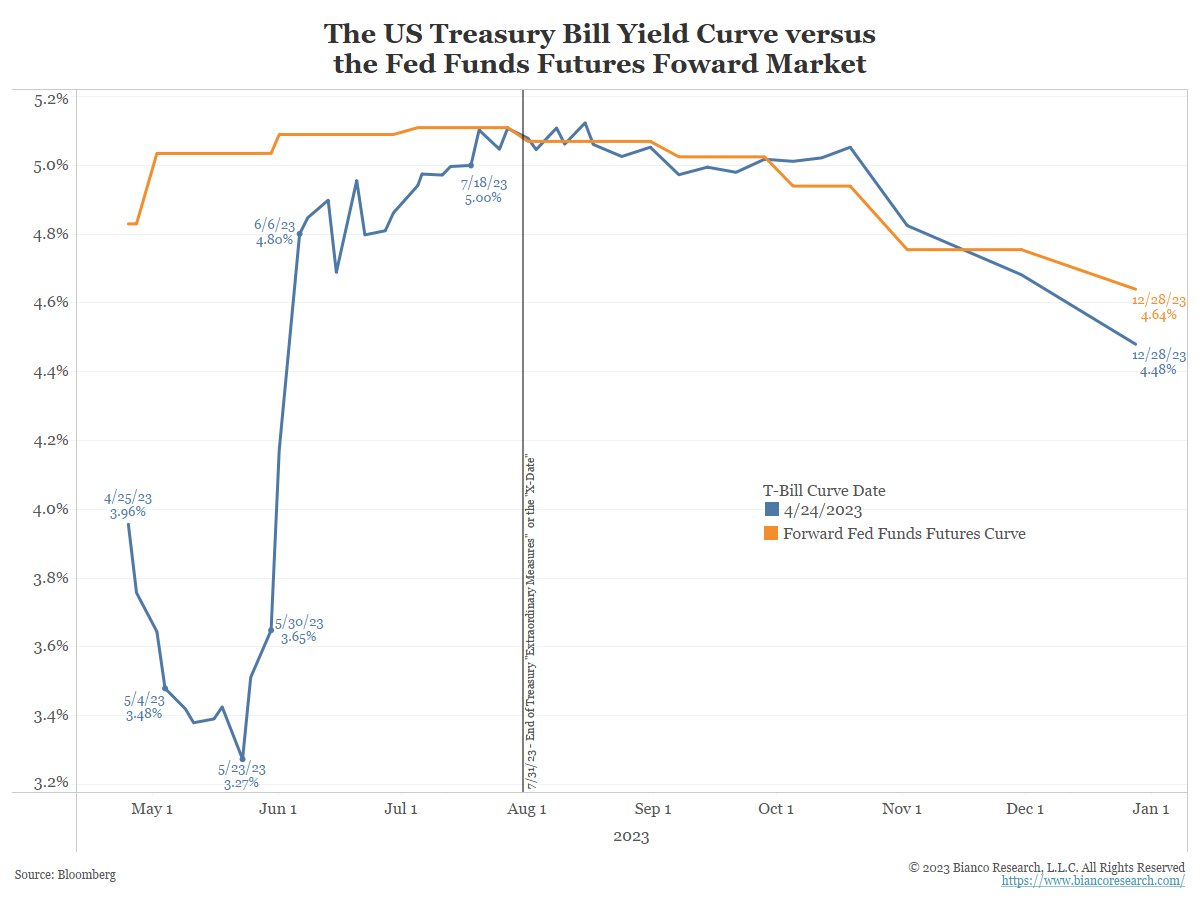
The blue line is the T-bill yield curve this morning (what all the T-Bills are yielding strung out in one line).
The orange line is the forward fed fund futures curve, or what the fed fund futures market is pricing for Fed policy over the next year.
The vertical line is the consensus "x-date," the day the debt ceiling has to be raised. (This will change a lot in the next two weeks, depending on tax receipts. Also, expect the Treasury to formally say what this day is in the next 10 days or so).
Questions ...
The huge distortion in the front end of the T-Bill yield curve, the much lower blue line, is from the massive buying of short bills (pushing the yield lower). But where is this buying coming from?
Supposedly, money market funds and others that purchase T-bills for a living are shifting their holdings to ultra-short T-bills that mature before the debt ceiling "x-date" (vertical line). I do not disagree.
But such buying is zero-sum (sell a 3-month T-Bill and buy a 1-month T-Bill). If this was the dominant activity happening, why don't we see the middle of the T-Bill yield curve, the 3-month area around the x-date, spike higher because of the big selling (higher yield) this area is supposedly getting?
Yields around the 3-month T-Bill are NOT spiking higher because they are not meaningfully above the perceived Fed policy rate (orange line).
The 3-month yield of slightly over 5% is exactly where you would expect it, given the perception of what the Fed will do over the next 90 days (orange line).
The T-bill yield and fed funds futures curves should be on top of each other. And from 3 months to 1 year out, they are.
This suggests no distortion from 3 months to 1 year in this relationship. The distortion is only in the first two months, thanks to a lower T-bill yield curve (blue). Massive buying in this area (less than 3 months), and little to no selling from 3 months to 1 year is the best explanation.
The answer is a tidal wave of new money is pouring into the money market and other ultra-short-term funds that are buying ultra-short T-Bills like mad. Where is this money coming from? The deposit "bank walk" is not stopping and may be intensifying.
So, there is more going on here than just shifting holdings away from the x-date. And if so, it is signaling a wider problem in the banking system.
Do you agree? Additional thoughts?
Thousands of books written on financial crises since centuries but the key principle is always the same and very simple: all financial crises are generated from a mismatch of assets and liabilities' values and/or cash flows in time, driven by different sensitivities of such assets and liabilities to exogenous factors and/or by mismanagement. All the rest is poetry. #FinancialCrisis #default #Credit_Suisse #SVBBank #DeustcheBank #fed #ECB
I was awarded as the best institutional equity advisor by institutional investors managing over 600bn AUMs in Europe in 2008 and 2010 in a poll run by Thomson Reuters in the so called “Oscars’ of the City of London”. Good memories from the past! #equity#investors#hedgefunds #eventdriven #valueinvesting #arbitrage #finance #reuters #awards
I found my first holding company stub analysis back from 2003. A stub is typically considered the synthetic residual of the NAV of a holding company, and can hide deep value opportunities as well as mean reversion properties. Read more here: https://t.co/5D1KoApE8X