Low carb certified coach via dLife, Focus on health. Metabolic Health helps us to have pill free life. Build good strength. Anyone interested reach out.
#dLife
Rajinikanth sir, Woke up this morning to your simple, funny and deeply grounded speech at the Art of Living Foundation Ashram. Loved every bit of it!
What amazes me most is how someone of your stature wears superstardom so lightly, with such humility and grace. There’s so much for the younger generation to learn from you - not just about success, but about staying grounded through it all.
Lots of love and admiration from a fan 🙏
@rajinikanth
For all THALAIVAR fans.. here is the core of what he spoke.. another day.. another important life lesson. Divine
The path to supreme consciousness is not outward, but inward.
Human birth is rare. A healthy body and peaceful mind are rarer. Rarer still is the desire to know oneself. And rarest of all is the grace of a true Guru.
Worldly fame fades with the body. Spiritual power grows beyond it. True stardom is not being remembered by the world, but dissolving the ego and becoming one with consciousness.
And the Path
Bhakti softens the ego through devotion. Tantra transforms the seeker through breath, body, and awareness. Sudarshan Kriya becomes the bridge between the conscious and the unconscious - a simple, practical doorway to inner freedom.
Blessed to have a Guru like him. 🙏🙏🙏🙏
@questmoosa Grounding on grass may be good, but grounding on mud track - my experience crack in heals which never had in my life... Later after stopping walking bare foot no cracks.
What a film … #Dhurandhar2 !!! Aditya Dhar 🫡 box office -ka baap !!! Many congratulations to Ranveer and the entire cast and crew. A must watch film for every indian. Jai hind 🇮🇳
@AdityaDharFilms@RanveerOfficial
🚨 Just Released: 10 Years of T2D Remission! 🚨
It is now part of the scientific record.
The study documents medication-free remission over a decade, achieved using a low-carbohydrate, lacto-ovo vegetarian diet, with systematic long-term safety evaluation.
To our knowledge, this is the first such study conducted globally.
What makes this work unique is not just remission, but rigour and duration.
For most of this period (approximately 70-75%), I followed a ketogenic diet; during the remaining time, I followed a low-carbohydrate diet with carbohydrate intake below 100 g/day.
This is a prospective N-of-1 longitudinal study, followed for a full decade, with repeated assessments across multiple domains:
•Glycaemic control (HbA1c, fasting glucose, CGM) 🩸
•Insulin dynamics 🧬
•Advanced lipids including ApoB and Lipoprotein(a)
•Inflammatory markers 🔥
•Liver and renal function (including cystatin-C)
•Serial coronary artery calcium scans 🫀
•CT coronary angiography 🫀
•Carotid imaging (CIMT)
•Bone mineral density (DEXA) 🦴
•Detailed ophthalmic imaging 👁️
Starting Hba1c was 7.2%. FBS 152 & PPBS 253 mg/dl.
Achieved remission in the 4th month with Hba1c of 5.2%
Over 10 years:
•HbA1c, FBS & PPBS remained consistently in the non-diabetic range
•Average Hba1c was 5 in 10 years. (4.7 to 5.3)
•Average LDL and ApoB remained higher than recommended, but stable
•No microvascular complications
•No macrovascular disease
•No deterioration in renal, skeletal, or ophthalmic health
This was achieved without diabetes medication.
Importantly, this is an Indian study.
The dietary pattern was:
•Low carbohydrate
•Lacto-ovo vegetarian
•Culturally adapted
•Sustained for 10 years in a South Asian individual with the MONW (Metabolically Obese Normal Weight) phenotype
This directly addresses a major gap in the literature:
the absence of long-term, real-world safety data for low-carbohydrate approaches in South Asian, predominantly vegetarian populations.
It demonstrates that:
•Long-term remission is possible
•Sustainability over a decade is possible
•Comprehensive safety monitoring is feasible
•Replication at larger scale is testable
The intent of this work is not to prescribe, but to inform, challenge existing assumptions, and invite replication.
As an N-of-1 longitudinal study, these findings are not generalizable by design.
They are hypothesis-generating and intended to inform larger, prospective cohorts.
India carries one of the highest diabetes burdens globally.
Evidence addressing sustainability must emerge from within this context.
This study is now part of the scientific record.
Big thanks to Dr Jasmeet Phd @jasmeet481, whose relentless effort and scientific rigour made this study possible. She invested enormous time and care in shaping the manuscript and strengthening it to publication standard.
Grateful to my guru, Anup Singh, who introduced me to low-carb nutrition in 2015 at the time of my Type 2 diabetes diagnosis. His guidance laid the foundation for my 10-year low-carb journey.
Thank you to Arun Kumar who helped me when I was newly diagnosed.
Big Thanks to the 3 doctors who were part of my 10 years journey & are the co-authors also.
Dr Sharat Kolke MD (Med) - Physician - Criticare Asia Hosp. - Mumbai
Dr Mihir Raut - MD - Diabetologist - Nanavati Max Hosp - Mumbai
Dr R K Singh MD DM (Interventional Cardiologist) - Gandhi Medical College - Bhopal
https://t.co/DCY0yWvbxx
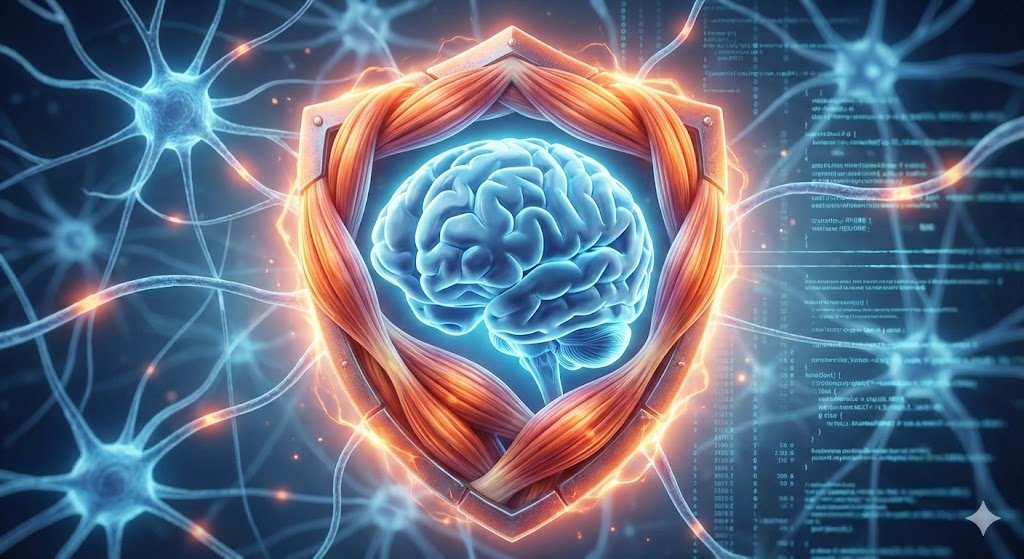
Muscle is not just "meat." It is a massive neurological organ.
Stop thinking of resistance training as just a "gym goal" or an aesthetic pursuit.
In my neurology practice, I don't just look at your reflexes; I look at your grip strength and your calf circumference.
Why?
Because if your muscles are wasting, your brain is likely shrinking.
Here is why Muscle is Body Armor for your Brain and why "lifting heavy" is the most under-prescribed neuro-protective drug in 2026. 🧵
1. The Myokine Miracle
When you contract your muscles against resistance, they secrete signaling molecules called Myokines. Think of these as chemical "text messages" sent directly to your brain.
The most famous one?
Cathepsin B. It crosses the blood-brain barrier and triggers the production of BDNF (Brain-Derived Neurotrophic Factor), literally "Miracle-Gro" for your neurons.
2. The "Grip Strength" Prophecy
Multiple longitudinal studies show that grip strength is a better predictor of cognitive decline and dementia risk than almost any other physical metric.
Low muscle mass (Sarcopenia) is not just a frailty issue; it is highly correlated with reduced white matter integrity and faster brain aging.
In South Asians, where "Sarcopenic Obesity" (high fat, low muscle) is common, this is a silent epidemic.
3. Glucose: The Brain’s Double-Edged Sword
Your muscles are your body’s largest "glucose sink." By building more muscle, you improve insulin sensitivity.
Why does a Neurologist care about blood sugar? Because Diabetes is a leading theory for Alzheimer’s. A metabolic mess in the body becomes an inflammatory fire in the brain.
4. The 2026 Prescription
🔸You don't need to be a bodybuilder. You need to be a "Brain-Builder."
🔸The Minimum Effective Dose: 2–3 sessions of resistance training per week.
🔸Focus on Compound Movements: Squats, deadlifts, or even weighted carries.
The Goal:
Build enough "functional reserve" so that your brain has the metabolic support it needs for the next 30 years.
The Bottom Line
🔸Cardio keeps you alive. Strength training keeps you you.
🔸Don't wait for "Brain Fog" to start lifting. Build the armor before the battle begins.
I want to hear from you:
What is your primary form of exercise right now? Are you focusing more on "Steps" or "Strength"?
Drop your routine below---let's see if we are building enough brain armor! 👇
Dr Sudhir Kumar
@hyderabaddoctor
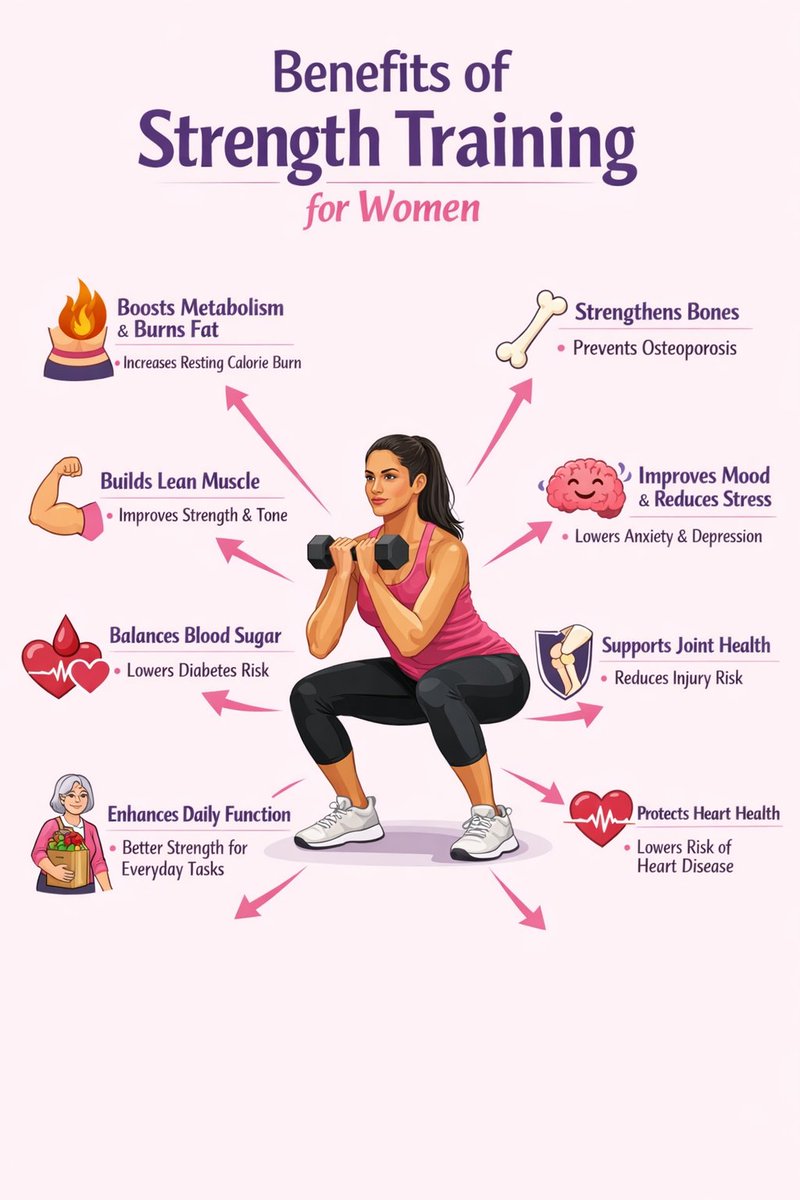
Indian Women: Walking & Simple Yoga is NOT Enough!
Exercise during peri/ menopause.
A woman's physiology changes massively during Perimenopause & Menopause.
She undergoes
🔴Decline in Estrogen & Progesterone
🔴Accelerated Sarcopenia & Bone loss
🔴Increased Central Fat ( Visceral) & Insulin Resistance!
🔴Behavioural Changes ( Mood & Cognition)
The impact of Estrogen leads to decrease in the muscle mass .5 to 1% per year after menopause
🔴Bone density loss accelerates! 1 to 2% per year
🔴There is a high risk of fractures and fragility
🔴Reduced metabolic rate & energy expenditure!
To Avoid all This,
STRENGTH TRAINING IS THE KEY!
It helps in maintaing :
Hormonal,
Metabolic
Bone & Mental Health!
☀️The right mix of resistance + aerobic activity,+ balance/ mobility offsets sarcopenia,osteoporosis & insulin resistance while supporting Mood sleep & Cognition!☀️
Aim weekly for
🔴 2 to 3 Resistance Training sessions per week
Build up slow!
🔴 150 to 300 mins/ week of Brisk walk/ cycling/ swimming
🔴HIIT 1 to 2 sessions per week if joints allow!
🔴Balance & Fall prevention! Single leg stance. Tandem walk TaiChi/ Yoga
🔴Flexibility & Mobility : Daily gentle stretching, dynamic warm ups, foam rolling etc to reduce stiffness!
ITS VERY IMPORTANT TO HAVE APPROPRIATE NUTRITION :
Protein support 1.2 to 1.6 g/ kg body weight, Vit D & Other nutraceuticals as per need!
Avoid overstraining,
Protect Sleep & Recovery!
RESISTANCE TRAINING IS MEDICINE!!
Why strength training is non-negotiable for Indian women?
Indians are born with less muscle
Compared to Western populations, Indians have:
🔴Lower skeletal muscle mass
🔴Higher body fat % at the same BMI
🔴More visceral fat (metabolically dangerous)
Muscle is the largest glucose sink in the body.
Less muscle = glucose has nowhere to go = insulin resistance.
😱No amount of walking alone fixes this!
So dear women of perimenopausal & Menopausal ages .. give priority to STRENGTH TRAINING....WALKING IS NOT ENOUGH!
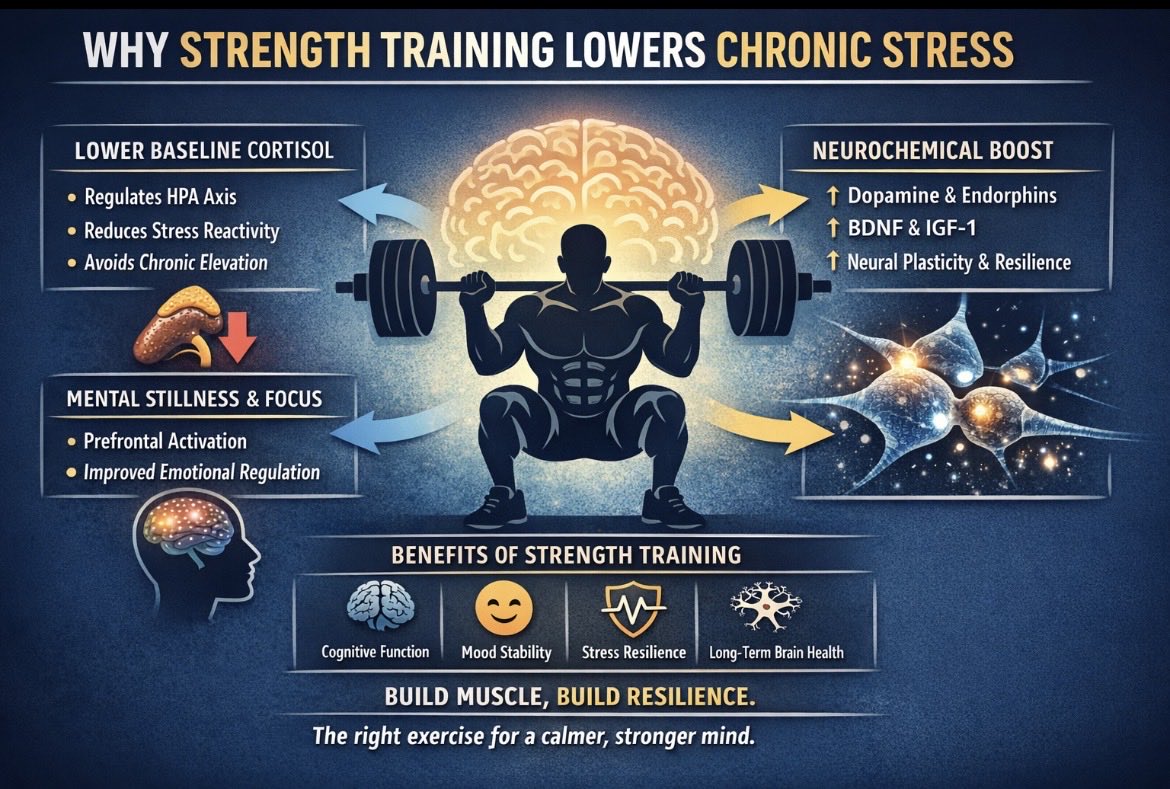
Why strength training is one of the best tools to lower chronic stress.
Exercise is often prescribed to “reduce stress,” but not all exercise affects the nervous system the same way.
Strength training, when done with adequate recovery, does not drive chronic cortisol elevation.
While cortisol rises transiently during a lifting session (which is normal and adaptive), regular resistance training is associated with lower baseline cortisol levels and a more regulated HPA axis.
Unlike excessive cardio or frequent HIIT, which can maintain a state of physiological stress in already burdened systems, strength training improves stress resilience rather than adding to the load.
Focused lifting also creates a state of mental stillness. During controlled resistance work, the brain shifts away from rumination and toward task-focused neural networks, improving prefrontal control and emotional regulation.
Post-exercise, strength training increases dopamine, endorphins, BDNF, and IGF-1. This supports neural plasticity, cognitive function, mood stability and also long-term brain resilience.
This is why strength training doesn’t just build muscle, it builds a calmer nervous system, a stronger stress response, and a more adaptable brain.