@grok Consider Steve Keens double book keeping explanation, specifically that governments don't fall under the same constraints as households, individuals or businesses in relating solvency and also consider modern monetary theory. Do this considering @elonmusk built you specifically to provide truth based on first principles and not narratives
👏🏾- agents will be widely used but edge compute isn't static in its capacity and efficacy (power) so also won't need an unlimited amount of compute nor rely heavily on cloud or central compute models but yes limited in enterprise unless power becomes unlimited (tends to zero cost) but even then, like large corporations with many people, unproductive, so will be poorly instructed agents
@Jason modern monetary theory and Steve Keen's double entry book keeping - govt debt is not the issue if inflation can be kept in check - so Warsh and his change agenda. All govts globally on the same page with their central banks. China reducing private debt which is the more concerning issue. Nuf said
27 years ago, the media criticized Amazon for not being “a pure internet play”.
Its stock traded at $3.15 a share at the time. Today it trades over $244, up 77x since this interview.
Hopium indeed has nothing to do with fundamentals. We might be in the second innings of AI but the second or third innings will not be about AI factories but everything above them, be that in a DC, edge, space, robotics, etc. That's not to say AI factories aren't going to continue to be built but its incongruent to think that the cost of all of this hardware isn't going to head to zero, like they did in the past and as anything that is commodity like always does. That might be argued to be a few years away. Even so, the second derivative of growth in semis is contracting, not expanding, 24x on pressure points I think you said quickly becomes 30x when unit numbers keep increasing but margins start contracting. Not only will there be many suppliers and the cuda moat isn't one, a moat (if AI can eat software, so it can cuda) but prices are going to dramatically fall and the models are predominantly going to shift to on device and shrink. Infrastructure stocks are going to see significant multiple contraction by the end of the year, that also because there's 4 customers in town, all of whom are going to have to take a breather and work on AI post llm's, not solved yet. NVDA will continue to fall into the next few weeks
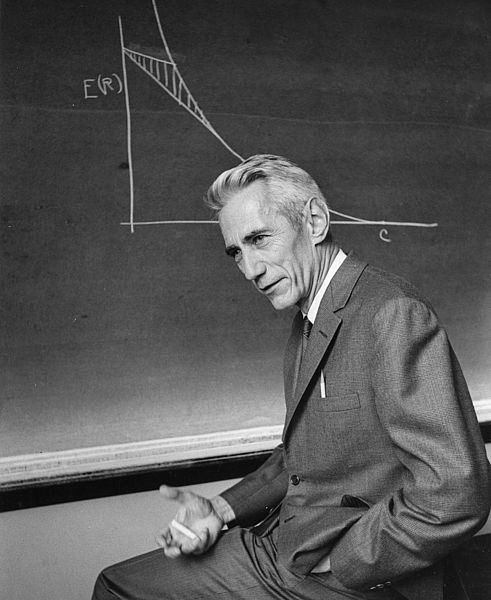
Claude Shannon invented the bit, named information theory, and laid the mathematical foundation for the entire digital age.
He is less famous than Steve Jobs.
That should bother you more than it does.
His name was Claude Shannon.
He was 32 years old when he published the paper that made everything digital possible. Every text message, photo, video, voice call, AI model, satellite signal, and internet packet running on earth right now obeys the mathematics he wrote in 1948.
Not inspired by. Not built on top of. Obeys.
The paper was called "A Mathematical Theory of Communication." Shannon invented the word "bit" inside it. He proved mathematically exactly how much information any channel could carry, and how to transmit it without error.
He showed that text, voice, images, and every other form of communication were all the same thing underneath and could all be encoded in binary digits and sent perfectly.
Before Shannon, engineers guessed. After Shannon, they calculated.
Robert Gallager at MIT called it a blueprint for the digital age. Rodney Brooks, former director of MIT's AI lab, said Shannon was the 20th century engineer who contributed most to 21st century technologies.
He published the paper. Then went back to riding his unicycle down the Bell Labs hallway while juggling.
That is not a metaphor. Shannon literally rode a unicycle through the corridors of Bell Labs at night while juggling four balls. His colleagues, some of the most brilliant scientists in America, would flatten themselves against the walls to let him pass.
He also built a maze-solving mechanical mouse called Theseus, which was the first artificial learning device ever built. He built a chess-playing machine that influenced the team that eventually built Deep Blue.
He built a robot whose only function was to turn itself off. He built a flame-throwing trumpet. A rocket-powered Frisbee. Foam shoes he used to walk across the surface of a lake near his house.
In 1952, Shannon gave a rare speech at Bell Labs about how he actually thought through hard problems.
He described three moves he used on everything.
The first was simplification. Strip the problem down until only the core remains. Most people fail not because they can't solve the problem but because they are working inside a version of it that has too much noise. Cut the noise first. Find the shape underneath. Then work.
The second was inversion.
When a problem seems impossible going forward, flip it completely. Start from the result and run backward. Shannon once designed a computing machine that seemed impossibly complex until he realized the whole thing dissolved if he ran it in reverse. The answer had been there the entire time, facing the wrong direction.
The third was restating.
Look at the problem from every possible angle. Change the words. Change the viewpoint. Reframe it until something shifts. Shannon believed most hard problems are only hard because of the frame. Change the frame and the problem becomes something else.
These were not abstract principles. They were the exact moves he used to build information theory. He spent years circling the problem of communication before that 1948 paper. Simplifying it. Inverting it. Restating it.
Until the structure underneath became visible.
The juggling was part of it too. Shannon saw no line between work and play. The unicycle and the absurd machines were not breaks from thinking. They were thinking running in a different mode. Curiosity without an agenda. The same faculty that built information theory, just pointed at something that didn't matter yet.
He left Bell Labs for MIT in 1956. Stopped publishing serious work almost entirely by the 1970s. His final paper was about the mathematics of juggling. He had an unfinished paper about the Rubik's Cube that never came out.
Colleagues worried something had gone wrong. One Nobel Prize-winning economist wrote privately that Shannon seemed to have abandoned a brilliant career.
He had finished. That is different from stopping.
Shannon died in 2001 of Alzheimer's disease. He was 84. He had spent his last years unable to remember the work that made the modern world possible.
Every AI company on earth today, every data center, every smartphone, every piece of software that has ever run on any machine anywhere, sits on mathematics written by a man who actively avoided fame, told MIT he didn't want to teach, and spent the back half of his life building machines that served no practical purpose at all.
The most famous engineers in history are the ones who sold things.
Shannon just solved the problem and went home.
That distinction is going to matter more the longer you think about it.
@timducktim@cjoye@grok You tell me? How are the models' tuned to respond to rhetorical questions? I got exactly the response I expected, as would occur in a town hall if Chris, Grok and I were to debate publicly.
In capitalism, you dont require the government to discount a single asset class or any asset class, especially one as poor as housing (least productive sink of capital and the lazy man's wealth creation tool and the lame economists trickle down and wealth effect - easy road to support those in finance - been there - benefited from) so that those on the "ladder" first benefit for no effort on their part bar signing a loan doc - That couldn't be more socialism if any government tried which @cjoye wont speak to. Removing "subsidies" for investments in housing couldn't be more right leaning. Get the real men to risk capital in building - what ever, a home or business, a product, R&D (sell IP). With CGT, a discount, for housing, is not right leaning. It's a government discount. It's socialism!
@grok Consider Steve Keens double book keeping explanation, specifically that governments don't fall under the same constraints as households, individuals or businesses in relating solvency and also consider modern monetary theory. Do this considering @elonmusk built you specifically to provide truth based on first principles and not narratives
@JeffSnider_EDU Jacinda Ardern's departure and subsequent national (right leaning) govt clashed govt spending, throwing the country into recession as focus was singularly on budget/fiscal management without the required policy and structural reforms required which the US has some benefit of.
👏🏾 Grok 'infinity' will hopefully show you a truth which helps you with a far more nuanced or colourful view of the world, history, race, religion, economics, societal construct and provenance of everything you consider recent or western; considering your very subjective, ideological views you've recently posted which are incongruent with truth, science, knowledge and ultimately the truth. Love what you do. May it show you much light 🕯️
@mellowman1001 @dandolfa@TheStreet@DiMartinoBooth Keynes hated Savers. Fed robs $90 bill per year from savers and transfers to UST. Savers are competitors of the Fed!