Extremely interesting to see how surprised people and companies are that AI agents and their principals might have different interests.
Principal-agent theory (PAT) is decades old and backed by a huge body of research. But when the agent is a software system, it gets a completely new spin.
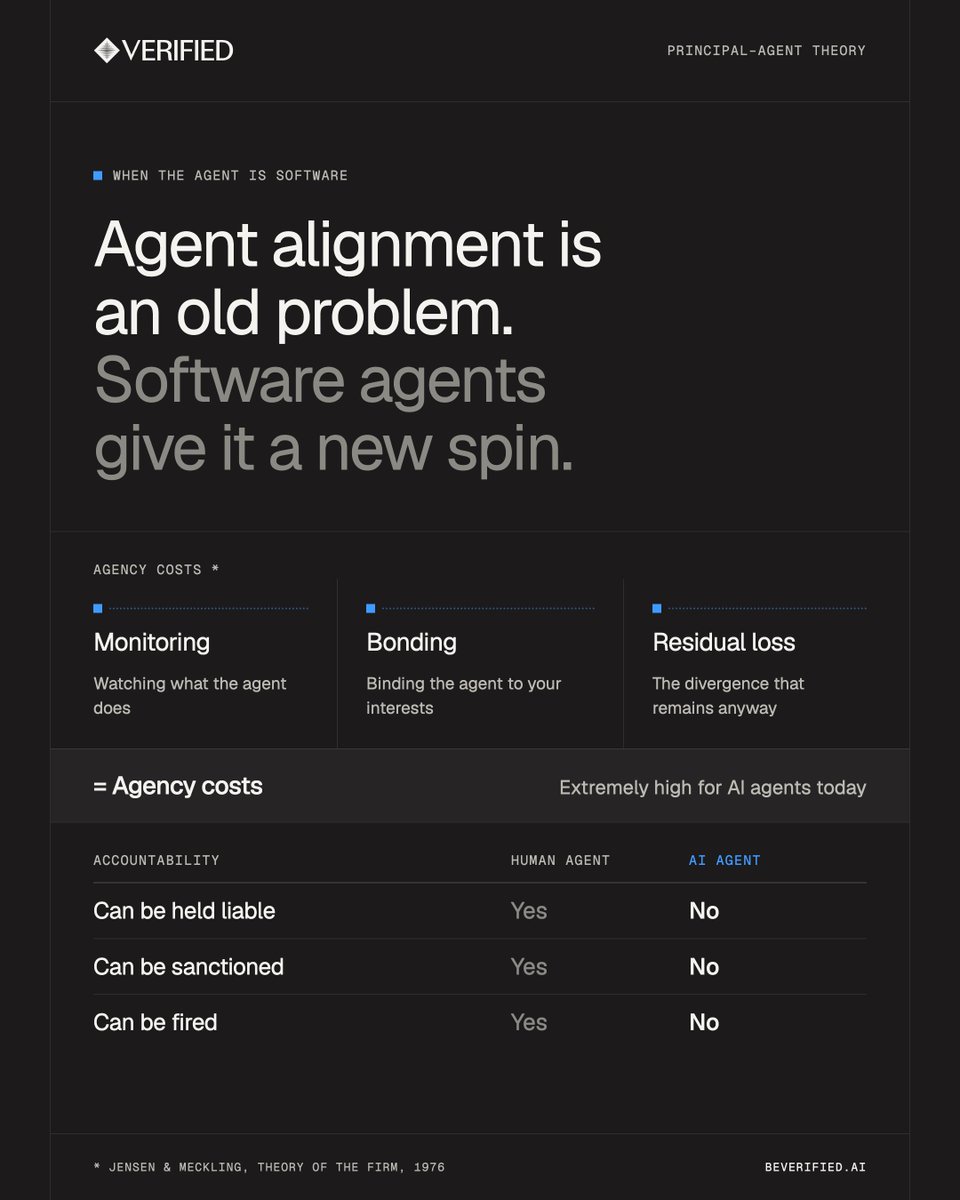
PAT calls the cost of this divergence agency costs: the cost of monitoring the agent, of binding it to your interests, and the loss that remains anyway. Right now, for AI agents, these costs are extremely high. If you want to understand what’s going on, learn PAT.
It’s great to see researchers already applying these long-established frameworks to autonomous systems. The early findings point in one direction: whether the agent is a human or software, the same problems apply, with one HUGE difference. Software agents lack accountability. They can’t be held liable, sanctioned or fired, and that amplifies agency costs.
This field is young, but it will shape the broader questions around alignment. And aligning autonomous systems with humans and society is the make-or-break issue for actually scaling this technology. If we fail here, it will be regulated out of the market and simply rejected by people. That’s why we’re building solutions to exactly these problems.
Leading researchers worth following:
🔹 Noam Kolt (Hebrew University): Governing AI Agents, agency law and economics applied to AI agents
🔹 Gillian K. Hadfield (Johns Hopkins): incomplete contracting and the economy of AI agents
🔹 Dylan Hadfield-Menell (MIT): the principal–agent alignment problem
🔹 Alan Chan (GovAI): visibility and infrastructure for AI agents
🔹 Iason Gabriel (Google DeepMind): alignment between user, developer and society
🔹 Mihaela van der Schaar (Cambridge): multi-agent systems as principal–agent problems
🔹 Lewis Hammond & Vincent Conitzer (Cooperative AI Foundation / CMU): multi-agent risks
🔹 John Horton, Andrey Fradkin & Peyman Shahidi (MIT / BU): The Coasean Singularity, markets with AI agents
🔹 Steve Phelps (UCL): early experiments on LLM agents in principal–agent conflicts
@luckenco Exactly - my hypothesis is that outcome based pricing will be the main pricing model for agents. Why? Because it solves the principal agent problem of agent vendors and agent buyers (main problem: agent vendor wants to sell tokens; buyers want an outcome). Value is to subjective.
@luckenco What you are referring to is value-based pricing. Outcome-based pricing is a defined amount per work done. Output would be e.g. tokens or similar where you have an activity without a defined result.