Really exciting work on Functional Attention! This feels especially useful for learning operators on PDEs, physical simulations, and geometric data where the underlying structure matters.
What if attention wasn't about matching tokens, but operating in function space?
Glad to share our #ICML2026 paper:
📄 Functional Attention: From Pairwise Affinities to Functional Correspondences
w/ @Jiefang_Xiao@GaoMaolin@stevenygd Daniel Cremers
📄 https://t.co/rhn9NtwrBm
Why a functional view of attention?
✅ Linear-time complexity
✅ Better generalization across resolutions and discretizations
✅ State-of-the-art results on operator learning, PDE modeling, point cloud segmentation, and OOD generalization
Code: https://t.co/vsHepaZgDD
@tumcvg goes #ICCV2025 in Hawaii! 🛫🌋
We are very proud of our students who will present five papers (+ 1 workshop) during the conference!
In particular, check out Back-on-track, which is an award candidate. (Congrats @wrchen530!)
Looking forward to presenting our paper "Finsler multi-dimensional scaling" at #CVPR2025 on Sunday 10:30am, Poster 462!
We investigate a largely uncharted research direction in computer vision, aka Finsler manifolds...
Excited to be attending CVPR 2025 this week in Nashville!
I’ll be presenting our recent work:
“4Deform: Neural Surface Deformation for Robust Shape Interpolation”
📍 Poster session: [13th June 4pm-6pm poster #111]
#CVPR2025#computervision
Looking forward to presenting our paper "Finsler multi-dimensional scaling" at #CVPR2025 on Sunday 10:30am, Poster 462!
We investigate a largely uncharted research direction in computer vision, aka Finsler manifolds...
After #CVPR2024, we further investigate beyond-Euclidean computer vision and extend the fundamental task of dimensionality reduction to the largely uncharted Finsler manifolds, with core applications in data analysis and visualisation!
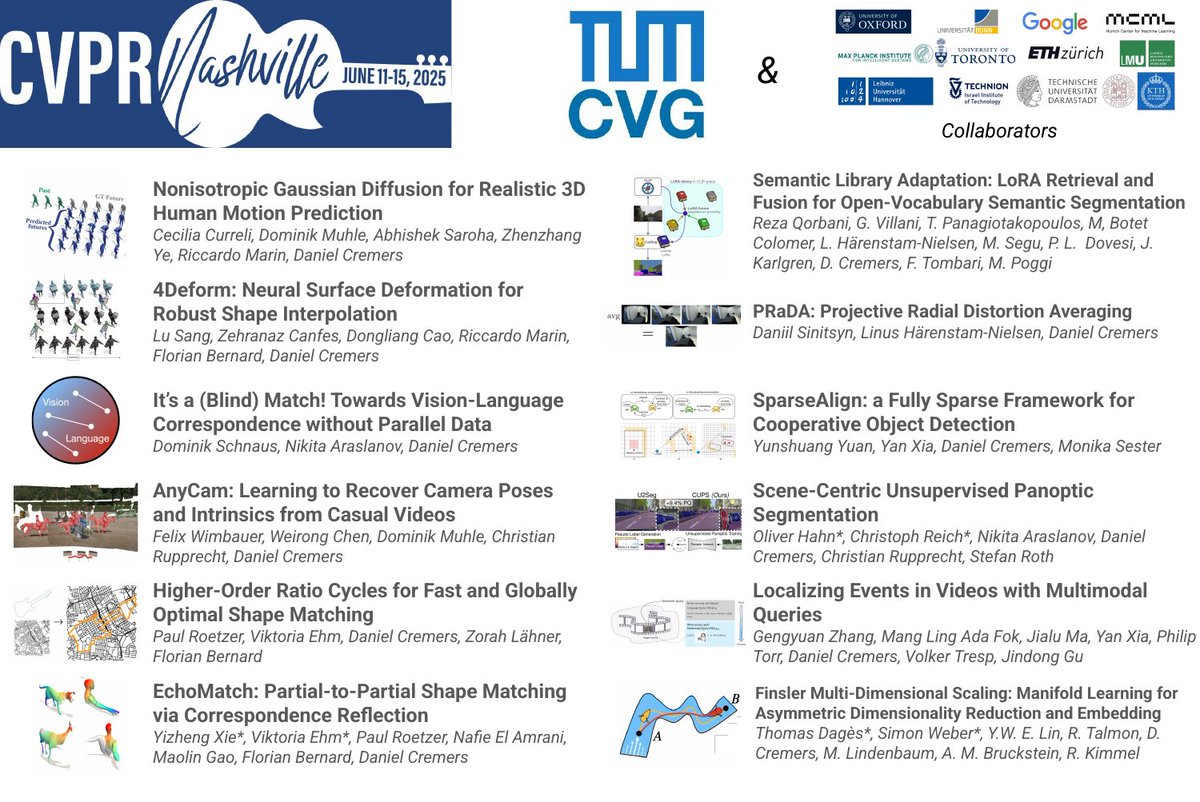
We are thrilled that our group has twelve papers accepted at #CVPR2025! 🚀
Congratulations to all of our students for this great achievement! 🎉
For more details, check out: https://t.co/pTTuMlMUdp
We are thrilled that our group has twelve papers accepted at #CVPR2025! 🚀
Congratulations to all of our students for this great achievement! 🎉
For more details, check out: https://t.co/pTTuMlMUdp
We are presenting DiffCD tomorrow morning at #ECCV2024!
Come by poster 214 to discuss how to fit neural SDFs to point clouds, from a geometric perspective
@Rafael_L_Spring Hey! Iterative re-weighting is possible. However robust cost functions as in "Robust Bundle Adjustment Revisited" (Zach, 2014) is quite difficult (afaik) and still an open challenge for the variable projection algorithm
Very glad to announce that our paper "Power Variable Projection for Initialization-Free Large-Scale Bundle Adjustment" has been accepted at #ECCV2024!
Check out https://t.co/eoP38Ye5DD
Looking forward to present "PoVar" at #ECCV2024 tomorrow at 4:30pm, Poster 097 !
Check out our paper 📝 : https://t.co/eoP38Ye5DD
our code 💻 : https://t.co/MauFu01LoC and our video 📹: https://t.co/G1BjKm3Nh1
Very glad to announce that our paper "Power Variable Projection for Initialization-Free Large-Scale Bundle Adjustment" has been accepted at #ECCV2024!
Check out https://t.co/eoP38Ye5DD
As a follow-up paper to our CVPR'23 "Power Bundle Adjustment" https://t.co/PBP6GKUrPp , we study now the BA problem without initialization and design an efficient solver based on the largely unexplored Variable Projection algorithm
Looking forward to present our poster "Flattening the Parent Bias: Hierarchical Semantic Segmentation in the Poincaré Ball" at #CVPR2024 in Arch 4A-E, Friday 21st, 5pm!
1. "Flattening the Parent Bias: Hierarchical Semantic Segmentation in the Poincaré Ball" by @SimWeberTUM et al.
Standard segmentation suffers from a bias to the parent class. Hyperbolic space is not biased due to more uniform separation of class margins, no hierarchies needed!