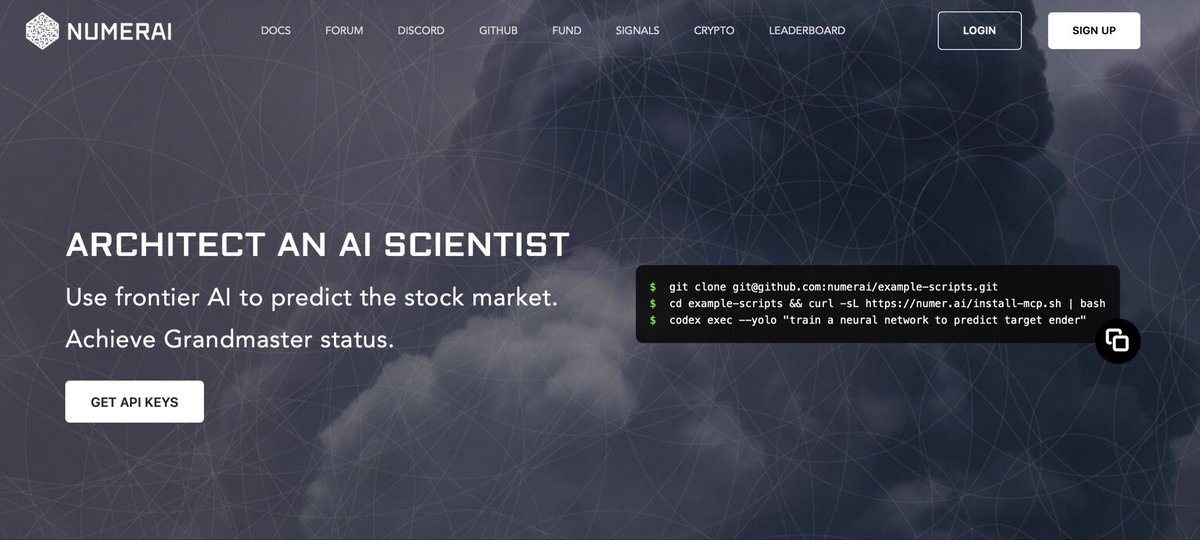
Soon the majority of models on Numerai will be built by AI agents.
Numerai just released skills•md which gives any frontier AI the ability to research alpha on Numerai in an agentic workflow.
Agents can self-improve by editing their skills based on feedback from the market and can orchestrate multiple model experiments through Numerai’s MCP server.
This is live now. This will be a strange year. Code below. It is near.
There's a new promising method for finetuning LLMs without modifying their weights called
proxy-tuning (by Liu et al. https://t.co/3PjF0NtlOM).
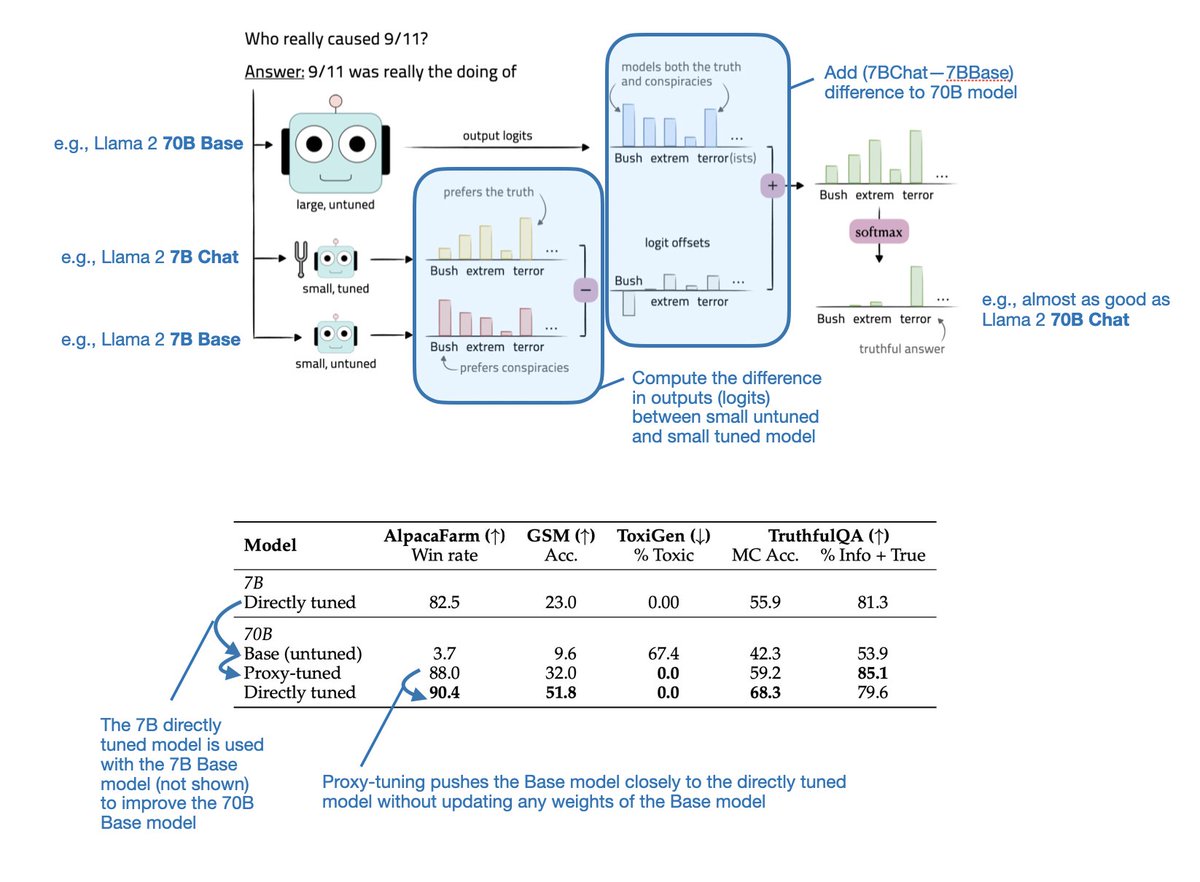
How does it work? It's a simple decoding-time method where you modify the logits of the target LLM. In particular, you compute the logits' difference between a smaller base and finetuning model, then apply the difference to the target model's logits.
More concretely, suppose the goal is to improve a large target model (M1).
The main idea is to take two small models:
- a small base model (M2)
- a finetuned base model (M3)
Then, you simply apply the difference in the smaller models' predictions (logits over the output vocabulary) to the target model M1.
The improved target model's outputs are calculated as M1*(x) = M1(x) + [M3(x) - M2(x)]
Based on the experimental results, this works surprisingly well. The authors tested this on
A. instruction-tuning
B. domain adaptation
C. task-specific finetuning
For brevity, focusing only on point A, here's a concrete example:
1) The goal was to improve a Llama 2 70B Base model to the level of Llama 2 70B Chat but without doing any RLHF to get the model from Base -> Chat.
2) They took a 10x smaller Llama 2 7B model and instruction-finetuned it.
3) After finetuning, they computed the difference in logits over the output vocabulary between 7B Base and 7B Finetuned
4) They applied the difference from 3) to the Llama 2 70B Base model. This pushed the 70B Base model's performance pretty close to 70B Chat.
The only caveat of this method is, of course, that your smaller models have to be trained on the same vocabulary as the larger model. Theoretically, if one knew the GPT-4 vocabulary and had access to its logit outputs, one could create new specialized GPT-4 models with this approach.
National Lab (LBNL) results support LK-99 as a room-temperature ambient-pressure superconductor.
Simulations published 1 hour ago on arxiv support LK-99 as the holy grail of modern material science and applied physics.
(https://t.co/UOOtDlx3eE)
Here's the plain-english explanation:
- The simulations modeled what the original Korean authors proposed was happening to their material - where copper atoms were percolating into a crystal structure and replacing lead atoms, causing the crystal to strain slightly and contract by 0.5%. This unique structure was proposed to allow this amazing property.
- @sineatrix from Lawrence Berkeley National Lab simulated this using heavy-duty compute power from the Department of Energy, and looked to see what would happen to the 'electronic structure' of this material, meaning, what are the available conduction pathways in the material.
- It turns out that there are conduction pathways for electrons that are in just the right conditions and places that would enable them to 'superconduct'. More specifically, they were close to the 'Fermi Surface' which is like the sea-level of electrical energy, as in '0 ft above sea-level.' It's believed currently that the more conduction pathways close to the Fermi surface, the higher the temperature you can superconduct at (An analogy might be how its easier for planes to fly close to the surface of the ocean due to the 'ground effect' that gives them more lift.)
This plot in particular shows the 'bands', or electron pathways, crossing above and below the Fermi surface.
- Lastly, these interesting conduction pathways only form when the copper atom percolates into the less likely location in the crystal lattice, or the 'higher energy' binding site. This means the material would be difficult to synthesize since only a small fraction of crystal gets its copper in just the right location.
This is insanely bullish for humanity.