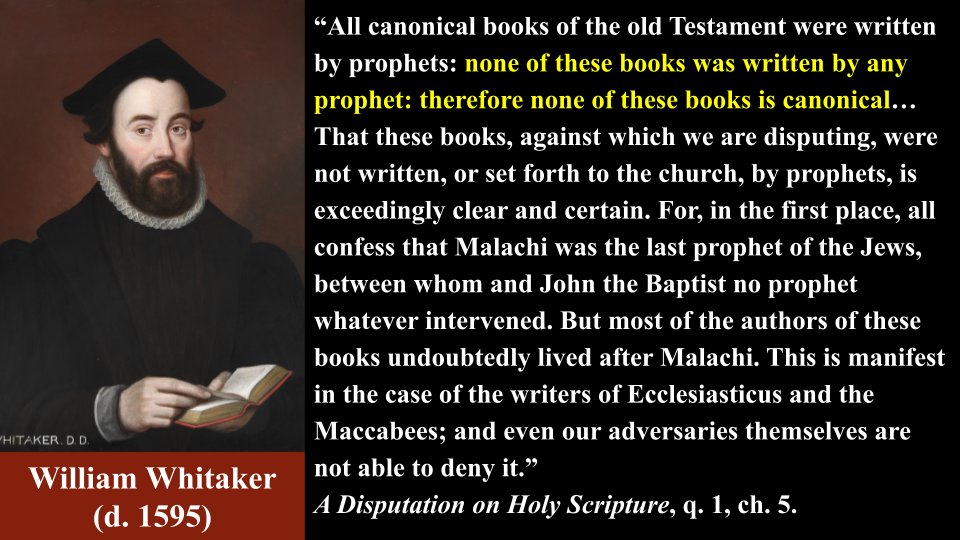
New members-only video and Substack article on a historical and scholastic response to the common Protestant argument which claims the Deuterocanon cannot be inspired because it was written during a period in which there were no prophets in Israel (see below).
I’ve asked this a few times now since the Craig Truglia v. James White debate on icon veneration and have not gotten an answer from an Eastern Orthodox interlocutor.
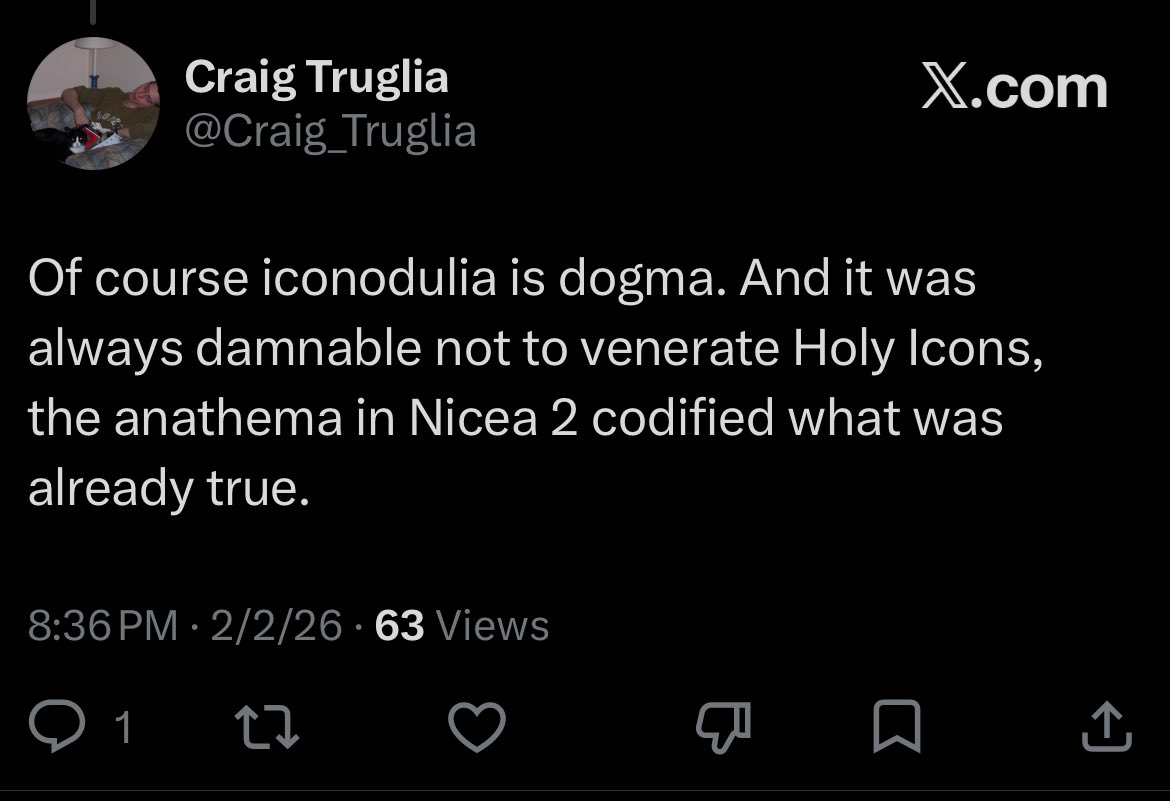
If St. Epiphanius’s quote (if authentic), according to EO apologist @barrelagedfaith, shows that icon veneration was “being debated” at the time, and as conceded by @Craig_Truglia, it shows that St. Epiphanius was in the minority, this would still show that icon veneration was not a dogma at the time. When an ecumenical council dogmatizes something that was not previously dogma, Catholics call that doctrinal development, homogeneous evolution of dogma, an increase in the explicit articles of faith, etc., a concept which EO apologists (falsely) accuse of being invented by St. JH Newman and utterly reject.
It cannot be the case that St. Epiphanius, a faithful son of the Church, by Craig’s and Kyle’s admission, felt free to disagree and “debate” something which, also according to Craig, was already a dogma since the beginning and in his time. You don’t debate settled dogma.
EO, how is this not development of doctrine, by your own concession?
@mythbuster1304@barrelagedfaith An iconoclast is one who rejects icon veneration. I venerate icons every weekend at Vespers and Divine Liturgy, and nightly when I pray the evening Trisagion in front of my icons. Why do you make false accusations?
@mythbuster1304@barrelagedfaith You say that jokingly but that’s what a lot of EO think when they read stuff like this. I’ve been accused of being iconoclast before 💀
@barrelagedfaith At some point it would be good to sit down and discuss this via voce. I am working on something similar. I’ll share with you once I publish it and if you want we could discuss it or you could just let me know your thoughts.
New members-only video and Substack article on a historical and scholastic response to the common Protestant argument which claims the Deuterocanon cannot be inspired because it was written during a period in which there were no prophets in Israel (see below).
New members-only video and Substack article on a historical and scholastic response to the common Protestant argument which claims the Deuterocanon cannot be inspired because it was written during a period in which there were no prophets in Israel (see below).
Sure, I don’t disagree at all. This is what I hold for the inspiration of many books. The apostles revealed their inspiration but this testimony was not well spread and thus books like Hebrews, 3 John, were disputed. I can still say however that if you rejected the inspiration of these books in the third century you would not be a heretic because the Church did not have certitude regarding whether the apostles really passed it on or not.
Now if you want to say the Apostles taught icon veneration explicitly, that’s fine, but irrelevant to my question. I will ask again: was it a dogma of the Church in the fourth century?
Respectfully, do you have a real answer for me first? Was it dogma in the fourth century or not? If yes, why was it being debated? If not, then Nicaea 2 developed dogma.
As for your point, the dogma promulgated at N2 is itself a development of doctrine since it dogmatizes something that was only implicit before and thus not previously dogmatic in the faith of the Church, whereas the rise in icon veneration prior to the council was a cultural development in that the external acts shown to relics for centuries was then shown to icons. The doctrinal development doesn’t happen until the dogma is promulgated though.
You’re not understanding. No one said this isn’t contained in the apostolic deposit or that a minority view makes something heterodox. This is about whether or not it was dogma in the 4th century. It either way and St. Epiphanius wasn’t aware of it, which is absurd, or he was a heretic, as one would be today, or, it wasn’t a dogma at the time, as Kyle indicated when he said it was debated.
Do not let the internet reduce the Faith to subject matter for debate! New video showcasing Fr. Vincent Contenson, O.P.’s work Theology of the Mind and Heart, which touches on every aspect of Catholic theology and dogma and offers a spiritual/moral reflection.
https://t.co/yKHUZiaeqG
Do not let the internet reduce the Faith to subject matter for debate! New video showcasing Fr. Vincent Contenson, O.P.’s work Theology of the Mind and Heart, which touches on every aspect of Catholic theology and dogma and offers a spiritual/moral reflection.
https://t.co/yKHUZiaeqG
The only reason I really care about GTA 6 is because I grew up in Miami and, from the few minutes of gameplay I’ve seen online, it seems like the development team absolutely nailed it in terms of capturing and recreating the city’s cultures, neighborhoods, landmarks, restaurants, etc. I certainly respect the hard work and artistic skill it took to recreate the city without endorsing the debauchery.
Hi everyone, my mom and brother are in serious need of help. Trust me, I know this is a hard time for everyone, and I do not take that lightly. If you are unable to donate please consider sharing and continuing to pray for my family. Thank you SO much!
https://t.co/0FHwjOF0Eo