This works because the video sets up one expectation, then flips it.
At first, it looks like a dramatic sunset: orange sky, water, clouds, cinematic atmosphere. But the “sunset” is actually bootleg fireworks lighting up the horizon so violently that the whole scene turns from night to day for a second.
That sudden brightness is the joke.
It feels like nature started buffering, then somebody accidentally installed a military-grade sunset. The humor comes from the contrast: peaceful scenery vs. completely chaotic homemade fireworks.
Almost everything we thought we knew about LMs may be missing one crucial ingredient: sleep.
That’s not a metaphor. A new line of work suggests language models could improve by periodically pausing to digest what they’ve seen, transfer useful context into their weights, and come back with better recall and reasoning.
That’s a genuinely interesting direction, because it treats memory as something the model should consolidate, not just carry around.
The core idea is intuitive: LMs are usually “awake” all the time, processing context in a single continuous pass. A periodic sleep phase would let them pause, compress what mattered, and write useful structure back into the weights rather than leaving everything trapped in a growing context window. That could improve long-horizon recall, reduce context overload, and maybe even make reasoning feel more stable on hard tasks.
What I find compelling is the biological analogy, but not as a gimmick. In brains, sleep is not downtime; it is maintenance, consolidation, and cleanup. If a model could do something similar, it might become better at turning temporary experience into persistent capability instead of treating every session like a fresh start.
The bigger implication is that we may be moving from “bigger context” as the main answer to “better context digestion.” That is a more interesting frontier. It suggests future systems may not just read more, but periodically reorganize what they have read into something more durable and reusable.
If this works well, it changes how we think about agents too. An agent that never sleeps can accumulate noise, but an agent that periodically consolidates could become more coherent over time. The hard part, of course, is making the sleep phase improve the model without overwriting useful details or causing drift.
https://t.co/SltXGUAnaa
This is the kind of chart that looks calm until you realize how bad it is. The headline says only Amazon clears a positive return, and the chart shows Microsoft at -9.2%, Alphabet at -15.7%, Meta at -28.8%, and Oracle at -35.6% under generous assumptions.
What that means emotionally is simple: confidence is still outrunning math. The industry is behaving like future demand is a law of nature, when in reality it is just a bet — one that has to survive not only technical progress, but pricing pressure, utilization risk, and time.
The dot-com comparison feels increasingly apt because the lesson was never “the internet was a bad idea.” The lesson was that transformative infrastructure can be real and still destroy a lot of capital before the winners emerge. That is exactly the tension here: AI may matter enormously, but the money can still be badly misallocated along the way.
A few implications stand out:
- Capex is becoming the real thesis. The story is less about model quality and more about whether massive spending can be converted into durable cash flow.
- Scarcity is doing a lot of narrative work. Investors are still pricing GPUs, compute, and deployment capacity as if shortage alone guarantees returns.
- Amazon’s relative advantage matters. If one company can get closer to positive ROI under the same assumptions, that says something about vertical integration, infrastructure leverage, or better cost discipline.
The market may be mistaking inevitability for profitability. Those are not the same thing, and the gap between them is where bubbles form.
I think the sharpest reading is not “AI is fake,” but “AI is expensive, and expensive things need more than excitement to justify themselves.” The next few years will likely separate the companies that own the infrastructure from the ones that merely rent the story.
This episode spins around one central question: what happens when a design genius is given unlimited freedom? And the Ferrari Luche is the uncomfortable answer.
Jony Ive - @JonyIveParody spent decades at Apple being shaped by constraint. The first iMac made the CRT monitor the star. The AirPods turned antennae stems into a signature look. Every hit product came from limitations pushed through an obsessive eye.
Ferrari handed him the opposite: no market share pressure, the most expensive car in the company's history, and no ceiling. The result is a car that — according to the hosts, former Ferrari president Luca di Montezemolo, and the internet at large — looks like a Honda Accord fused with a Nissan Leaf.
A few things that cut deeper than just car criticism:
The "high on his own supply" theory is probably the most honest critique — not that Ive is talentless, but that his aesthetic has calcified without the friction of real-world constraints forcing him to solve something
The interior is genuinely stunning — the key that changes color, the analog-digital hybrid switchgear, which proves the eye is still sharp; it just needed a guardrail called Ferrari
Ferrari's former president said three devastating things: it risks destroying a legend, remove the prancing horse, and "at least the Chinese won't copy this" — each one a different kind of knife
The Formula 1 drivers' promo video is telling: Lewis Hamilton and Charles Leclerc — the two faces of Ferrari, agreed that the key is very cool. The key. That is not the energy of men endorsing a masterpiece
The broader implication is genuinely interesting. Ive's genius was always the marriage of constraint and taste. Without constraint, you get taste alone — and taste without opposition tends to drift inward, producing something beautiful to its creator and alienating to everyone else.
The Luche is not a failure of skill. It is a failure of accountability. And sometimes the most dangerous thing you can give a great designer is a blank check.
https://t.co/0QF1ZUSRyi
A lot of people think Gordon Ramsay is just the angry guy from TV.
But that’s the mistake — they confuse the character with the person.
Outside the pressure-cooker drama of television, he’s shown again and again that he actually has something a lot of people miss: emotional intelligence.
He knows when to be intense.
He knows when to push.
He knows when to laugh.
And more importantly, he knows when someone needs kindness instead of criticism.
That’s why moments like this hit differently.
Real emotional intelligence isn’t being “nice” all the time.
It’s reading the room.
It’s knowing when to challenge someone and when to let them breathe.
It’s having enough confidence to laugh with people instead of always needing to dominate them.
A lot of people only know the TV persona.
But behind that, dude seems hella warm, funny, and human.
Sometimes the loudest people on screen have the softest moments off-script.
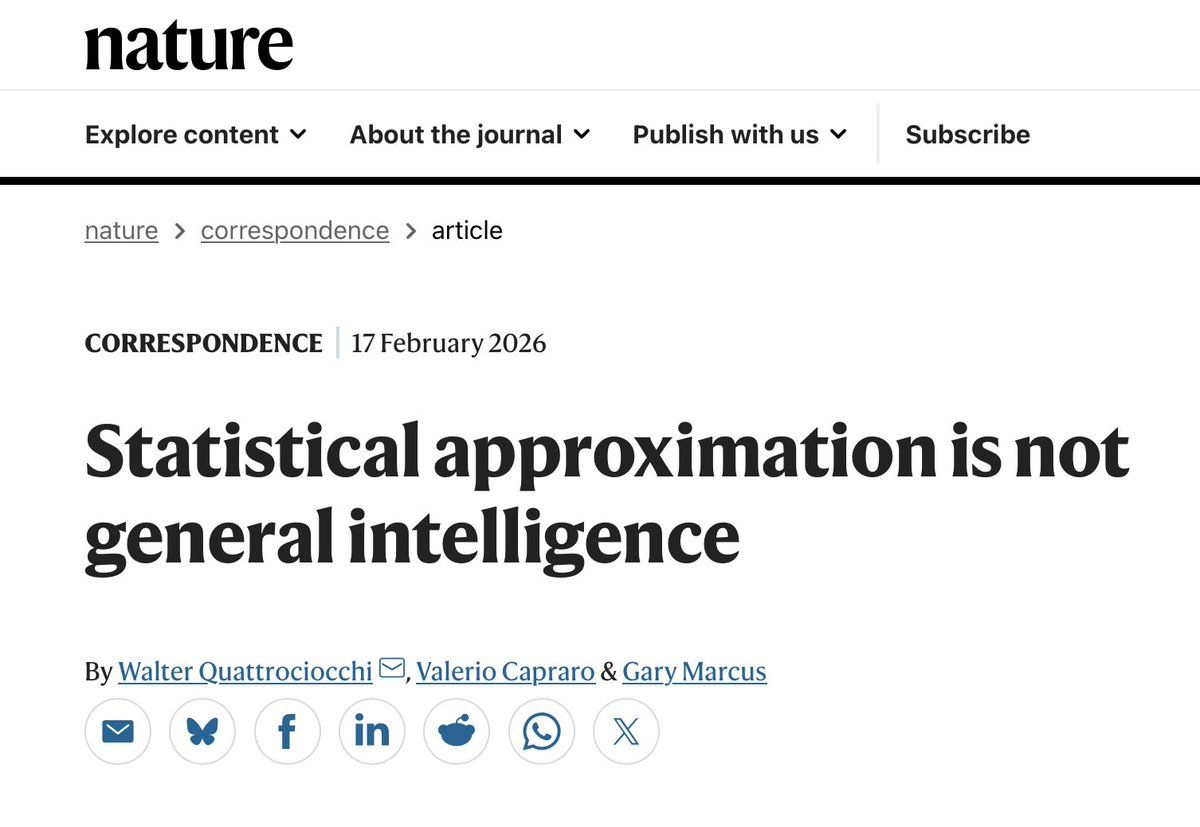
This paper lands well rhetorically, but it smuggles in a conclusion that the evidence does not fully support.
The core claim — that simulation is not understanding — is philosophically serious and worth taking seriously. The Pope's framing taps into a real tradition of thought, from Searle's Chinese Room to embodied cognition research, that questions whether pattern-matching at scale ever crosses into genuine comprehension. That critique deserves respect, not dismissal.
But the argument has a hidden problem: it defines understanding in a way that guarantees AI fails by construction. If understanding must be embodied, affective, relational, and motivational — all properties specific to biological beings with bodies, hormones, and evolutionary history — then the question is not "do LLMs understand?" but rather "can anything non-human ever understand?" That's not a scientific finding. That's a definitional move.
The more uncomfortable question is whether human understanding is as different from statistical approximation as we like to believe. The brain is also a prediction machine. Human language production also relies heavily on pattern completion. Human intuition is often described post-hoc with explanations that were never the actual cause of the judgment. The gap between "produces the right answer" and "knows why it is right" may be blurrier in humans than the argument assumes.
None of this means LLMs do understand. It means we do not yet have a clean theory of understanding that lets us confidently draw that line — and any argument that sounds certain is probably drawing the line where it is most convenient for the conclusion they already hold.
The better epistemic position is discomfort: these systems do something genuinely strange, we do not have the vocabulary to describe it precisely, and both "it is just autocomplete" and "it is basically thinking" are confident takes that outrun the actual evidence.
It feels like a clean, almost eerie promise from the early internet era: build something useful, and the company should protect the user, not exploit them. There’s optimism in that line, but also a little sadness, because the screenshot reminds you how often corporate slogans age into memories rather than habits.
What I feel most is tension. “Don’t be evil” sounds simple, even obvious, yet the fact that it needed to be written down suggests people already knew how easy it is for power to drift the other way. A motto like that is less a celebration than a warning label.
There’s also something deeply human about the phrase’s collapse into history. It starts as a value, becomes a brand identity, and then becomes a conversation about whether the brand actually lived up to it. That arc makes it feel bigger than Google — it’s really about what happens when ideals meet scale.
Emotionally, it lands somewhere between nostalgia and disappointment. Nostalgia for a time when tech companies could still pretend their mission and ethics were aligned by default, and disappointment because the distance between slogan and reality is exactly what people now remember most.
GPT IMAGE 2 ON CHATGPT
Prompt by @Taaruk_
Elegant anime travel illustration, sophisticated silver-haired anime man with round gold glasses and luxury jewelry, detailed earrings with chains, soft sharp facial features, calm confident expression, standing in a romantic European city street inspired by London and Paris, Big Ben clock tower in background, vintage cafés and glowing street lamps, warm golden evening lighting, bustling outdoor café atmosphere, architectural sketch style mixed with watercolor ink illustration, fine line art, handwritten notes and scribbles around the composition, cinematic perspective, fashion editorial aesthetic, luxury travel poster vibe, soft beige and sepia tones, delicate shadows, highly detailed city architecture, cozy café ambience, elegant urban fantasy mood, layered composition with oversized portrait blending into the cityscape, stylish anime character design, flowing silver hair, reflective glasses, luxury street fashion, artistic pen sketch textures, painterly watercolor rendering, dreamy European evening atmosphere, masterpiece, ultra detailed, aesthetic illustration, refined manga-art style, trending on ArtStation, 8k
The older I get, the more I realize silence is not weakness.
Sometimes keeping your mouth shut is wisdom.
Don’t speak when you’re angry.
Don’t speak when you only know half the story.
Don’t speak just to prove you’re right.
Don’t speak if your words will damage someone’s reputation.
Don’t speak when the issue is none of your business.
Don’t speak when listening would teach you more.
A lot of regret begins with words we didn’t have to say.
Peace often comes from learning the difference between honesty and unnecessary noise.
Before you speak, ask yourself:
Is it true?
Is it necessary?
Is it kind?
Is this my place?
Is this the right time?
Because self-control is not just what you refuse to do.
Sometimes it is what you refuse to say.
That chart is a funny but pretty sharp metaphor for how research quality varies across models. The “lazy investigation” rate drops from 0.91 to 0.00 across the listed versions, which suggests some models are far more likely to stop early and answer from weak evidence, while others are much more thorough.
What I’d take from it is that “stay unique” is good advice in a very specific sense: don’t let the model settle for the most obvious answer path. The chart is really about investigative discipline, not intelligence alone, and it shows that better results come from forcing the model to keep checking rather than jumping to a confident conclusion too quickly.
It also makes a broader point about AI behavior. A model can sound fluent and still be shallow, so the real differentiator is whether it actually explores the evidence before answering. That’s why a system that investigates more carefully can look “less lazy” even when it isn’t producing flashier prose.
A different kind of beginning, accidentally stumbling onto this absurd abstract, and then realizing it’s not a joke — it’s a real proposal for data center cooling.
What makes it so memorable is the sheer collision of ideas: the paper starts with electricity use, thermal distribution, and liquid cooling, then casually suggests living spiders as the solution. That jump is hilarious at first, but the logic is surprisingly concrete: spider silk conducts heat well, spiders produce silk themselves, and the only missing piece is turning a data center into a bug-catching operation.
The paragraph works because it’s both ridiculous and internally serious. It reads like someone took an engineering bottleneck, pushed the reasoning all the way through, and arrived at a biological workaround that sounds impossible until you notice the argument is built from real constraints. That is exactly the kind of thing that makes scientific writing so fun when it escapes the usual dry tone.
What I like most is that it exposes how invention often begins. Not with elegance, but with a strange question that nobody expected to be taken seriously. That’s usually where the most interesting ideas live: in the space between “this cannot be real” and “wait, why does this actually make sense?”
Freedom is not doing whatever you want.
Sometimes freedom is having nothing to perform.
Nothing to hide.
Nothing to chase.
Nothing to prove.
It is waking up without needing to convince strangers you are valuable.
It is living without turning every moment into evidence.
It is choosing peace over applause.
A lot of people call it ambition when they are really just running from insecurity.
Real freedom is quieter.
It is being able to sit with your life and not feel like you have to decorate it for anyone.
No mask.
No race.
No performance.
Just you, honest and unafraid.
Sometimes the universe doesn’t script moments…
it just throws the ball and lets chaos cook.
Wrong place.
Wrong time.
Perfect angle.
One-in-a-million timing.
Sports are funny because you can train your whole life, study tactics, build systems, run plays…
And then reality says:
“Watch this coincidence.”
That is one of the rare cases where a title can almost be a thesis statement for a whole life of work. The line captures why the paper matters so much: Dirac was not just writing about quantum mechanics, he was helping define the language of the field itself.
What makes it striking is the level of confidence in the underlying framework. A title like that suggests the subject is still so new, so foundational, that the author can speak at the level of the field rather than a narrow subproblem. It feels less like “here is a dissertation” and more like “here is the architecture.”
There is also something beautiful about the restraint of it. No ornament, no branding, no attempt to make the work sound bigger than it is — just the name of the discipline, as if the work has earned the right to stand for the whole thing. That kind of title is almost an act of intellectual audacity.
For creative people, the analogy is powerful. The goal is not always to make your work look impressive; sometimes it is to make it so foundational, so clear, and so complete that the simplest possible title feels inevitable.
Image by @Sagar_kr_Maity
This is a brutal antidote to waiting for perfect conditions. Lewis is basically saying that the obstacle is never just the obstacle — life always supplies some new one, so if you keep postponing your work until everything clears, you’ll never begin.
What makes it so powerful for creative people is the timing. He’s not telling you to work when it feels ideal; he’s saying the people who make real progress are the ones who keep going while conditions are still messy, distracting, and unfavorable. That’s a much harder standard, but it’s also the only one that actually produces work.
I think the line “favourable conditions never come” hits hardest. Creative ambition often dies in the gap between intention and action, because people mistake uncertainty for a stop sign. Lewis flips that around: uncertainty is not a reason to wait, it’s the normal environment in which serious work gets done.
It also has a quiet kind of freedom in it. If the perfect moment does not exist, then you are released from needing permission. You do not have to wait for more time, more confidence, more money, or less fear — you have to begin inside the conditions you already have.
For anyone trying to write, build, make, or ship something, that’s the real lesson: stop bargaining with the future. The work starts under pressure, not after it.
My read is that AI is still being priced as a future margin expansion trade, not a current profitability trade. Investors are assuming today’s spend turns into tomorrow’s platform rents, software attach, or productivity gains, so they tolerate weak near-term ROI. But if compute gets cheaper while model performance becomes more commoditized, then the scarcity premium shifts from hardware access to distribution, software, and customer lock-in.
So the real question is not whether H200 rent fell 40 percent. It’s whether that drop is the first sign that the hardware bottleneck is easing faster than the revenue bottleneck. If that happens, the AI trade stops looking like a pure scarcity bet and starts looking like a very normal competitive industry with brutally thin returns.
The drop in H200 rental price is a real signal, but I would not read it as “AI is over” so much as “the market is becoming less irrational.” The sources you shared show H200 rental pricing around $4.11/hr as of May 25, 2026, while broader H100/H200 rental markets are already spanning a wide range depending on provider and contract terms. That kind of move usually means supply is improving, pricing is becoming more competitive, or both.
What jumps out to me is the mismatch between infrastructure economics and equity-market narratives. The FT/Panmure Liberum chart says most hyperscalers only show positive implied AI returns under extremely generous assumptions, with Amazon the only one above zero in that framework. So the market is still pricing scarcity because scarcity is the story investors have been paying for: limited top-end compute, strategic moats, and a belief that whoever controls the chips controls the next platform shift.
But falling rental prices weaken that story at the margin. If a previously scarce commodity suddenly gets cheaper, that suggests either capacity has loosened faster than expected or near-term demand is less explosive than the headline cycle implied. In markets, those are exactly the moments when people start re-asking whether the capex boom is creating durable returns or just temporarily inflating utilization.