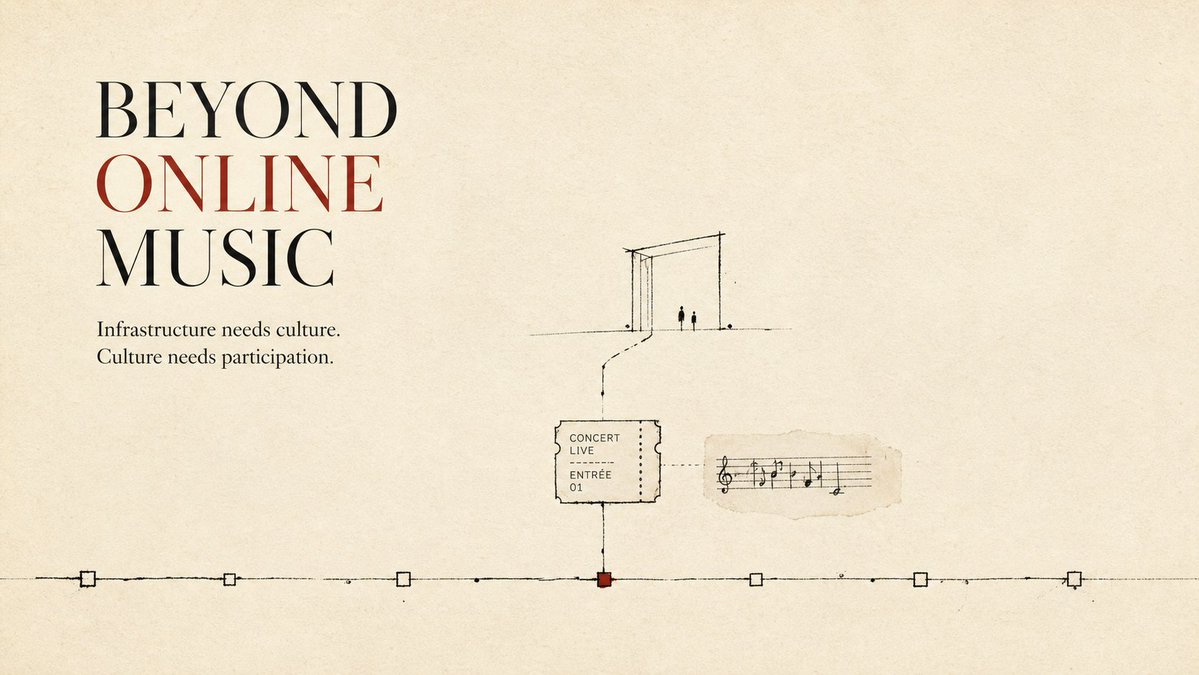
A Web3 music ecosystem needs real-world activity.
Without artists, it is just infrastructure.
Without fans, it is just theory.
Without events, it lacks culture.
Without IP, it lacks depth.
Without community, it cannot grow.
This is why SING Global focuses on connecting Web3 infrastructure with real music scenarios.
The strongest Web3 music ecosystems will not be built only online.
They will connect online participation with offline culture.
Music IP needs better infrastructure.
Not because music lacks value.
But because the value is often fragmented across platforms, contracts, events, fan communities, and distribution channels.
Web3 can help create a more transparent layer for music IP interaction.
That does not mean every song needs to become a financial product.
It means music rights, artist growth, live events, and community participation can be connected in more open ways.
The future of music IP may be less isolated, and more networked.
In the old music economy, fans were mostly treated as consumers.
They bought tickets.
They streamed songs.
They followed artists.
They shared content.
But in reality, fans do much more than consume.
They create momentum.
They build communities.
They shape culture.
They make artists visible.
Web3 gives us a chance to rethink the role of fans.
Not just audience.
Participants.
Why are you interested in Web3 music?
A. Artist monetization
B. Fan ownership
C. Music IP and RWA
D. Tokenized communities
E. Live events and culture
We believe the future will not be built by one group alone.
It will need artists, fans, builders, music institutions, and Web3 communities working together.
@amitisinvesting Wall Street is the greatest show on Earth because the fundamentals, the narrative and the price can all tell different stories at the same time.
@PeterSchiff A 25 bps hike is a signal, not a solution.
The Fed can tighten money. It cannot offset unlimited fiscal expansion without eventually breaking the economy.
@gurgavin A ~30% hike probability just hours before the decision is extraordinary for a Fed that spent years eliminating meeting-day surprises.
The real regime change isn’t whether they hike today. It’s that forward guidance is fading and genuine two-way policy risk is back.
If 7–10 Democrats are genuinely ready to support market-structure legislation, put the bill on the floor and let every senator go on the record.
But willingness to negotiate is not the same as a committed yes vote. The final ethics and consumer-protection language will determine whether the 60-vote coalition is real.
Web3 music is often misunderstood.
It is not just turning songs into NFTs.
It is not just launching another token.
It is not just putting a streaming platform on-chain.
The real opportunity is deeper:
Can artists build with fans instead of only broadcasting to them?
Can music IP become more transparent and programmable?
Can live events, digital assets, and communities become part of one ecosystem?
That is where Web3 music starts to matter.
$10K ETH is possible—but Ethereum needs a new narrative backed by real innovation.
DeFi gave ETH a reason to exist beyond speculation. The next cycle needs another breakthrough of that magnitude: something that brings new users, capital and economic activity onchain while accruing value back to ETH.
Without that, $10K is just a liquidity target—not a sustainable valuation.
@R89Capital Structurally bullish, tactically unpredictable.
CLARITY would remove a major discount applied to the entire US crypto industry. But even transformational legislation can trigger short-term selling if positioning gets crowded.
The law and the candle are different time horizons.
@gurgavin If the Fed holds, markets get temporary relief. If it hikes and stays hawkish, every long-duration asset—from tech stocks to crypto—has to reprice the discount rate.