[1/7] We trained a world model on 30,000 hours of first-person video.
It learned exactly where the hands go. What happens to the things they touch, much less so.
Going from 300 to 30,000 hours did not narrow the gap, and a 4× larger model barely did either.
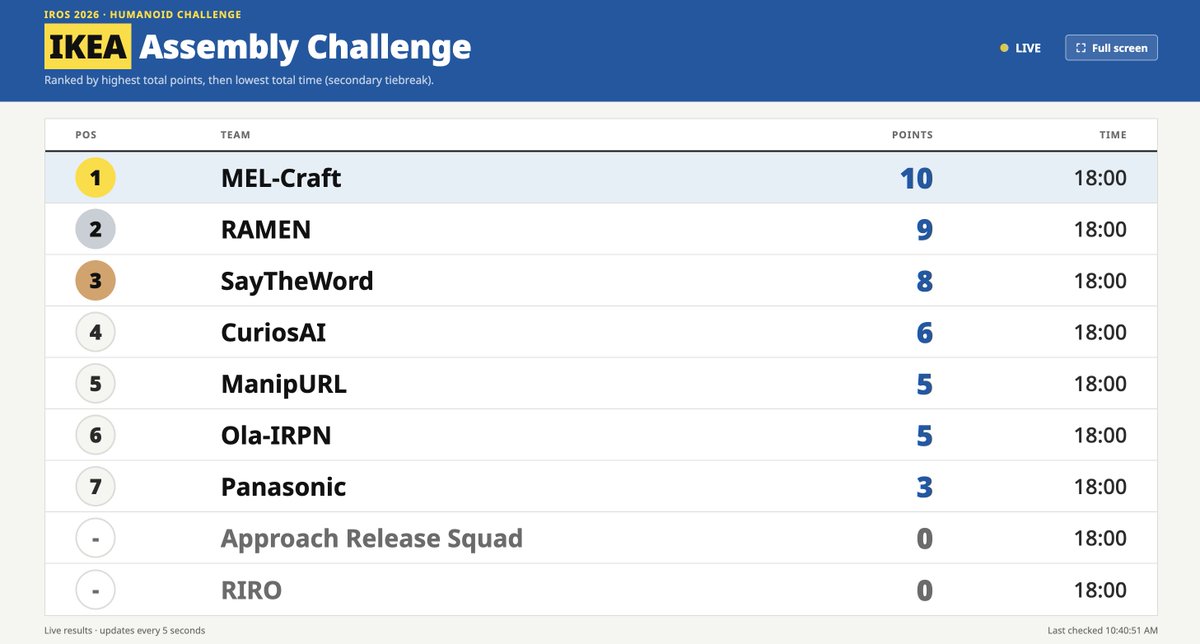
Congratulations to our top 3 teams and participants!
🥇 @merl_news: 10/29 points
🥈 @ramen_group_ai: 9 points
🥉 SayTheWord: 8 points
7 of 9 teams scored, but no one completed the full assembly. The results show just how challenging long-horizon loco-manipulation is.
It was a great experience participating in the first Humanoid IKEA Assembly Challenge and securing first place! 🥇 Congratulations to all our team members, and thanks to the organizers!
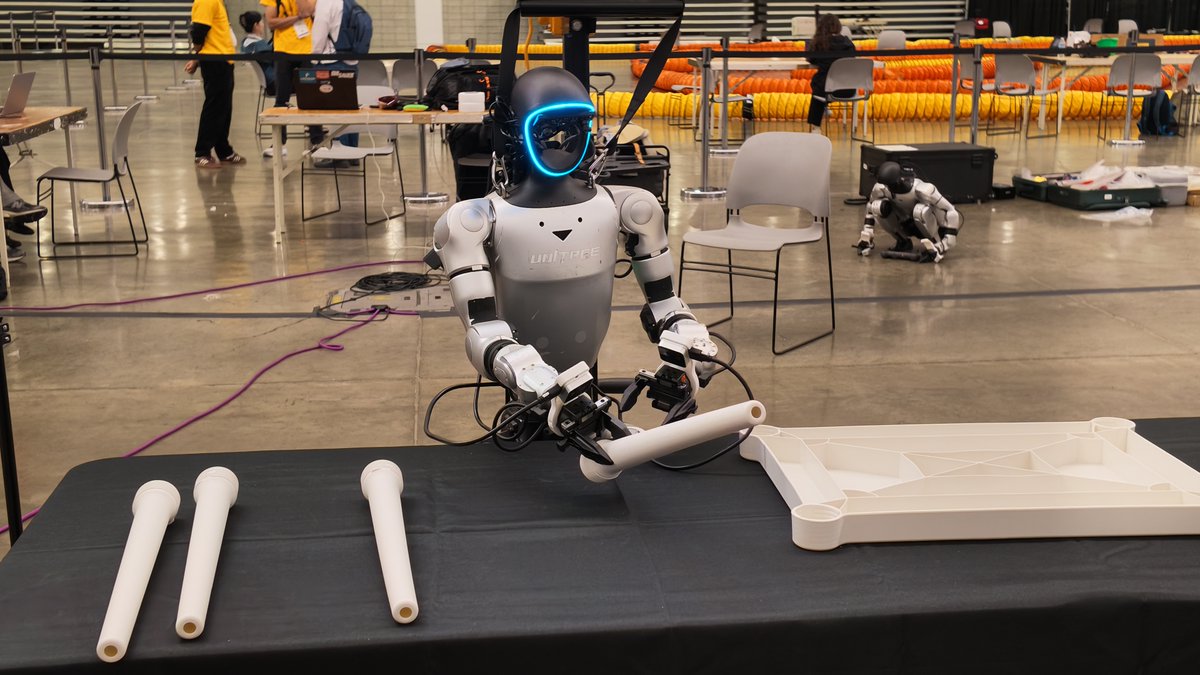
The first Humanoid IKEA Assembly Challenge, co-organized with @UnitreeRobotics, @LightwheelAI and @singaporetech, took place at @ieeeiros.
9 global teams tested their loco-manipulation policies to assemble an IKEA UTTER children’s table. Full results ↓
Day 1 recap at @ieeeiros: we have 36 finalist teams competing across 3 benchmark challenges in auto-navigation, dexterity, and loco-manipulation
We're tallying up the leaderboard results, but drop by the competition area to see how teams are improving their policies
1/ Nobody has benchmarked a humanoid on autonomous IKEA furniture assembly before.
Today at @ieeeiros 2026, the first attempts begin.
It’s a test of autonomous loco-manipulation: long-horizon sequencing, precise coordination, contact, force, recovery, and movement ↓
I don't use Twitter much to share wisdom but here is one:
It is impossible to have a codec that plays all video formats, a projector that project all screens, and a Papercept that doesn't crash before ICRA/IROS deadlines.
Force is arguably the most overlooked ingredient in modern robot learning.
Introducing FACTR 2: it turns *any* commodity robot into a force-aware system with no force sensors required.
Train a tiny force network in <1min with <10mins of data and drop it into any existing teleop pipelines:
✅ Free force sensing for both the robot and the operator arm
✅ Makes demos higher-quality → fewer of them needed.
✅ A new force-aware learning algorithm (FIRST) uses those recovered forces to figure out which parts of a demo actually matter, making learning data-efficient.
✅ Strong performance on complex tasks with fewer demos and even no pretraining!
More details below.
I want to offer some unsolicited advice to computer vision researchers jumping into robotics. Don't focus too much on VLMs, VLAs etc. That's fine, but the real action is at the sensorimotor level. Most of the open problems in robotics are in manipulation, which is about hand-object interaction, and contacts and forces are central. Proprioception and tactile sensing are as important as vision. Don't get seduced by cherry-picked demos. You can't do robotics without doing robotics.
Launching my research group, MAGIC (Manipulation and General Intelligence Control) Lab @NUSComputing, Singapore!
We focus on building the next generation of human-centric models for robotic manipulation — deployable safely, reliably, and easily in the real world. Our research spans MLLM reasoning, 3D vision, robot learning, simulation, dexterous manipulation, and cross-embodiment learning.
Interested in joining? Sign up here and I'll send a reminder email: https://t.co/9lEQnFERuh
Eka means unity -- “one,” in Sanskrit and “first” in Finnish.
We’re building intelligence for the physical world in its native language: forces.
Until now, robotics faced a tradeoff — generality or speed. The real world requires both. Robotics also faced a data problem.
Our Vision–Force–Action (VFA) model — the first of its kind — breaks the generality-speed tradeoff and the data barrier.
It's a new foundation uniting performance, generality, and safety for putting capable robots in everyone's hands.
Today, I am excited to share our journey of pushing robots beyond human limits.
Today, dexterity becomes scalable.
Today, I welcome you to the Era of Eka.
Co-founded with @haarnoja, and so thrilled and grateful to be working with a dream team at @EkaRobotics.
Learn more: https://t.co/QYQ6x2Etyi
For 40+ years, building a robot that could rally with an elite human table tennis player at full speed was an unsolved problem. Sony AI's Ace research project set out to change that—and the results are now accepted for publication in @Nature and featured on the cover.
I see every week on X an announcement or demo which implies that robotic manipulation has been solved. The only reason I don't believe it is because manipulation had already been solved last week by somebody else! So may I propose the "5 year old paired comparison test" ? At the next conference let's set up a number of tables to which you can bring your robot hardware. Next to it we will have another table where there will be a 5 year old child. In parallel we will try 100 different manipulation tasks that a neutral person has chosen- we could start with "pick up anything" - only household objects (e.g. as might be found in a typical American home) will be used, and we compare the performance of your robot with that of the 5 year old. Can you pick up a coin? Or a book? Or untwist a bottle top? Or insert any plug into a matching socket? Rotate one face of a Rubik's cube? Until your robot can do all the "open world manipulation" that a 5 year old kid can, some humility is in order.