Met Shri V. D. Satheesan, Hon’ble CM of Kerala to discuss the Sikh community in Kerala. What made it even more special was seeing him patiently listen to me speak about his community, his city and Gurudwara Guru Nanak Darbar, Trivandrum. @vdsatheesan#KeralaNews
“Confirm shaming” by Rapido is definitely shame conforming. You can’t put fear and pressure on customers by making them feel like they’ll lose access to a service unless they give in. That’s not persuasion but it’s manipulation. #rapido#cabs
If true, this is deeply disturbing. The system is only as fair as the people operating it. If “fixer lawyers” are facilitating bribery and gaming the judiciary, then V aren’t merely witnessing corruption but V are playing with the very system meant to deliver justice. #legal
Senior Advocate Mahesh Jethmalani sounded caution against "fixer lawyers" who facilitate bribery of judges while delivering the welcome address at the 6th Ram Jethmalani Memorial Lecture today
Read here: https://t.co/l0Nip2TiWn
@JethmalaniM
DILJIT IS COMING FOR THE CROWN. 👑🔥
21 NOVEMBER 2026. India’s biggest stadium. 🇮🇳
Crazy, man. CRAZY.
Can he dethrone The Chainsmokers and become No. 1? #punjabiaagayeoye@diljitdosanjh
While reading Dudgeon v. United Kingdom, 1981 (4) ECHR 149, I came across a beautifully simple description of privacy, drawing from Warren & Brandeis:
“The right to be let alone.”
Few definitions say so much with so little. #legal#SupremeCourtIndia
The Supreme Court on Thursday set aside directions treating NOIDA's time-extension charges as insolvency process costs in two delayed high-rise projects, holding that homebuyers and the new resolution applicant cannot be made to pay penalties for the original developer's default.
Read more: https://t.co/QFzxMSZ0sG
#SupremeCourt #insolvency #homebuyers
Fun fact: Can a Trial Court take cognizance of a police report without even specifying the offence(s) for which cognizance is being taken? Strange.
Answer: No.
#law
Punjab, the land of Gurus and a rich legacy of courage and resilience, sadly now also carries the growing shadow of drug abuse. If this is true, perhaps Udta Punjab was about more than one reason. #Punjab
BREAKING: NCLT constitutes five-member bench to decide Subhash Chandra’s insolvency case after a two-member bench held that no majority view had emerged and no final order could be passed on his ₹6.25 crore repayment plan.
The five-member bench will hear the case tomorrow at 10.15 AM.
Lawyers definitely want Ayyoub “Ello” El Osrouti’s willpower. #ello
93 yards. 623+ km. More than three days. And every hour, he went again. The mind kept saying “one more.” The body eventually said “enough. Absolutely phenomenal grit and determination.
This Subhash Chandra insolvency case does not look like a normal commercial haircut to me. The deeper you read the NCLT record, the more uncomfortable the questions become.
Let’s understand the Maths.
The easiest defence being circulated in the Subhash Chandra insolvency case is that he was “only a guarantor.” That description is legally misleading.
Under Section 128 of the Indian Contract Act, the liability of a surety is ordinarily coextensive with that of the principal debtor unless the contract provides otherwise. In simple words, a personal guarantee is not a ceremonial signature. If the borrower defaults, the creditor can proceed against the guarantor for the guaranteed liability. That is precisely why claims of around ₹22,006 crore were admitted against Subhash Chandra in his personal insolvency proceeding.
And there is another important point. He was not a man worth ₹31 crore when these guarantees were being given. The NCLT record itself refers to net worth certificates showing approximately ₹45,888 crore in 2017 and ₹40,562 crore in 2018. So the story is not that a person worth ₹31 crore somehow guaranteed ₹22,000 crore. The real story is that a promoter who had represented personal wealth of more than ₹40,000 crore gave massive guarantees, and years later, when those guarantees became enforceable, his disclosed net worth had fallen to around ₹31.79 crore.
That immediately creates the first serious question.
Where did the wealth go?
If assets worth tens of thousands of crores disappeared from the personal balance sheet, then before granting an almost complete discharge of personal liability, the natural thing should have been to trace those assets properly. Which assets were sold, to whom, for what price, where did the consideration go, whether any assets moved to relatives, group entities, LLPs, trusts or connected companies, whether those transactions were at market value and what ultimately happened to the money.
This was not merely an outside suspicion. The Technical Member herself considered the fall in net worth serious enough to call for an independent forensic audit and asset tracing exercise.
Then comes the part which, to me, makes the case even more extraordinary.
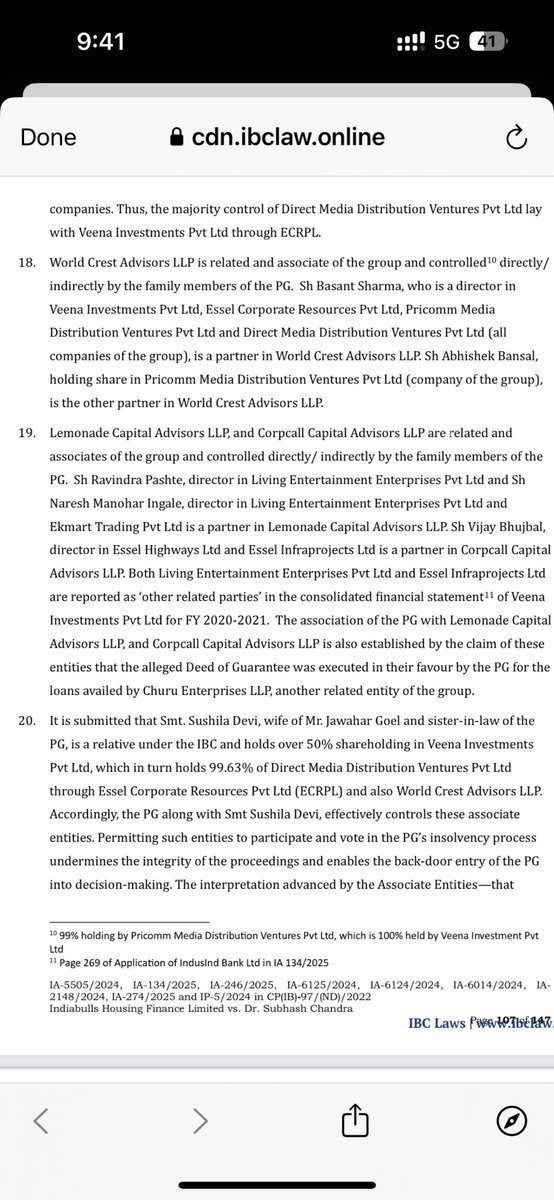
Five disputed creditors, World Crest, Lemonade, Corpcall, Veena Investments and Direct Media, together controlled around 61.78 percent of the total voting power. Their links with the Chandra and Essel ecosystem through family relationships, directorships, shareholding and corporate connections were argued before the NCLT. The Technical Member found these connections serious enough to question their voting rights. The Third Member took a narrower statutory view and said the legal test to disqualify them as associates had not been fully satisfied.
But the mathematics does not disappear.
Around 77.48 percent of the total voting share supported the plan. Remove these five disputed creditors and the support falls to around 15.70 percent, while around 18.42 percent had voted against it.
So these five were not minor creditors sitting on the side.
Their votes were decisive.
Now understand why this matters economically.
Suppose a promoter has ₹10,000 crore of personal liability. A company within the same economic ecosystem holds a ₹6,000 crore claim and an outside bank holds a ₹4,000 crore claim. The connected company accepts almost nothing on its ₹6,000 crore claim and uses its voting strength to approve the plan.
On paper it looks like that company suffered a massive loss.
But if both sides are really part of the same economic pocket, then the internal claim is only being sacrificed on paper, while the same vote helps reduce or extinguish the outside bank’s ability to recover ₹4,000 crore personally from the promoter.
That is why the real question is not who took the biggest haircut on paper.
The real question is whose money was actually lost.
If these five creditors were genuinely independent and commercially separate, then their decision is one thing. But if their economic interests were aligned with Chandra or the Essel ecosystem, then their huge nominal claims could have supplied exactly the voting power needed to cut down the personal recovery rights of outside banks.
That possibility is exactly why beneficial ownership and real economic control should have been forensically examined before approving such a massive discharge.
And there is one more fact which makes it impossible to casually say that the entire process was flawless. Claims of more than ₹185 crore on behalf of 1,260 people were admitted without proper supporting documents and later had to be excluded by the Third Member.
So no, the real issue is not simply that ₹22,006 crore became ₹6.25 crore.
The deeper issue is this.
A person once represented as worth more than ₹40,000 crore came into personal insolvency with a disclosed net worth of around ₹31.79 crore. Five disputed creditors with documented links to the wider Chandra and Essel ecosystem held 61.78 percent of the voting power. Their votes were mathematically decisive. No complete independent forensic asset tracing was done before the plan was approved.
That is why “he was only a guarantor” is not an answer.
The two questions that must be answered are very simple.
Where did the wealth go?
And who really controlled the 61.78 percent voting block?
Until these two questions are answered through a proper forensic investigation, this will not look like an ordinary commercial haircut. It will remain a serious test of whether our insolvency system can actually deal with powerful promoters, connected entities and enormous financial claims without allowing form to defeat substance.
@FinMinIndia@RBI @IBBIIndia @narendramodi@RahulGandhi@khurpenchh@NaukarshahiGems
#SubhashChandra #NCLT #NCLAT #IBC #Banking #ForensicAudit #CorporateGovernance #FinancialSystem #Accountability #BankingFraud
The bigger question: what happened to the remaining ₹21,993.5 crore, and who ultimately bears that burden? After reading Mint’s report, I finally understood how this resolution plan was approved. #salute
DHC:
A good IBC matter is being argued.
Judge observes how CIRP process has been badly misused to game IBC process.
Bhambani, J (on light note): "This reminds me something I read in a testamentary case: That estate of deceased will be distributed amongst lawyers!"
//
Gracious Leadership
Thank you, Mr. Vikas Singh, President, SCBA, for your leadership over the four years. Your resolve to pass on the baton to someone who is a regular practitioner before SC reflects your commitment to the Bar. A commendable thought for the future of our Bar.
After four terms as President of the Supreme Court Bar Association, I am deeply grateful to all members for their trust and support.
My tenure has been dedicated to the well-being of our members and the integrity of the institution.
As the baton is passed, I hope our Bar continues to be led by those who genuinely understand its members and remain independent of politics, money and outside pressure.
The strength of the SCBA has always belonged to its members.
My best wishes for the continued strength and progress of our Bar.
#VikasSingh #SCBA #SupremeCourtOfIndia #LegalProfession