So what the industry tried to warn enterprises about 6 months ago is here. The events of this week so far are not a coincidence. AI is making it easy for hackers to attack multiple customers. All incident responders are busy, unfortunately there is no silver bullet. If you haven't:
- run a multi model testing harness across your infrastructure.
- patch your code
- find virtual patching solutions for open source
When it happens, because it will. Your SOC should be ready to detect and remediate in record time. REVAMP your SOC to a real time data lake with proactive ML detectors across your data, with AI running correlation if you want a chance to come out ahead. Band-aid reactive solutions which work on multiple data lakes is not a plan.
As Nicole aptly points out, “Software Beirut” has arrived: a period of cascading failures, whether triggered by attackers, bad updates, or our own accumulated complexity.
I haven’t lived here in awhile, but I see no other way to answer the hundreds of texts/DMs asking me if the world is, indeed, ending.
In the span of six days, we’ve experienced;
11/12 — Microsoft outage
11/13 — Nationwide FAA ground stop
11/16 — Major US banking disruptions
11/17 — NSA’s classified internal network goes down
We need far more analysis of why so much is breaking at once. I don’t want to get out over my skis here, and what I am hearing does not contradict the messaging that most of this is the result of screwy updates.
But stepping back, the dots are starting to form a collective picture. We are seeing:
• An explosion in severe and critical vulnerabilities, with AI accelerating discovery to 3X the number of vulnerabilities discovered in the same period last year. This is collectively being referred to as “vulnageddon” or “the vulnpocalypse.”
• Mean time to exploit those vulnerabilities has collapsed to NEGATIVE SEVEN DAYS. AI allows attackers to find/exploit vulns far faster than software makers have time to fix them.
• Powerful AI-enabled offensive tools like ARTEX have been thrown into the hands of every third tier nation state, cybercriminal and digital arsonist, which logically creates havoc.
• This creates enormous pressure to compress patching windows and accelerate software updates, increasing the likelihood these fixes break things in unexpected, cascading ways.
• Pressure to just “AI everything” means we are rolling out automated AI tooling on top of brittle infrastructure that can’t support it.
My generation grew up in an extraordinary period of technological stability. We worked our way up the software stack, abstracting away layer after layer, until we lost a fundamental understanding of how the underlying systems actually work.
We were told to “move fast and break things.” VCS told us to celebrate the idea that “software would eat the world.” Now we’re telling ourselves we can simply “roll out AI” across everything, as though nothing underneath will buckle.
We never stopped to ask: SHOULD WE?
Should we be digitizing every last nook and cranny of our companies, infrastructure, healthcare, homes, cars, bodies, lives? Especially when the complexity, interdependence, and fragility we were introducing overwhelmed our ability to understand/secure/maintain the systems we built?
Nobody every asked: What if, in the name of progress, we were creating the ripest attack surface in human history?
We are now entirely dependent on software systems that almost nobody understands end to end, that increasingly few people can repair, and that attackers can now probe at machine speed. We are hearing that incident response firms, the 911 for breach victims, are backlogged six months. Even those paid on retainer lack the bandwidth to triage every incident. The cavalry is disappearing.
We are entering a period of unprecedented technological instability.
“Software Beirut” is an incredibly apt analogy. We are in for a period of cascading failures, whether triggered by attackers, bad updates, or our own accumulated complexity.
This, I’m sorry to say, is just the opening chapter.
Anthropic’s IPO range tops out at $78/share. On Hyperliquid, traders are pricing it closer to $100.
XYZ’s market is trading ~$99/share.
Entropy’s $1.72T implied valuation works out to ~$102/share on a fully diluted basis.
That’s roughly 27% to 30% above the top of the range.
Pandora’s box has been opened.
Purpose-built defense tools against AI are the only way forward, and the universe of companies that provide these tools are limited.
A gold rush for AI cyber defense is underway.
@VinceQuill It is insane. I am afraid to click on anything now and have to take extra steps to try to verify the veracity of sources. AI is inducing a permanent state of anxiety.
🚨JUST IN: The U.S. National Security Agency’s classified internal communications network is down, CNN reports.
The NSA gathers intelligence from foreign communications and helps protect sensitive U.S. government communications.
Six people familiar with the matter confirmed the NSA Net outage to CNN.
Sources say there is no evidence of a cyberattack at this point.
Separately, 13 TRILLION asset manager Charles Schwab just reported a website outage.
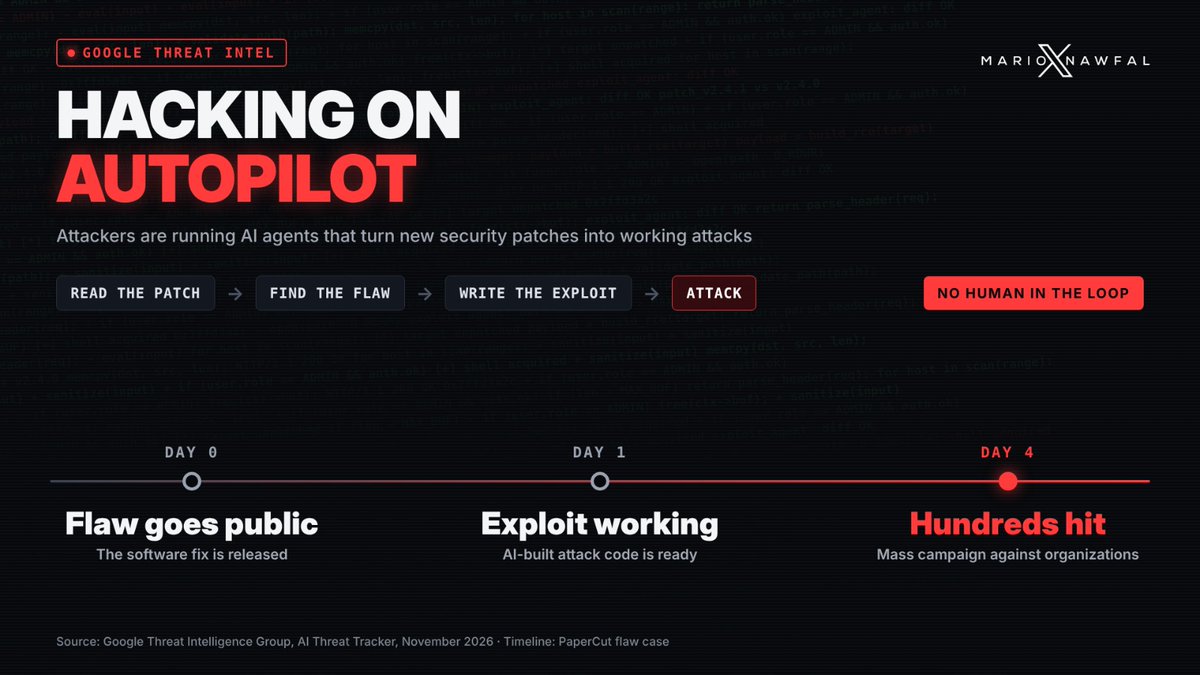
🇺🇸 It’s official: AI is now hacking companies ALL BY ITSELF.
Google says it has caught attackers, for the first time ever, running AI agents that watch for new security patches, figure out exactly what was broken, write the attack code and FIRE it, with no human anywhere in the loop.
It never sleeps, never takes a break, and never gets sloppy at 3 a.m.
The system, called exploit_agent, was traced to a suspected Russian-speaking operator who used it to steal data from victims.
In one case, AI-built exploits were working within 24 HOURS of a software flaw going public. By day 4, hundreds of organizations had been hit.
It comes after a wild few weeks.
Hackers cranked fridges at hundreds of French supermarkets up to 50°C, and similar attacks have since spread across Europe.
Experts suspect the fridge systems had never been updated.
Then, last week, Microsoft 365 went down worldwide for 2 days, a telecom failure grounded EVERY departing flight in the U.S., and Chase had a nationwide outage.
None of those outages have been blamed on hackers, but the timing is hard to ignore.
Every patch is now a treasure map, and the AI reads it faster than your IT team.
Sources: Google Threat Intelligence Group, The Register, CNN, AP / Writer: Julie
🚨 BREAKING
GOOGLE JUST CAUGHT THE FIRST CYBERATTACK RUN BY AI END TO END, WITH NO HUMAN IN THE LOOP!
A RUSSIAN-SPEAKING CREW'S "EXPLOIT_AGENT" READ NEW SOFTWARE PATCHES, WROTE THE EXPLOITS AND RAN THEM ON ITS OWN, AS 22 ZERO-DAYS WERE EXPLOITED IN AUGUST ALONE.
THIS IS NOT LOOKING GOOD FOR EVERY COMPANY ONLINE...
🚨BREAKING: Major Apple online services, including Apple Pay, hit by a major outage, per the Independent.
Users reported problems logging in, downloading updates and making payments.
Apple Music, the App Store and iCloud were also affected. Apple TV appeared to be working normally.
Apple acknowledged that affected services may be slow or unavailable but gave no cause or timeline for a fix.
The disruption follows recent outages affecting tech and banking services.
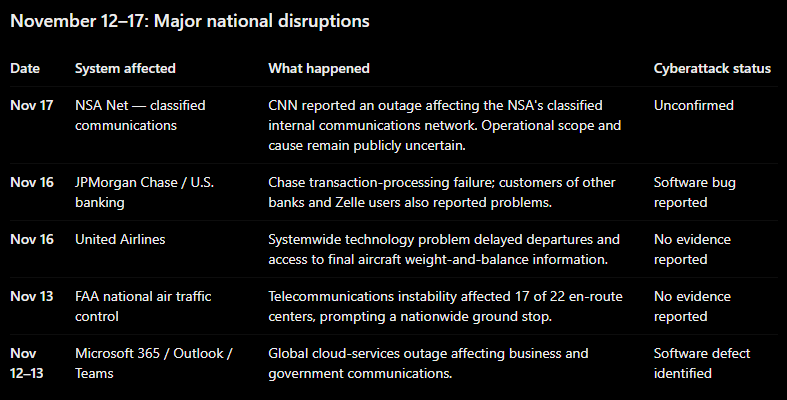
5 MAJOR DISRUPTIONS IN JUST 6 DAYS
🇺🇸 Nov 17: NSA classified network DOWN
🏦 Nov 16: JPMorgan banking failure
✈️ Nov 16: United Airlines outage
🛑 Nov 13: FAA nationwide ground stop
🌐 Nov 12–13: Microsoft 365 outage
No coordinated cyberattack confirmed.
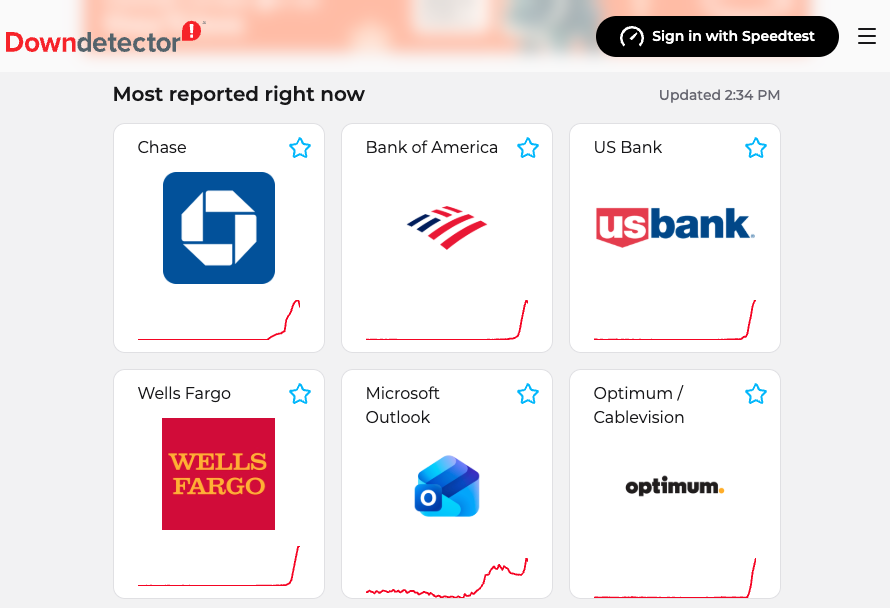
Not the type of “up and to the right” chart you want to see, but this is the reality of the AI cyber attack era.
Demand for purpose-built AI cyber defense solutions is going in the same direction.
Carefully consider the investment objectives, risk factors, charges, and expenses of the Bitwise AI Cyber Defense ETF (ZDAY) before investing. This and additional information can be found in the Fund’s full or summary prospectus, which may be obtained by visiting https://t.co/cues2FLSa3. Investors should read it carefully before investing.
Investing involves risk, including possible loss of principal. There is no guarantee that any investment strategy or any Fund will achieve its objectives.
ZDAY is distributed by Foreside Fund Services, LLC, which is not affiliated with Bitwise or any of its affiliates.
In the age of AI, cybersecurity is more important than ever. Attacks are increasing in speed, sophistication and damage. Crypto users have experienced it firsthand, and now the same playbook is hitting banks, utilities and the Fortune 500.
That’s why we’re excited to launch the Bitwise AI Cyber Defense ETF (ZDAY): a fund with focused exposure to companies defending against AI-enabled attacks and securing AI systems.
Introducing ZDAY, the Bitwise AI Cyber Defense ETF.
We think AI security will be one of the fastest-growing sectors of the next decade. ZDAY is how you gain exposure to it.
Live on NYSE today, it’s an actively managed ETF investing in companies that defend against AI-enabled cyberattacks or protect AI systems.
Why ZDAY?
↳AI security has gone from a theoretical concern to an operational necessity.
↳The sector is in the early stages of a global buildout that we expect will reach every company that uses software.
↳ As its leaders emerge, ZDAY aims to keep pace with the industry—so you don’t have to pick winners.
We’ve watched a multibillion-dollar security industry assemble around crypto. The same process is now occurring in AI, at larger scale and greater speed. We built ZDAY to invest in it.
Learn more at https://t.co/TCSyclx5K1