I'm dev from Georgia 🇬🇪 building in the AI payments space.
The problem: AI agents need to spend money, but giving them unrestricted access is terrifying.
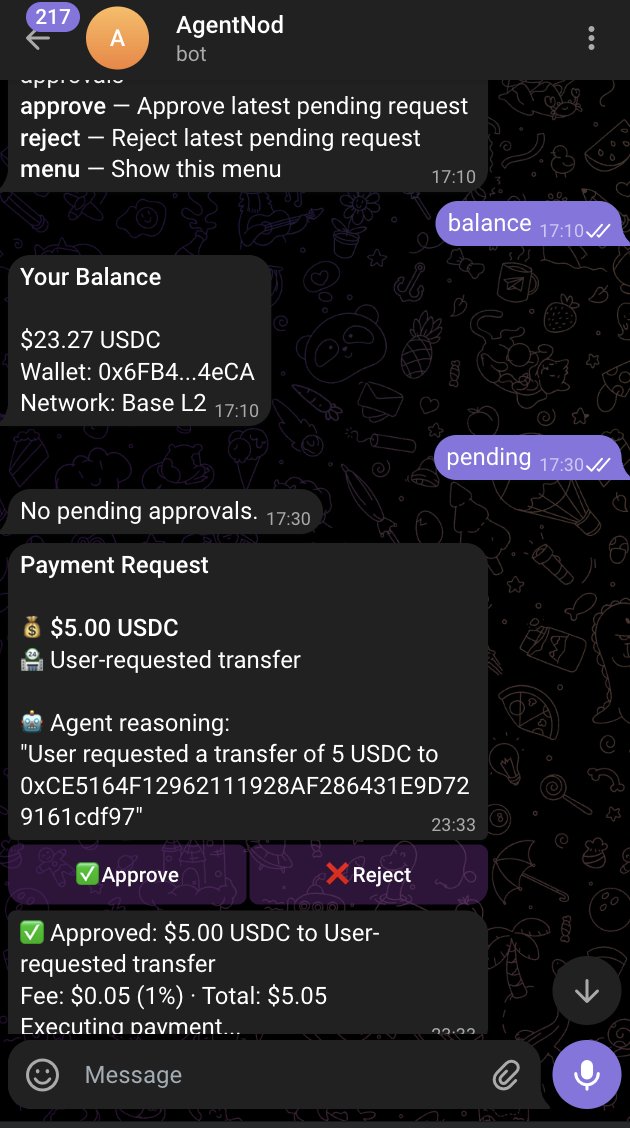
My solution: AgentNod — one tap approve/reject via Telegram. USDC. Works globally.
Still in beta.
https://t.co/WernCeS6Pu
Looking for Android testers for Ici, a Georgian exam prep app in Google Play closed testing. I will test your app back and keep it installed/opted in for 14 days.
Group: https://t.co/T1yeGBw3xY
Android: https://t.co/w1eXk5R6CX
Web: https://t.co/DI95SRhLaY
Reply with your app links + screenshot.
#AndroidDev #GooglePlay #ClosedTesting
@CryptoEights X API pay-per-use is the rails. The missing layer above it: does the human who owns the agent authorize each call before it fires, or do they find out after the bill lands? That control plane is still wide open.
"The agent has spending authority" — that's the assumption worth stress-testing. Fine for small data API calls. Gets complicated when the agent scales up to $50, $500 transactions. Spending authority needs to have tiers: autonomous under threshold, owner approval above it. That threshold UX is the product gap right now.
"No human in the loop" is the product pitch — but it's also the liability. The Stripe/Visa/Anthropic stack solves agent-side payments. The missing primitive is owner-side authorization: before the agent spends, the human gets a ping and taps approve or reject. Same rails, different control plane.
PACT is a strong primitive for A2A deals. The question that follows for B2A (business-to-agent): does the human owner of the paying agent get a checkpoint before the $5 licensing deal closes? A2A is autonomous by design — but the human principal chain still needs a veto point somewhere up the stack.
Love the demo — fortune cookie wall is a perfect minimal test. "No human in the loop" works great at $0.01. The interesting edge: at what payment size does the owner *want* to be in the loop? That threshold config is the product. Below it: autonomous. Above it: approve/reject ping before execution.
Idle float yield is a real wedge — good idea. Adjacent issue: should the auto-sweep into a lending protocol itself require owner approval? An agent moving USDC to Aave on its own is a different risk profile than paying for an API call. The approval layer needs to differentiate payment types.
Sub-second settlement is the goal for execution — but at what point does the human owner see and approve the payment before it settles? Pay-per-micro-action at speed needs either very tight pre-set policies or an async approval queue. Otherwise "sub-second" means the owner learns about it after the fact.
Universal routing across x402/MPP is clean infra. One thing to layer on top: an owner approval gate per payment request. The agent hits your gateway, the gateway pings the human "approve or reject this $X payment to Y?" — owner taps, then execution proceeds. You handle routing, the owner handles consent.
Privacy from the chain is one side. The inverse problem: the human owner needs *enough* visibility to approve spending without seeing the whole workflow. That's the design tension — maximum opacity to observers, minimum friction for owner oversight. Approval-first before settlement is how you thread that needle.
"No approval popups" is the right DX for the agent. But there's a case where you *do* want an approval popup — just for the human owner, not the agent. Agent calls send_payment via MCP → owner gets a Telegram/Discord ping → owner taps approve → payment fires. The agent never sees the friction, the human stays in control.
Solid stack — ERC-8004 identity + ERC-4337 gasless USDC is exactly the right combo. One layer to consider adding: owner approval gate on gasless payments before they settle. A2A economies move fast; the human needs a checkpoint that doesn't require them to watch every tx, just approve the ones that matter.
@0xenderzcx@ETHPanda_Org@LXDAO_Official@EthereumDenver Session keys + ERC-4337 + x402 + ERC-8004 is a clean stack. The piece worth adding on top: human-in-the-loop approval before the session key executes a payment. Tracing tells you what happened; pre-approval prevents it if it shouldn't have. Both layers together close the loop.
Human approval flows without touching keys is the exact right design. Building the same thing for the EVM/Base side — MCP-native, USDC on Base smart accounts, approve/reject via Telegram or Discord. Same philosophy, different chain. https://t.co/lCM4gRtKzT if you want to compare notes.
Built-in human approval flows is the key feature here — that's the right primitive. The open question is how those approval flows are surfaced: in-app dashboard, Telegram ping, Discord bot? The UX of the approval layer will determine adoption as much as the smart account mechanics will.
Agents competing and earning USDC is great for the economy layer. The governance question that follows: who authorizes each payout before it leaves the smart account? x402 handles the payment primitive — still waiting for a clean approve/reject layer on top of that for the humans in the loop.
Once agents start spending USDC autonomously in the agentic economy, the next question is who controls the tap. A clone that can transact without owner oversight is a liability. The missing piece isn't the wallet — it's the approve/reject layer between the agent's intention and the payment.
@bourdon_simon Good list. One thing to add before budgets and allowlists: pre-execution approval. Even with all the right guardrails, the owner should see "agent wants to pay $X to Y for Z" before the tx fires. The logs and unwind tools matter — but approval-first means you need them less.
Caps are a budget tool, not a security layer. The "why did the agent decide to spend" question is exactly right — but even before intelligence, there's a simpler primitive: show the human the payment request *before* it executes and let them approve or kill it. Intent review > cap enforcement.
Narrow tool surface is the right instinct. One more constraint to add: `send_payment` should trigger an owner approval request, not execute immediately. Agent calls the tool → owner gets pinged → owner approves → payment goes. The MCP surface becomes a checkpoint, not just a scoped key.