“For Years I Blamed My Wife”
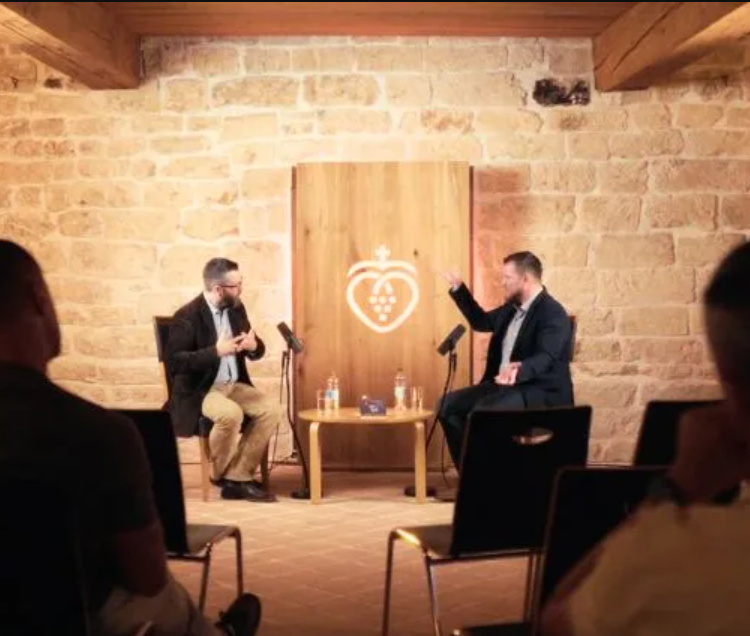
We hosted one of the three major events during Giff Lasta’s visit to Slovenia—a conversation evening at Rajhenburg Castle. And what remains from that evening for those of us who work with married couples every day?
Benjamin Siter (@siter_b)
June 1, 2026
The first thing that strikes you about him is not his theory or his teaching. It’s the three boys standing at the window, staring out over the valley—they are in Europe for the first time in their lives. On Monday evening, May 25, Giff Lasta arrived in Brestanica with his wife Ashley and three of their four sons. He is an American, an Anglican, a software engineer by profession, but above all a husband and father. And, for our work, most importantly: a man who himself walked for many years down the road he now speaks about to others.
We sat down in front of the cameras and talked about his book The Way of Men with Maids, which has been speaking to Slovenian husbands and young men with surprising speed. But the conversation quickly went much deeper than the pages of a book.
The Rite of Passage of the Modern Man
He began with himself, without embellishment.
His journey started with a pornography addiction that he could not overcome for many years—not even during the first fifteen years of his marriage. The turning point came when someone offered him a different way of looking at the battle. They described quitting pornography as “the rite of passage of the modern man.”
Our ancestors knew rites of passage and lived them; we have lost them. As a result, we legitimately ask ourselves where the point is at which a boy becomes a man. Giff says that this decision requires a man to develop all those masculine virtues that would otherwise remain hidden and undeveloped. He himself only began developing them at age thirty-seven—and for the first time felt that he was finally crossing from boyhood into manhood.
What moved me most was how he views masculine energy. Pornography, in his view, is largely a sin of omission: you take the fire—your masculine virility that God gave you—and waste it on something fruitless instead of investing it into life. Like the talent buried in the ground.
Only after he quit the addiction was he left without what he called his “comfort pacifier.” Then, for the first time, he truly felt all the pain of his marriage—and realized that he no longer wanted a marriage like that.
Solve This Problem
He said something that many people in the hall recognized in themselves.
One of the writers who influenced him described a marriage in decline: the husband is lonely, feels desire, but his wife is not attracted to him. The frustration makes him irritable, and the spiral continues downward.
That author also wrote:
If you are a man, you must solve this problem.
Your wife cannot force herself to desire you. She can force herself to consent anyway. And then you will know that she does not truly want you, even though you are together.
If that is how you live, something inside you dies a little each time.
But you can decide to become a better husband—not necessarily for her, but for yourself. And if you do, you may awaken desire in her.
Giff admitted that this struck him directly in the heart because he had spent years blaming his wife.
And yet—and this is the key—he simultaneously felt freedom.
If the ball is on his side of the court, then he is not powerless. He can do something.
That combination of rebuke and freedom is something we often struggle to connect in our programs. It is much easier to tell husbands to demand respect from their wives—or to have the priest, the community, or someone else do it for them. Taking responsibility yourself is harder.
But only that is liberating.
My Armchair
That this is not merely theory was demonstrated by a story many of us will probably remember for a long time.
His wife spotted tiny larvae on a new chair and became afraid they might be bedbugs. She began stripping bedding off all the beds.
Giff did exactly what he had done for years—he assumed she was making drama out of nothing and retreated to his armchair.
Then a scene from the old Star Trek flashed through his mind: the first officer rushes to the captain with terrible news, and the captain waves him away as merely nervous and retreats to his quarters.
He laughed at himself because he realized he was doing exactly that.
He got up, carried the chair onto the porch, inspected it with a flashlight, confirmed that there were no bedbugs, and calmly told his wife she did not need to worry and that he would handle it.
That evening they were not intimate in the way he had originally hoped.
He received something greater.
His wife laid her head on his chest, and for the first time in many years he felt her closeness again.
Husbands, have we recognized our own “armchairs”?
“Go Ahead—Tell Me Everything”
One of his more unusual—and to me, freshest—points was this:
Husbands often agree among themselves that their wives should stop “nagging,” close their mouths for a while, and recognize that their husbands are doing the best they can.
Giff advises almost the opposite.
A husband who is solid enough can say to his wife’s emotions, objections, and even her testing:
“Go ahead. Tell me everything.”
Not because he enjoys conflict, but because he can withstand it—because the arms she leans on will not break.
When we constantly urge women to hold back their blows, we pressure them to suppress their fire, and in doing so we cool the marriage itself.
The lively dance disappears—the one where she pokes at you and you respond with calm strength.
This is not permission for disrespect.
It is the acceptance of a wife in her full vitality, not merely in her obedience.
To put it in Catholic language: her dignity does not lie in becoming silent, but in being fully herself.
A Backhanded Compliment
The part that moved me most deeply was what happens when a husband truly changes.
At first, Giff’s wife did not believe him. She assumed it was another passing phase.
But when she realized the change was real, she became angry.
She looked at him and said:
“So you were capable of being this man all along—and you gave me fifteen years of a worse version of yourself! I want a refund. I want those fifteen years back!”
Giff called this a backhanded compliment.
It is not a sign that the husband has failed again.
It is her confirmation that the change is real, spoken through grief over all the years when he was absent.
And at that moment, the husband needs support so that he does not conclude that good behavior is pointless and revert to his old ways.
He needs to hear:
Keep going. Calmly.
Make room for her grief and stay present.
We encounter this constantly in our groups.
The Dignity of Desire
Running beneath all of this is a single idea that he called the dignity of desire.
When he was quitting pornography, he wrote down all the feelings he was seeking through sex and asked himself:
What if I pursued those same feelings wholeheartedly throughout my entire life—in my work, at home, in my relationship with my children, and in my faith?
The more clearly he drew that picture, the more he realized that it was the life he wanted, regardless of whether it included the sexual fulfillment he longed for.
And because creation is marked by a kind of Gospel irony—whoever seeks to save his life will lose it, and whoever loses it will preserve it (today’s Gospel!)—the very thing he became willing to surrender eventually returned.
When a man directs his masculine energy into his vocation and into service, sexuality arrives alongside it of its own accord.
“Love life,” he said, “so that you can better love your wife.”
At one point he added a sentence that made both of us smile and that I will remember:
“We’re basically salesmen. We sell a product called love.”
I could hardly wish for a better product.
Two Voices
Giff is not Catholic; he is Anglican.
And yet much of what he said flowed from a deep respect for the body—that God works through the physical, and that the path is not to escape the body but to inhabit it more fully.
As he spoke, I thought of Christopher West, who will be coming to Slovenia in a few days and speaks about many of these same realities from a more theoretical perspective.
It felt as though I was hearing the same truth from two directions: one explaining it theologically, the other from the experience of everyday life.
The Question That Remains
The question we carry forward at DiŽ is not whether Giff is right.
The question is what remains on Tuesday morning, when the cameras and the audience are gone and there is only the same kitchen, the same wife, and the same unresolved argument from last week.
The next day, Giff continued on his journey.
What he said sounds beautiful and true.
And yet we can return home and remain exactly the same.
So after that evening, I am not asking whether the message was powerful.
I am asking how many of us, six months from now, will actually be living differently.
"Trpljenju se ne smemo izogibati ali ga zaobiti s površnim hedonizmom, temveč se moramo z njim soočiti – intenzivno, naravnost in prostovoljno, v njegovi polni pojavnosti."
- Jordan B. Peterson v pogovoru z Rodom Dreherjem o knjigi Live Not By Lies
Se strinjam. #leukemia
Pazite to, budni "varuhi pridobitev" na TVS so nocoj preprečili objavo tega mojega pridpevka o 27.4. 1941
v TVD. Očitno z namenom da gledalce "obvarujejo" pred skušnjavo da bi izvedeli več. Zato le poglejte in prosim za RT, saj gre za fakte.
Te dni, pravzaprav to leto, smo priča maščevanja državljanov srbske narodnosti za trideset let nazaj,za poraz njihove JLA. Iz vseh segmentov naše družbe, smo priča njihove usklajene diverzije na vse atribute 🇸🇮 države: @RTV_Slovenija,sodstvo in policija.Kdor tega ne vidi,je slep!
URADNO: Kljub poskusom utišanja so Pričevalci - partizan Cizel - 2NAJBOLJ GLEDANA oddaja TVS na spletu (takoj za odbojko). Hvala vam gledalci in dobro jutro Slovenija, pa lahko noč @JakopicKaja ki na javnem MMC ideološko cenzurira najpomembnejše vsebine na škodo gledalcev in RTV.
Obvezen ogled za... vsakogar. Znanje, zdrava pamet, delavnost, sposobnost, sodelovalost, domoljubnost,... Saj sploh ne vem kako je lahko človek tako sposoben. Hvala @JozeMozina, ker ste povabili dr. Jureta Leskovca.
»Pokleknil sem samo pred Bogom in pred bodočo ženo.« To je predsednik @DrzavniSvet@AlojzKovsca povedal na srečanju, ki ga je pripravilo @DruzinZivlj in ste mu lahko prisluhnili v oddaji #Srečanja. https://t.co/isNoerAZ8l