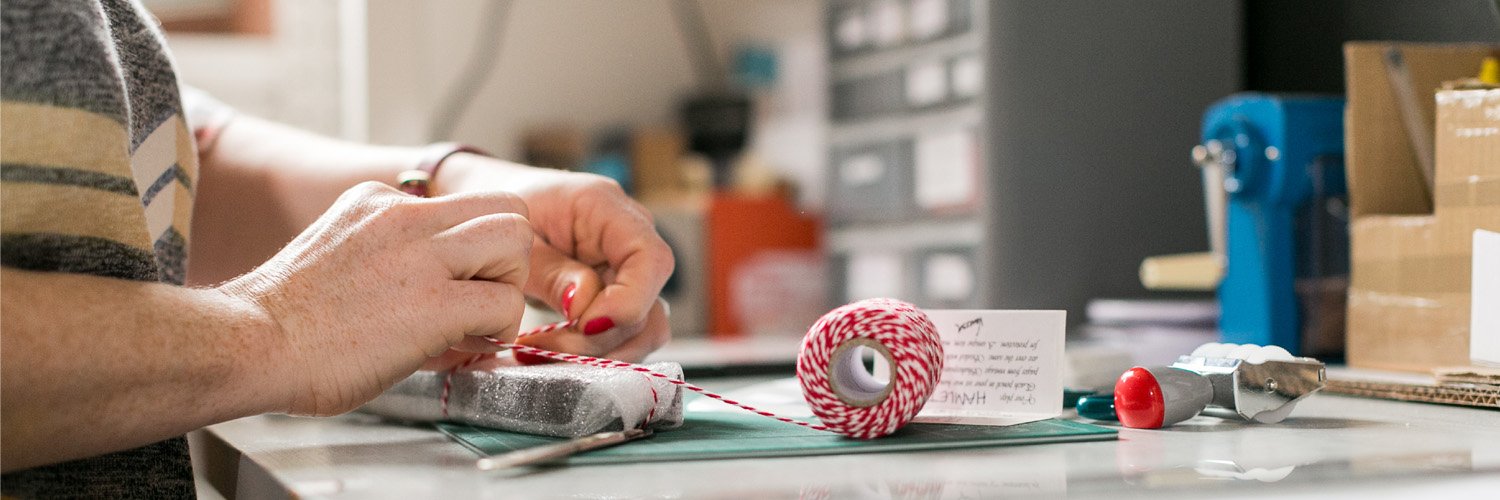
100% @Postvox the increases for international mail are making being a small business owner selling online unsustainable. The last post hike already made it expensive but to go up +€1 to €6 for posting my pencil sets to USA. 😭 And that's untracked!
Why is there no outcry from small businesses regarding @Postvox postal increases today? It's not just 5c on a domestic stamp, they have increased international post by 20% and domestic 100g large envelope by 50c. Small businesses struggling already this is an outrageous attack
Birkenstock IPO’d today at a ~$8B valuation.
Its CEO Oliver Reichert did a massive turnaround in the past decade: sales 5x’d from $125m in 2012 to $1.3B in 2022.
The wildest part: he has zero background in footwear or fashion.
Prior to taking over the top job in 2013, he was a crisis reporter in Africa and an exec at a German sports TV station.
Reichert was introduced to the Birkenstock family in 2009 via an art dealer friend and became an external consultant.
The brand was struggling because the Birkenstock family had three heir sons battling over strategy and control.
Reichert created a plan for two of the brothers to exit the business, which simplified the corporate structure.
Then he went to realize the full potential of the brand:
▫️NEW MODELS: The most iconic Birkenstocks retail for ~$130. In 2015, the company released a water-proof EVA rubber sandal at half the price, $50-60. This sandal now accounts for ~15% of the 30m Birkenstock units sold.
▫️DTC: The website Birkenstock dot com was launched in 2016 and the online channel has gone from 0% to 38% of sales in 7 years.
Birkenstock went wild during the pandemic (work from home boost) and 90% of interest is word-of-mouth (US Birkenstock owners have 3.6 pairs on avg).
He 3x’d the workforce to 4k+ and — even as sales grew 5x — expanded operating margin from 27% to 35%.
For the effort, he owns at least ~5% of Birkenstock (~$400m).
One of the better “consultant comes in and fixes business” stories I can remember.
Not bad for someone who said in an interview with The Cut in 2018, “I don’t give a shit about fashion.”
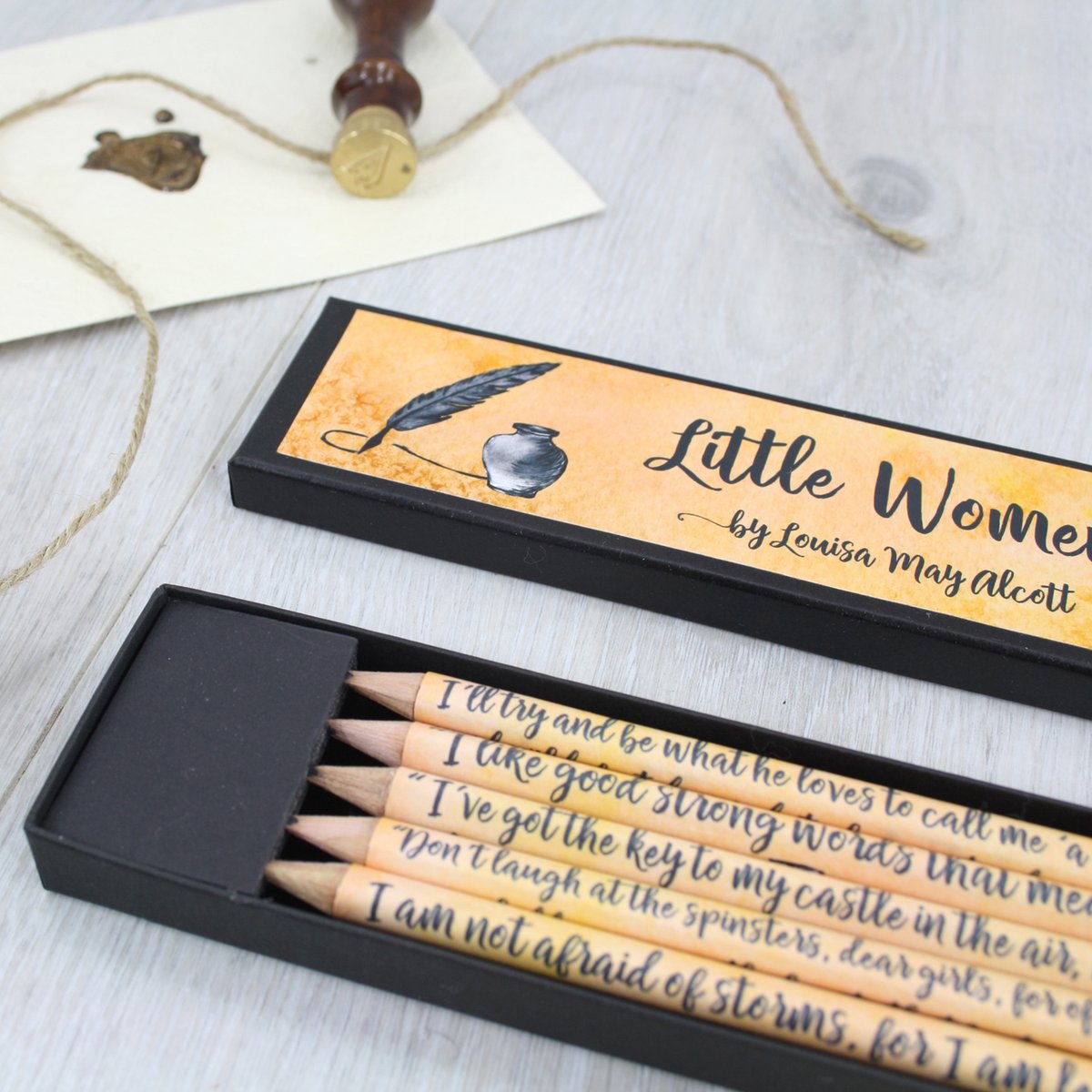
Some literary love for your Friday
Little Women Quote Pencils, Literary Gifts for Girls, Louise M by six0sixdesign https://t.co/W7GA01rHxw via @Etsy#littlewomen#bookgifts
History says,don’t hope On this side of the grave. But then,once in a lifetime The longed-for tidal wave Of justice can rise up, And hope & history rhyme.
So hope for a great sea-change On the far side of revenge. Believe that further shore Is reachable from here,
#Heaney
"Dare not say that man forgets sooner than woman, that his love has an earlier death. I have loved none but you. Unjust I may have been, weak and resentful I have been but never inconstant."~ Jane Austen, Persuasion
(📸 Rupert Penry-Jones as Captain Wentworth in Persuasion 2007)
As we approach the 10th anniversary of his death, here is my favourite #Heaney poem, Postscript:
And some time make the time to drive out west Into County Clare, along the Flaggy Shore, In September or October, when the wind And the light are working off each other .. 1/3
We've teamed up with @AerLingus to celebrate the return of the non-stop route from Dublin to Miami ✈️🇺🇸
You could win return flights to Miami for you & a friend, and it's so easy to enter:
FOLLOW & REPOST
Winner announced Friday, Sep 1.
Good Luck! 🤞
https://t.co/WglAlq9xvU
The unreinforced concrete dome of Rome's Pantheon - a miracle of ancient architecture that survived the fall of an empire. Nearly 2,000 years later, nobody has ever built a bigger one.
The mighty dome, built by the Emperor Hadrian between 119-128 AD, measures 142 feet in diameter - still the largest unreinforced concrete dome ever built. Its most striking feature is a 27-foot wide oculus, completely open to the elements and acting as the building's only light source.
Many believe the oculus once functioned as a giant sundial. Every year at noon on 21 April, traditionally the birthday of Rome, the sun’s rays light up the entrance - the Emperor entering the building on such occasions would have been bathed in sunlight in dramatic fashion.
Most remarkable is the secret to the structure's longevity, itself a fascinating recent discovery. Roman concrete includes calcium carbonate lumps called "lime clasts" - these were previously thought to be the result of poorly mixed concrete, but are now understood to provide "self-healing" properties. Water seeping in through cracks in the concrete has been shown to dissolve the calcium carbonate, creating a solution which then recrystallizes to plug the gaps.
It also boasts several other architectural innovations. The coffered ceiling was intended to reduce the weight of the dome (as did the oculus itself), and the mix of concrete used was exceptionally light by design. It also decreases in density moving from bottom to top, making greater use of lighter volcanic material.
The result is one of ancient Rome's best preserved monuments that will likely stand for several more millennia. It inspired countless architectural feats over the ages since, notably Brunelleschi's dome of Florence Cathedral (1436), although that was built from brick - the ancient formula for concrete being long since forgotten.
It stands today as a testament to the ancient Romans' unparalleled mastery of engineering. It even won the resounding endorsement of Michelangelo, architect of the dome of St. Peter's Basilica, for which he undoubtedly took cues from the Pantheon. Seeing it for the first time in the early 1500s, he called it "an angelic and not a human design".
What the hell is an ampersand and why does it look like that?!
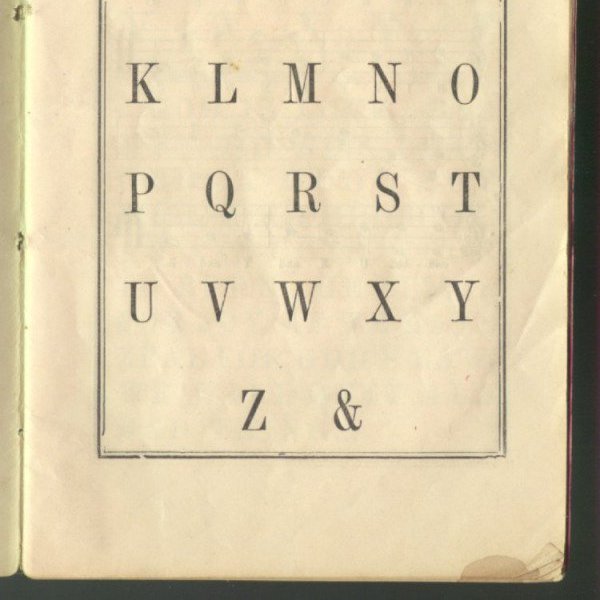
The first thing you need to know is that "&" used to be the 27th letter of the alphabet...
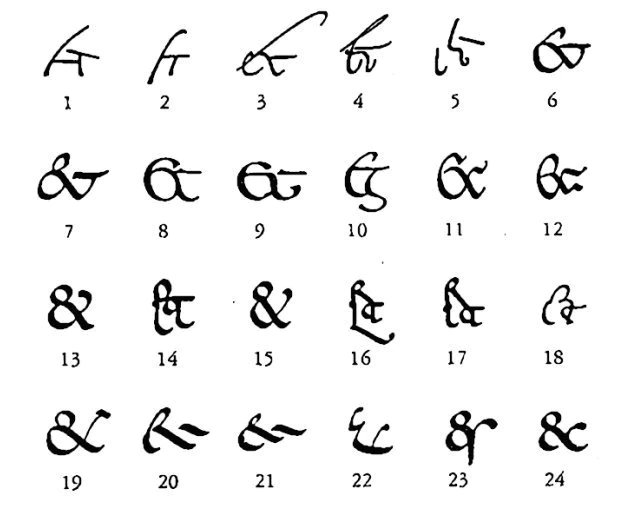
But there are three parts to this story. And the first begins over two thousand years ago in Ancient Rome with a single word: et. It's the Latin for "and". At some point Roman scribes started combining the two letters of et into a single symbol, which was the ancestor of our modern &.
The earliest example of the "et" symbol is actually from graffiti in Pompeii. In any case, it did not disappear with the fall of the Roman Empire.
Latin survived as the language of the Catholic Church and of scholarship in Medieval Europe. Scribes during the Dark Ages continued to use the & symbol. It evolved down the centuries, in places losing any semblance of the letters e and t whatsoever.
The second part of the story is that during the 18th and 19th centuries, as education and the teaching of literacy spread, & was added to the end of the alphabet as a sort of 27th letter.
On a related note, although "et cetera" is now usually just abbreviated as etc., for a long time it was instead abbreviated as "&c". The & was for et and the c for cetera.
The third and final part of the story is about how the alphabet was taught to children — and how it was read out loud.
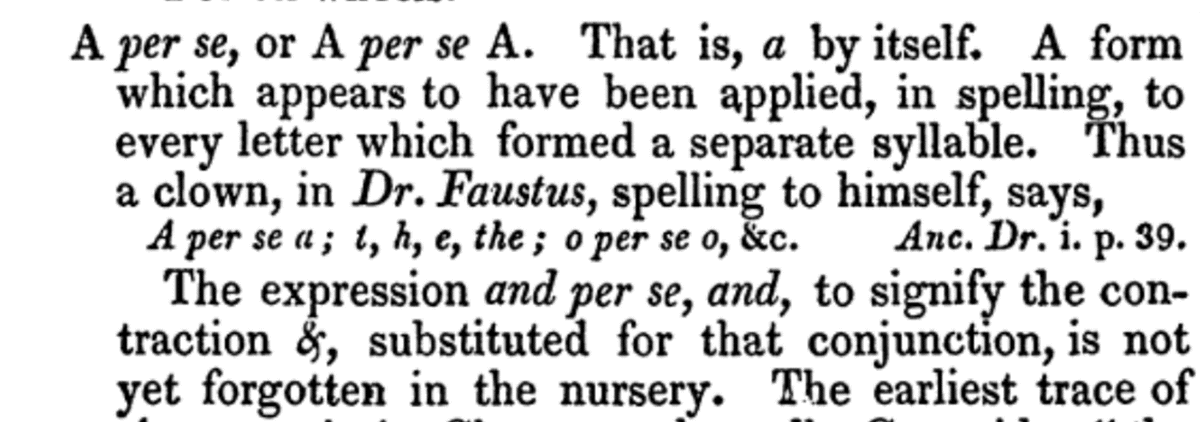
As this 1822 Glossary of Words and Phrases explains, it had been normal during the Renaissance, when speaking the alphabet, to add "per se" before any letter which could also be a word on its own — "per se" means "by itself" in Latin.
Take the letter A, which can also be a word of its own. When reading out the alphabet people would say "A, per se A, B, C, D, E, F, G, H, I, per se I..." and so on. O was also considered a word of its own.
Which means, when people got to the end of the alphabet, with & being the 27th letter, they would say: "S, T, U, V, W, X, Y, Z, and per se &."
When this old way of reading the alphabet was taught to children in the 18th century and they were reciting it aloud, they would garble "and per se " into what eventually became... ampersand.
A Dictionary of Slang and Colloquial English from 1905 relates some of the many other pronunciations school children apparently came up with:
"Ampersand. The sign &; ampersand. Variants: Ann Passy Ann; anpasty; andpassy; anparse; apersie; per-se; ampassy; am-passy-ana; ampene-and; ampus-and; ampsyand; ampazad; amsiam; ampus-end; apperse-and; empersiand; amperzed; and zumzy-zan."
Well, of all the many pronunciations that might have stuck, it was "ampersand" which came to be accepted and is now the official name for &... rather than zumzy-zan. So, from hurried Roman scribes to unruly school children, that's where "&" came from.
The great conflict of my life is being someone with a deep sense of social justice but also with a debilitating fear of confrontation and ALSO a total inability to retain info so if I DID get into a row I would struggle to spit facts even though I know there ARE many many facts
@chrburns@conor_pope It does seem really mena alright, especially given the demographic of who is buying. Lots of parents trying to get tickets for kids. So much pressure on them.