A normal birth can become an emergency‼️
When moments count in an obstetric crisis, things move quickly. What should you expect if you suddenly need an emergency C-section?
Our full video is out now 📺.
#OBGYN#childbirth#Csection#spinal
https://t.co/dlXnXpt1Uu…
Is opi0id-free always safer? 🤔
While opi0id-sparing strategies can reduce harm, there may be:
-drug interactions
-inadequate analgesia
-kidney injury
-bleeding
-delayed recovery
Listen to this #APSFPodcast & tell us how you balance your #anesthesia! ⚖️
https://t.co/UtRNBkvk0L
APSF Annual Conference!
📅 9/ 9–10, 2026
📍 Gaylord Resort, National Harbor, MD
Theme: “🆘 Signals of Safety… Safely across the Patient’s Perioperative Journey”
🎟️ In-person seats are limited & primarily by invitation — but the LIVESTREAM is open!
🔗 https://t.co/IVKtMGdbdY
BIS-guided closed-loop systems hit a superior safety profile — cutting excessively deep #anesthesia without trading it for light anesthesia.
Have YOU used closed-loop systems in your practice? 🤔
#PatientSafety#Anesthesiology
https://t.co/O8krKbtaTv
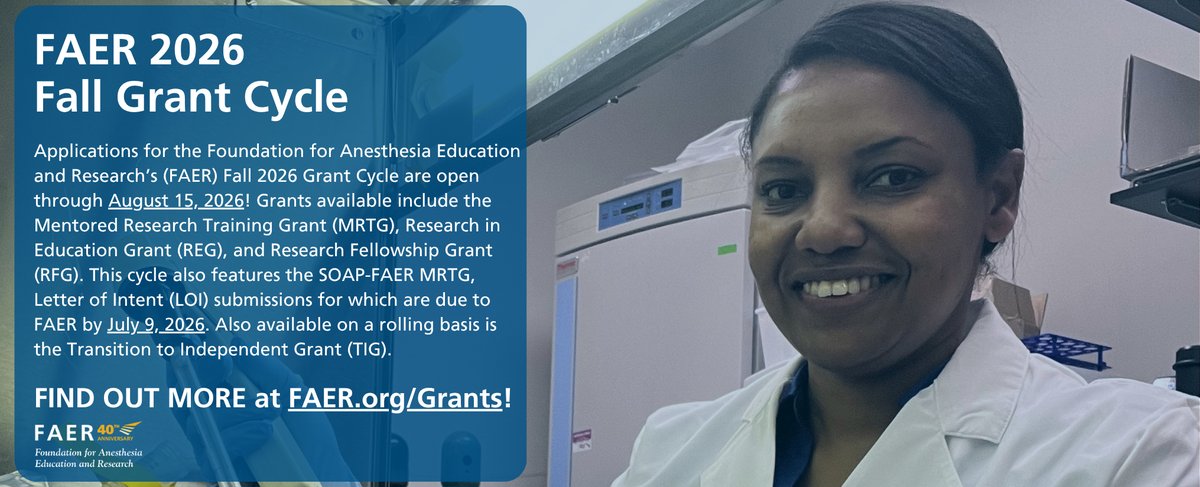
The Foundation for Anesthesia Education & Research Fall 2026 Grant Cycle is underway, don’t forget to submit your research application today & start the academic year off right!
https://t.co/CQ9mADp2Z8
American Society of Anesthesiologists®
#anesthesia@faeranesthesia
22 steps to reach the airway is not a workflow problem—it’s a #patientsafety problem ⚠️
In this #APSFPodcast, learn how one team transformed a cluttered neuro-IR suite into a safer, more efficient NORA workspace using simple, evidence-based redesign.
https://t.co/UtRNBkvk0L
A study of 16,811 #cardiac surgery cases found that patients cared for by the least familiar #surgeon and #anesthesia teams had an odds ratio of 1.9 for operative mortality.
Would you change your assignment patterns based on this information?
https://t.co/WM5axyKYKd
New #APSF editorial:
“A flexible, patient-centered, opioıd-sparing multimodal approach rather than absolute opioıd elimination may better support #perioperative safety and recovery while addressing the complexities of surgical pain management.”
https://t.co/fcr8mioddE
The #anesthesia consent will take an hour if we explain every possible complication of every medication and every event. How much is too much - or too little?
APSF’s @MaxFeinsteinMD discusses with Paul Lefebvre, JD.
https://t.co/lUxPfbYfPr
Your patient is worried about his #surgery and asks you for “something to take the edge off”. Is it a good idea to before the #anesthesia informed #consent?
APSF’s Max Feinstein, MD, finds out with Paul Lefebvre, JD, of Preferred Physicians Medical.
*Not medicolegal advice.*
2,000+ patients. One surprising finding. 👀
#Ketamine vs. #etomidate for RSI in critically ill adults — a new NEJM RCT found no difference in 28-day mortality. But ketamine came with more cardiovascular collapse & lower peri-intubation BPs.
https://t.co/NKs2JIDwb4
#Anesthesia
One birthday party: 90 minutes, 33 infections, 11 deaths. 😳
Person-to-person #hantavirus transmission is rare, but not impossible. A former CDC Epidemic Intelligence Service Officer wrote a Letter to the Editor in the #APSFNewsletter. Are you prepared?
https://t.co/embrCfKzCW