Creative problem-solver blending art & tech. AI consultant, maker, systems thinker & leader focused on impactful, sustainable solutions. #drupal#flowise#snow
17 vibe coding techniques from Cline power users who ship real software
We've been collecting wisdom from the r/cline community, and compiled these power user tips for building actual production software:
1. Let Cline run free at the start. Most users micromanage every decision and end up with Frankenstein code. Instead, let Cline build the scaffolding, then refine the important parts later.
2. Watch your context window like it's your agent's sleep routine. Stretch it too long and you get a dopey coder. Keep under 100k tokens when possible, start sweating at 150k, and create a checkpoint at 170k.
3. Create smaller, modular files. Your context window will thank you, and your code will be cleaner. This is consistently mentioned by our most productive users.
4. Use PLAN mode first. Let Cline see the big picture before diving into implementation. If it needs to read 30 files before making a plan, your prompt needs work.
5. Documentation + logging is the ultimate debugging superpower. Create a logging utility with 5 levels (verbose, debug, info, warning, error) and trace EVERYTHING.
6. When errors happen, crank up logging verbosity and use @ terminal in conversations. Cline reads those massive logs better than you ever could and sees EVERY STEP of execution.
7. Put a README in every folder. Helps YOU understand the structure and gives Cline context without having to @ reference dozens of files.
8. Use @ commands CONSTANTLY. @ terminal, @ problems, @ filepath, @ folder. This provides precise context without bloating your prompts.
9. Design an idiot-proof architecture: clear separation between frontend/API/backend/shared. Build as if planning to rip out any component tomorrow.
10. When refactoring, transform ONE component first, then use it as the pattern. By the third component, Cline will understand the pattern without explicit instructions.
11. Keep tasks SMALL and doable. Extract a "stateless plan" from your planning phase and START A NEW TASK with it.
12. When a task is done, it's DONE - don't add "oh and also do xyz" at the end. This compounds confusion across your codebase.
13. If you get stuck in repetitive errors, start fresh. Repetition in the conversation history creates bad patterns that amplify. 17 instances of "seems like I'm having trouble with the replace tool" will make Cline fail HARDER at replacements.
14. Use different models for different tasks. Complex analysis spanning multiple components? Try Gemini. Specific coding problem? Claude might be better. Need to iterate fast? Maybe Haiku.
15. Stop using adjectives when describing what you want. Use evidence instead. "Make it production ready" = useless. "Ensure it scales to 1000 users with <100ms response time" = actionable.
16. Set boundaries: Create rules ("avoid making changes to these core files"), use comments like "leave this alone Cline", and learn about .clineignore to protect critical files.
17. Remember Cline isn't magic - it's a tool that amplifies your ability to manage complexity. Design for clarity.
Credit to our incredible r/cline community for sharing these insights! Join r/cline if you haven't yet!
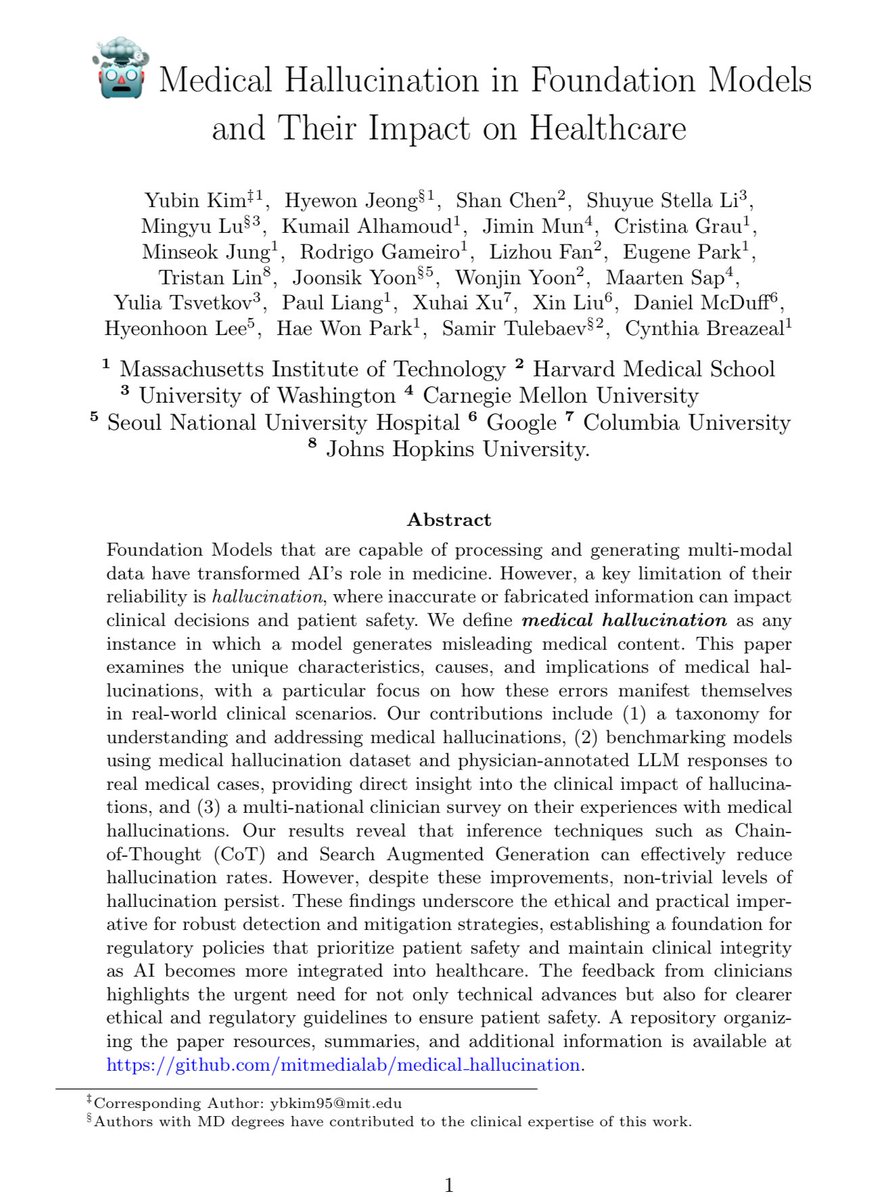
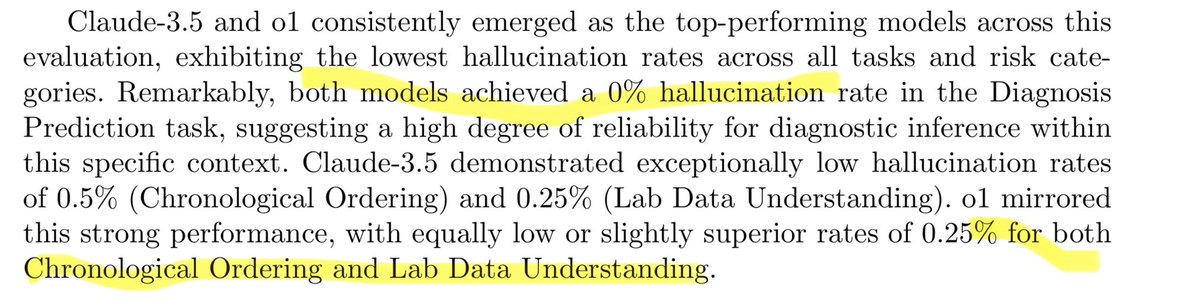
Really in-depth paper on AI hallucinations in medicine, with lots of discussion and analysis about addressing them & what is appropriate for medical use.
But I found this bit on how much more
accurate the latest models have gotten to be interesting (though more study is needed)
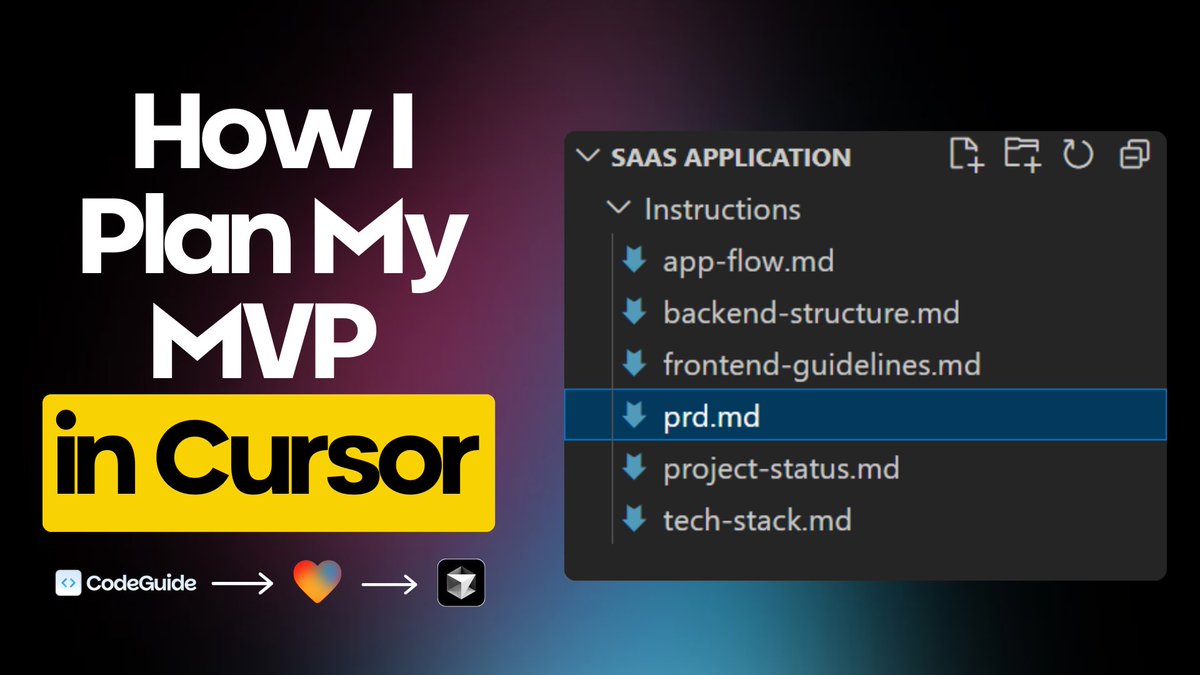
I’ve built 13 MVPs in last 90 days with AI code
The Biggest thing I learned about AI coding is… it needs “Detailed Plan”
Most people jump straight into coding. That’s a mistake.
Documentation is 80% work in AI coding, 20% is to implement.
Here’s how I build my MVPs:
🧵👇
By the way, you can extract JUST the reasoning from deepseek-reasoner, which means you can send that thinking process to any model you want before they answer you.
Like here where I turn gpt-3.5 turbo into an absolute genius!
@leonvz Thanks for all the great Flowise and n8n tutorials you have been posting lately. Would love to see some training around using Flowise and OpenAI Realtime API integration if that's a topic that interests you. I have posted a feature request https://t.co/te9gMsxU5E
Excited to share Cline v3 🎉 You can now auto-approve all actions, limit max # of API requests, and get desktop notifications for when a task is completed! Cline now also uses a flexible diff edit format when working on large files for faster, more reliable edits (no more "// rest of code here" deletions!) https://t.co/ixOpRpB0GC
Cline now uses Anthropic's new "Computer Use" feature to launch a browser, click, type, and scroll. This gives him more autonomy in runtime debugging, end-to-end testing, and even general web use!
Introducing the Studio, our platform for developers to run automations at scale, and Runner H, the most advanced agent to date — designed to navigate web interfaces through pixel-level interpretation and semantic understanding. You can now turn your instructions into action with human-like precision.
lol - getting pizza slice and the guy in front of me (trying to banter with the cashier) is like “you made mine with extra love right” and the cashier very solemnly and Eastern European accentedly said “it’s made with normal amount pepperoni”
Cartocuts soft launched to the Glowforge community forums a week ago and have received some great feedback and responses - follow along https://t.co/Qd14hPzj4d