🦋 Is the butterfly effect why AI-content often feels empty? In complex systems, the starting point shapes everything — the infamous butterfly effect. The starting point for generative AI is random numbers. This seed of meaninglessness then cascades throughout the final result.
So, when making this piano piece with @SunoMusic, I chose a different starting point: A few awkward notes I recorded as a teenager, armed with a Casio keyboard and too many feelings. Now, that seed of vulnerability from the past flutters through this new AI-aided composition.
Imperfect? Yes! But flawed sensitivity beats hollow perfection. Goethe hated wax figures for being too close to what they mimicked, yet soulless. That’s the uncanny valley of AI content: So close; so wrong.
In AI, art, or life—we should start from something real. Especially if it’s strange.
🎶 YouTube Music: https://t.co/TxkOfgOkbZ
🎧 Spotify: https://t.co/IY3jcFL8Lm
🔥 Suno: https://t.co/ZawRjf7cOG
A prominent leader described to me how the future of AI would unfold according to the Hype Cycle.
Two years ago, I noticed a post by @tomfgoodwin calling the Hype Cycle «useless, wrong, and should be wiped off the planet».
I mapped out the similarities between the Hype Cycle and another 5-stage cycle, the 1969 Kübler-Ross Grief Cycle, which oversimplifies the complex and unpredictable into a sequence of denial, anger, bargaining, depression, and acceptance.
Are Hype Cycle-following executives making critical decisions about the future from a framework for mourning the past?
I refused to believe it at first. Then, I grew frustrated. "It is neither scientific nor predictive!". I tried to understand its appeal - portraying the future as a predictable curve is emotionally reassuring. Depressingly, I was getting nowhere.
Ultimately, I accepted that the leader’s mind was set. But we should know better than believing that we predictably follow the stages of a curve.
I had the honor of being interviewed as an ecosystem innovation for the report «The Ecosystem Surrounding Quantum Technology» report by @kongsberg. My contribution is reflected in the closing chapter, «Changing the Narrative» - emphasizing @jhagel's argument that we need to change our narratives about the future, from driven by threat to driven by opportunity.
The media’s take on quantum and AI tends to tilt towards the apocalyptic, causing fear and a defensive approach. To foster innovation, we need opportunity-driven narratives addressing the exponential opportunities in this space.
But an opportunity-driven narrative comes alive through action. What small steps could we take now towards a future of quantum leaps?
📖 Read the full report: https://t.co/9MueOciL9Z
A future of AI unplugged?
Just weeks after DeepSeek dethroned RedBook as the top app, it exposed over a million lines of sensitive chat data. This reinforces my belief that while AI will be everywhere, it won’t always be online.
The future of AI includes choosing what data leaves your device. As @jhagel points out: The quality of AI hinges on our willingness to share data, and the shift of increasing consumer power will continue.
So, as a small 45-minute experiment, I made this chat interface for a small language model running locally on my computer. While it learns from our conversation, it is completely disconnected from the internet—no data ever leaves the device.
After all, when chatting with friends or your partner— the most important factor may not be for them to have “PhD-level intelligence,” but rather their deep understanding of your needs — and knowing that what you say stays between you.
https://t.co/vQ7pZTMdI4
Could physics answer why millions of Americans fearing losing access to TikTok did not migrate to one of the hundreds of social video platforms in the US, but instead to the Chinese app Xiaohongshu? Bringing an app sharing the name of Mao’s “Little Red Book” to #1 on Apple’s App Store?
The Constructal Law introduced by Duke physicist Adrian Bejan points out that all flows in nature—whether water, traffic, or people—seek the channels that can carry the flow fastest. And the fastest structures are the largest.
300 million people are already using Xiaohongshu, but being a giant isn’t enough. The same law also states that to live over time, what carries the flows—the platform—must have the freedom to morph to accommodate what flows through it.
Here, Xiaohongshu has a steep hill to climb. My first visit greeted me with a Chinese interface and posts tributing Mao—signaling that I wasn’t the guest they had in mind. Like the other new tourists on the platform, I’ll be moving on to platforms offering more freedom.
However, the rapid development of generative AI is about to unleash something never seen before in nature: the Morphing Giant. Generative AI will be implemented to instantly tailor the entire experience of platforms for each user, with system learning able to learn exponentially faster from its massive user base. In this hyperspeed evolution, the selection of advantageous mutations takes place in seconds instead of over millions of years.
In Europe, there are currently heated discussions in different camps on banning @elonmusk’s X as well as TikTok, but less so on the following questions:
• After a ban, where will the flows go?
• Who will be the first to address the exponential opportunity of becoming a morphing giant?
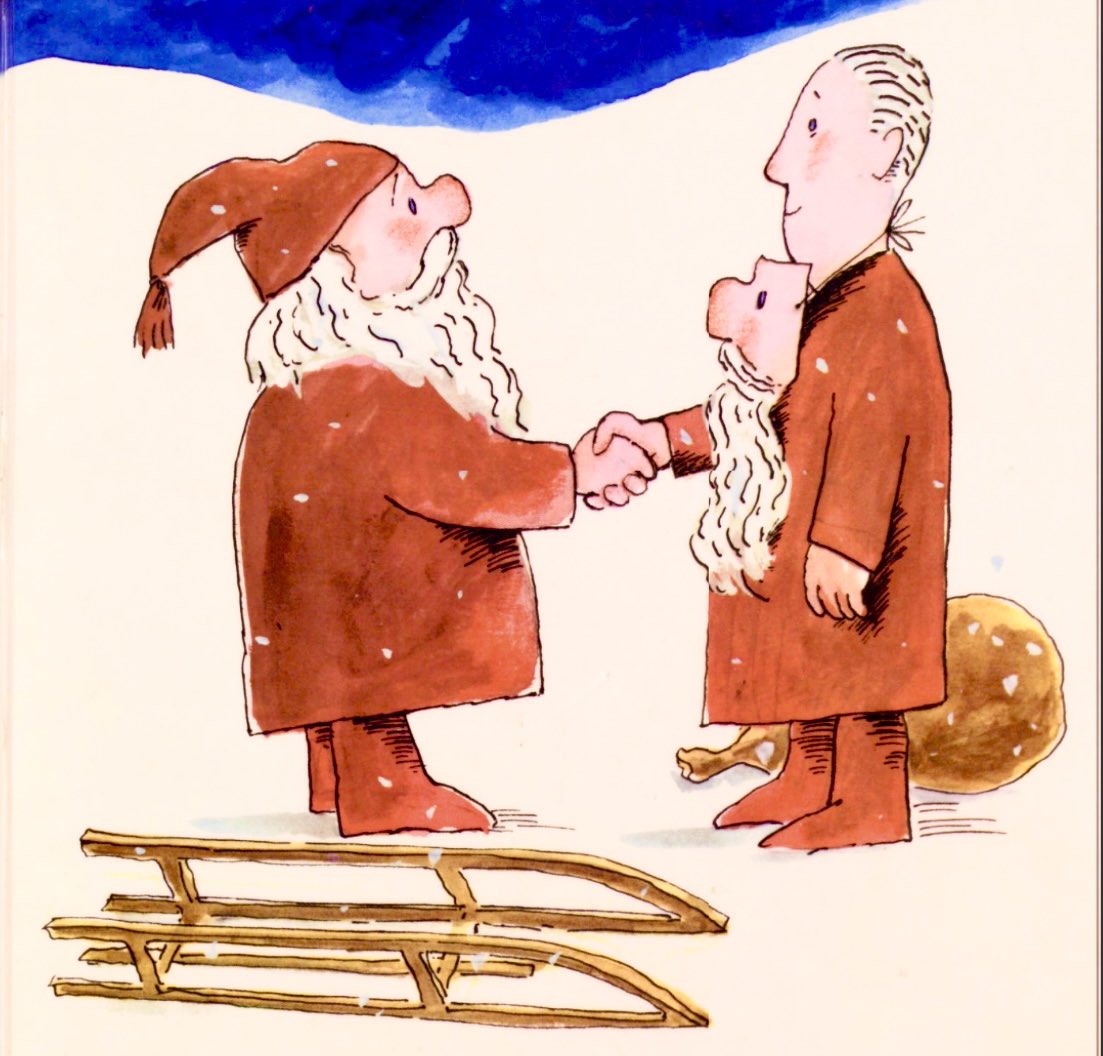
"𝐈 𝐛𝐞𝐥𝐢𝐞𝐯𝐞 𝐢𝐧 𝐒𝐚𝐧𝐭𝐚, 𝐛𝐮𝐭 𝐧𝐨𝐭 𝐚𝐬 𝐨𝐧𝐞 𝐦𝐚𝐧—𝐡𝐞’𝐬 𝐦𝐢𝐥𝐥𝐢𝐨𝐧𝐬 𝐰𝐨𝐫𝐤𝐢𝐧𝐠 𝐭𝐨𝐠𝐞𝐭𝐡𝐞𝐫.” The words of my 7-year-old stuck. If kids can appreciate a network distributed role, are we too attached to narratives about the lone, heroic leader?
I dreamed of being a musician when I grew up. Until I realized I couldn’t do both. But on the side, I coded music - despite the many complaining that "electronic music" was an oxymoron. Combining generative AI and my passion, I produced this song for fun
https://t.co/ejpUYolX5n