Senator, Bomet County; Chairperson, Senate JLAHRC, Member of Speaker’s Panel & SBC. Executive Member- CPA. Advocate of the High Court. Founder- HSF Foundation.
I had the honour of attending Rongo University for its 11th Graduation Ceremony, and the installation of its Second Chancellor, Prof. Eng. John Mosonik,CBS
Congratulations, Prof. @EngJohnMosonik on your well-deserved appointment.
As Chair of the Senate Committee on JLAHRC, I delivered the response to the debate on the National Assembly’s amendments to the Elections (Amendment) (No. 2) Bill. Following the Senate’s rejection of certain amendments, the Bill now proceeds to mediation.
A clear bicameral lawmaking in regards to the NADCO and specifically the IEBC issue; Senate passed the bill, the National Assembly amended the bill and sent it back to senate, the Senate will reconsider & If Senate still disagrees, that is where the Mediation Committee steps in.
🚨In today’s alert, we examine the High Court’s decision on AI regulation in Kenya and what it means for businesses and public institutions deploying AI.
In Wangai & 2 others v Cabinet Secretary, Ministry of Information, Communications and the Digital Economy & 3 others [2026] KEHC 5690 (KLR), the High Court declined to impose a blanket moratorium on high-risk AI systems.
However, the Court also:
Allowed the petitioners to amend their case to identify specific AI systems and affected rights.
Directed government agencies to report on progress towards AI regulation.
Reinforced the importance of regulatory accountability as AI adoption expands.
What does this decision mean for Kenya’s evolving AI regulatory landscape?
In our latest legal insight, our partner @MueniMedrine examines the Court’s reasoning, its implications for AI governance and the considerations for organisations deploying AI.
Read the full analysis on the our website:
https://t.co/UEcKosvxCg
🚨An employee’s absence from work does not automatically amount to abandonment of employment.
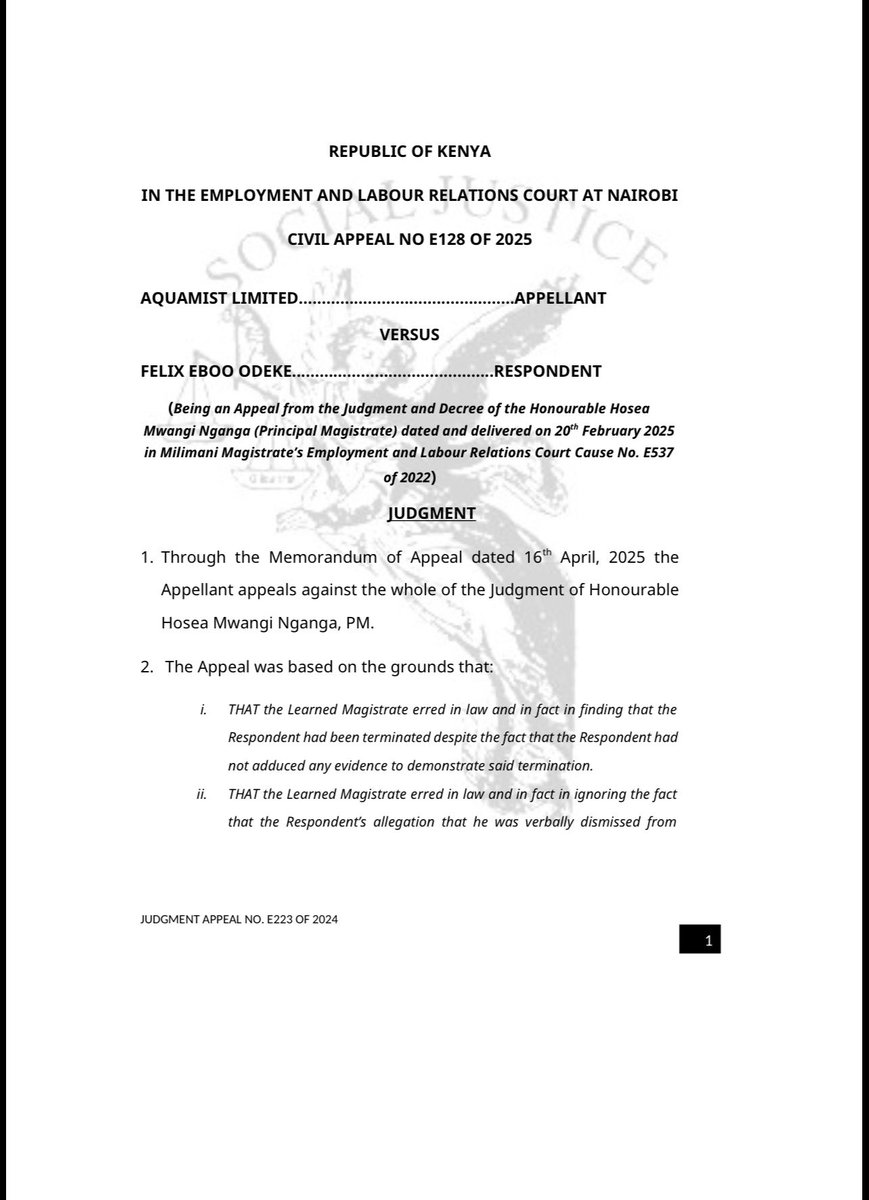
In Aquamist Limited v Odeke [2026] KEELRC 15069 (KLR), the Employment and Labour Relations Court considered whether an employer could rely on alleged absconding of duty to defeat a claim for unfair termination.
Aquamist Limited maintained that its former employee, Felix Eboo Odeke, had stopped reporting to work on 22 March 2021.
The company relied on an attendance register to demonstrate his absence, arguing that he had abandoned his employment.
What did the Court determine?
1. Absence from work does not automatically establish desertion.
The Court distinguished proof of absence from proof that an employee had abandoned employment.
An attendance register could establish that Odeke was absent but did not, on its own, demonstrate that Aquamist had lawfully handled the situation.
2. Employers must demonstrate reasonable efforts to contact absent employees.
The Court found insufficient evidence that Aquamist had attempted to contact Odeke, required him to explain his absence or initiated disciplinary proceedings when he stopped reporting to work.
Correspondence exchanged months later through the Labour Office and advocates did not establish that these steps had been taken at the relevant time.
3. Alleged absconding does not eliminate procedural fairness requirements.
Section 44(4)(a) of the Employment Act recognises absence without leave or lawful cause as potential grounds for summary dismissal.
However, Sections 41, 43 and 45 require employers to establish a valid reason for termination and observe procedural fairness.
4. The finding of unfair termination was upheld.
Justice Abuodha dismissed the appeal, leaving intact the award of six months’ salary as compensation and one month’s salary in lieu of notice.
In Owudu v Digital Sanitation Services Limited [2024] KEELRC 917 (KLR), the Court similarly emphasised that alleged absconding does not automatically terminate employment.
Employers must demonstrate reasonable efforts to contact the employee and address the alleged misconduct through a fair process.
The broader legal and constitutional question
On one side, employers have a legitimate interest in maintaining workplace discipline and addressing unauthorised absences.
On the other side, Article 41 protects fair labour practices, while the Employment Act safeguards employees against unfair termination.
How should courts balance employers’ right to enforce workplace discipline against employees’ right to procedural fairness where absconding is alleged?
Key takeaway: Absence from work may justify disciplinary action, including summary dismissal, but it does not automatically establish abandonment.
Employers should document attendance, attempts to contact absent employees and the disciplinary steps taken before terminating employment.
Follow @Lexken_EMSLaw for practical legal insights on employment law, workplace disputes and labour rights in Kenya.
🚨Court of Appeal quashes a murder conviction and 20-year sentence after finding that a confession was improperly admitted into evidence.
In Belio v Republic, the Court of Appeal examined whether a conviction could stand where the trial court admitted a disputed confession without conducting a trial within a trial.
Jackline Chepkwemoi Belio had been convicted of murder in December 2017.
Her conviction relied on a confession recorded by a police officer, despite objections concerning the circumstances under which it was obtained.
The appellant challenged its admissibility, arguing that the confession was involuntary and had been recorded contrary to statutory requirements.
What did the Court of Appeal determine?
1. A disputed confession requires a trial within a trial.
Where an accused person challenges the voluntariness of a confession, the trial court must determine its admissibility before admitting it into evidence.
The Court found that the trial judge’s failure to conduct this inquiry, despite an objection by the defence, was a material procedural error.
2. Confessions must comply with statutory safeguards.
Section 25A of the Evidence Act regulates the circumstances in which confessions may be admitted.
The Court identified several concerns regarding the appellant’s confession:
The investigating officer was present during its recording.
Evidence indicated that the appellant had been threatened with being handed over to a mob.
Although Kiswahili was the preferred language, the confession was recorded in English.
The record did not adequately demonstrate compliance with the requirements concerning language and reading back the statement.
These circumstances raised substantive concerns about voluntariness, beyond the failure to conduct a trial within a trial.
3. The remaining evidence could not independently sustain the conviction.
After excluding the confession, the Court assessed whether the prosecution’s circumstantial evidence established guilt beyond reasonable doubt.
Applying the principles in Abanga alias Onyango v Republic, the Court found that the remaining evidence did not sufficiently connect the appellant to the offence.
The Court reiterated the distinction between suspicion and proof beyond reasonable doubt.
4. A retrial is not an automatic consequence of an invalid conviction.
Although the prosecution conceded the appeal, it requested a retrial.
Applying Fatehali Manji v Republic [1966] EA 343, the Court considered the nature of the defects, the available evidence, the prospects of a conviction and the interests of justice.
It declined to order a retrial, noting the weakness of the remaining evidence and the substantial period the appellant had already spent in custody since December 2017.
The conviction was quashed, the sentence set aside and the appellant ordered released unless otherwise lawfully held.
The broader legal and constitutional question
On one side, the State has a legitimate responsibility to investigate serious offences, prosecute suspects and secure justice for victims and their families.
Confessions may constitute relevant evidence where they are lawfully obtained and reliably recorded.
On the other side, Articles 49 and 50 protect accused persons against compelled self-incrimination and guarantee fair trial rights.
Allowing convictions to rest on confessions obtained through threats or admitted without the prescribed safeguards risks undermining the reliability and fairness of criminal proceedings.
Key takeaway: A confession must satisfy both procedural and substantive admissibility requirements. Where it is excluded, the remaining evidence must independently establish guilt beyond reasonable doubt. A retrial remains a separate judicial determination, not an automatic remedy.
Follow @Lexken_EMSLaw for practical legal insights on criminal procedure, constitutional rights and evidence law in Kenya.
#LexKenEMSLaw #CriminalLaw #ConstitutionalLaw
Back for the Senate 5th session; the final one this year.
As chair of JLAHRC, i will give a report regarding a petition seeking the re-introduction of the Elections (Amendment) (No. 3) Bill, 2021, to allow candidates to use their popular names on nomination and ballot papers.
🚨 How tall can Nairobi build, and who gets to decide? The Supreme Court has now answered, and its answer is that for years nobody was deciding it lawfully at all.
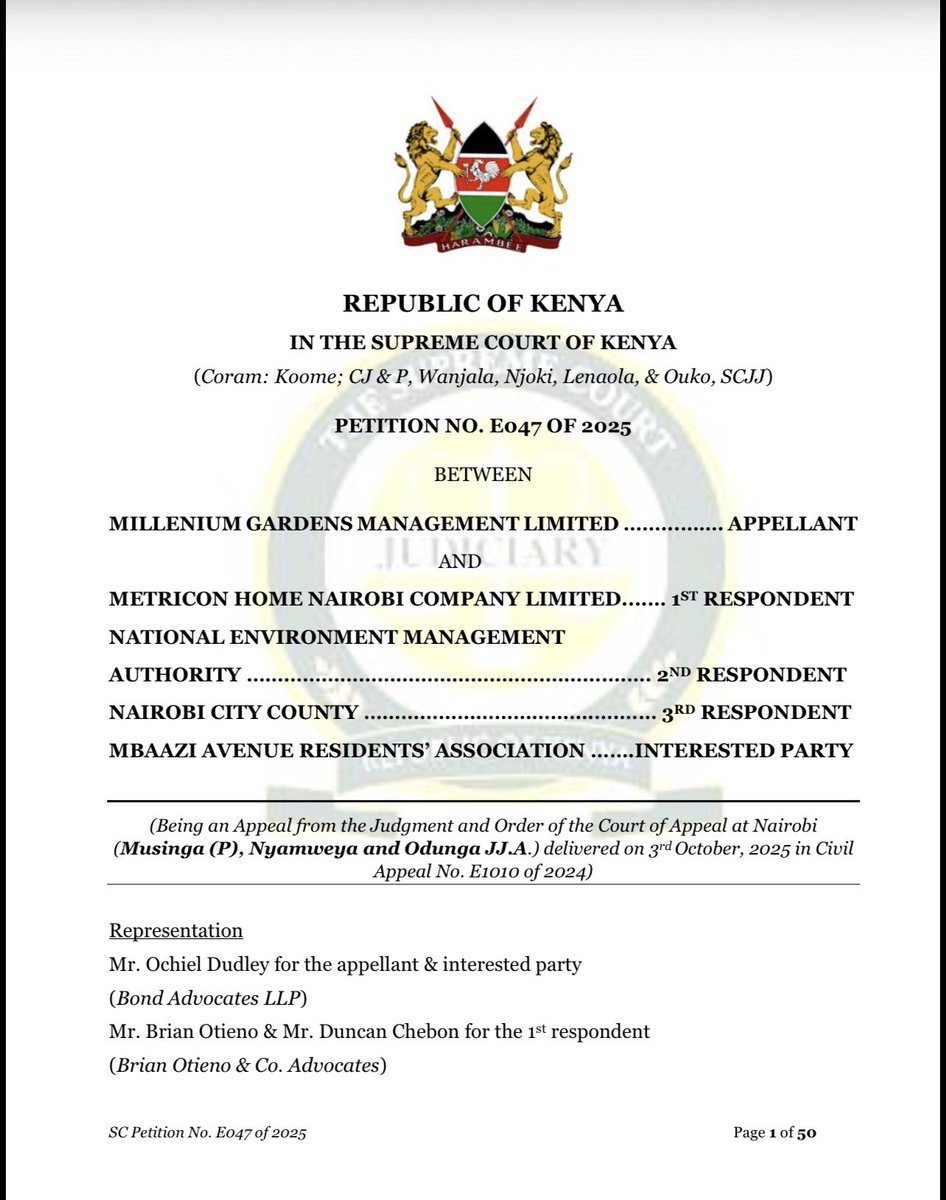
These are two companion judgments delivered together on 30 October 2026: Claire Kubochi Anami & Others v County Executive Committee Member for Built Environment and Urban Planning & Others, Supreme Court Petition No. E044 of 2025, and Millenium Gardens Management Limited v Metricon Home Nairobi Company Limited & Others, Supreme Court Petition No. E047 of 2025. Here is what they mean.
Both cases began with residents objecting to high-rise towers next door. On Rhapta Road in Kilimani, the County and the environmental regulator had approved buildings of 17 to 22 floors in an area residents said was zoned for four. In the Thompson area, a one-acre plot was cleared for three 16-storey blocks holding 512 units beside a low-rise residential property. In both, the approvals had been processed under the Nairobi City Development Control Policy of 2021.
The Supreme Court found the problem beneath all of it. That 2021 policy was never law. It was approved by the governor but never passed by the County Assembly, and never enacted and gazetted as the Physical and Land Use Planning Act requires. It remained a draft. And a draft cannot be the legal basis for zoning an area or setting a building's height.
The consequences run deep. Where a county has no validly approved plan, the Court held, its power to decide development applications on their merits is suspended. A public authority cannot widen its own discretion by failing to put in place the very framework the law requires of it. The courts below had leaned on the idea that the law does not tolerate a vacuum, and used the draft, and in one instance even Google Maps, to fix zones and heights. The Supreme Court set that approach aside. The absence of a law is not a source of power, and zoning is not a matter of impressionistic geography.
But the Court drew an equally firm second line. Courts review the legality of planning. They do not plan. A court can compel a county to zone, but it cannot zone, set height caps or order demolitions in the county's place, least of all where the technical facts are contested. The developers here had obtained every approval in good faith, and the only proven breach was institutional, the County's own failure to legislate. So the approvals were upheld, demolition was declined as a last resort that would punish the wrong party, and the way forward was left as a fresh, lawful review under the Development Control Policy the County has since, finally, enacted in 2026.
The legal dispute worth noting. On one side, residents are entitled to orderly, lawful planning and a genuine voice in it, and a county should not raise towers over a neighbourhood on the strength of a draft it sat on for nearly five years while approving at its own discretion. On the other, developers who secured every licence and built in reliance on them should not lose those buildings because the public authority failed to do its job, and the cost of the State's own default should not be shifted onto the innocent party who trusted its approvals. Where the protection of good planning ends and the protection of good-faith reliance begins is the line these judgments walk.
Key takeaway: development rights must rest on a plan actually enacted and gazetted under the Physical and Land Use Planning Act, not on a draft policy, however widely it has been used. A county that fails to plan cannot cover the gap with discretion, and a court cannot cover it by planning from the bench. Approvals obtained in good faith will usually stand, and the remedy for a planning vacuum is to compel a lawful plan, not to demolish what was built in reliance on the old one.
👉 Follow @Lexken_EMSLaw for practical legal insights on land use, planning and environmental law.
From a constituent college of Moi University to a fully-fledged university early this year, 2026.
Today, i was honored to attend and witness the graduation of Bomet University's first-ever cohort of 712 students.
Congratulations to the Class of 2026!
Sincere condolences to my colleague Sen. @VeronicaMainaW and her entire family for the loss of their father, Mzee Joareph Nduati Kamachu.
It shall be well.
🚨 From 1 November, if your imported cargo is not insured by a Kenyan insurer, it will not leave the port. The Kenya Revenue Authority is enforcing a requirement that has been law for years.
This is the enforcement of mandatory local marine cargo insurance. Here is what it means.
From 1 November 2026, the Kenya Revenue Authority, working with the Insurance Regulatory Authority, will not clear imported cargo unless it is covered by local marine cargo insurance, evidenced by a digital certificate. In practice, no local cover, no clearance.
The requirement itself is not new. The Insurance Act has, since amendments that took effect in 2017, required that goods imported into Kenya be insured by an insurer licensed in Kenya. What has changed is enforcement. For years the rule sat on the books with little effect, and uptake stayed low. Tying it to the customs clearance system, through a digital certificate, is what now gives it teeth.
The purpose is to keep money in the country. Billions of shillings in marine insurance premiums have flowed to foreign insurers, and with them the capital, the jobs and the tax they generate, and the claims that are then fought out in foreign forums. Insuring imports locally keeps those premiums, and that activity, in Kenya.
For importers, the practical effect is contractual, and worth acting on now. Many buy on CIF terms, cost, insurance and freight, where the foreign seller arranges the insurance abroad as part of the price. That arrangement no longer satisfies the law. Importers will need to buy on terms such as free on board, where they take on the insurance themselves, and place that cover with a local insurer. Supplier contracts, and the clearance paperwork, have to be adjusted to match.
The legal dispute worth noting. On one side, this is enforcement of an existing law, and the case for it is real. Keeping premiums onshore builds the domestic insurance industry, retains capital and jobs, and keeps claims within reach of Kenyan courts, where an importer can actually pursue them. On the other side, the change brings cost and friction. Importers must renegotiate long-standing contracts, may face double cover during the transition, and depend on local insurers having the capacity and competitive rates to carry the risk, and blocking cargo at the port can delay trade and push up the price of goods, which consumers ultimately pay. Whether enforcement at the border is the proportionate tool, and how to grow the local industry without raising the cost of imports, is the balance to watch.
Key takeaway: from 1 November, imports need local marine cargo insurance to clear, and a foreign policy bundled into a CIF purchase will not do. Importers should review their shipping terms and supplier contracts now, and arrange local cover, rather than discover the problem at the port.
👉 Follow @Lexken_EMSLaw for practical legal insights on trade, customs and insurance law.
🚨 Court rules that a notice affecting more than five thousand plots cannot stand where it kept the people affected in the dark. Publishing in the Kenya Gazette is not the same as telling them.
This is Ali Hassan Abdirahman & another v National Land Commission & others. Here is what it means.
The case concerned the regularisation and allocation of 5,317 plots in Mandera, a process run through the National Land Commission. Residents went to court arguing that the notice behind it did not tell them what they needed to know, and did not give them a real chance to take part. The court agreed and quashed the notice.
The legal problem was a lack of information. A notice that sets in motion the allocation or regularisation of thousands of parcels must disclose the things that let an affected person respond, which parcels are involved, and on what terms and at what values the transactions are proposed. This notice did not. Without that, there was nothing meaningful for residents to react to.
That failure offends two guarantees. The first is public participation, a national value under Article 10 of the Constitution, which also requires the involvement of communities in decisions about land and natural resources. Participation is only real where people are given adequate information and a genuine opportunity to be heard, and a gazette notice that most affected residents will never see, stripped of the key details, does not meet that standard. The second is fair administrative action under Article 47, which requires proper notice before a decision that affects a person's rights. A process that keeps people in the dark about their own land fails both.
The court did not stop the regularisation itself. It ordered that it be done lawfully. It quashed the defective notice, directed a fresh notification process that meets the legal requirements, and stopped any further steps under the old notice until that is complete.
The legal dispute worth noting. On one side, regularising thousands of plots is a genuine public good. It gives residents security of tenure and formal title, settles long-standing informal occupation, and allows orderly planning, and demanding exhaustive, individual notice for every one of more than five thousand parcels can slow a programme meant to help those very residents. On the other side, a decision that affects thousands of landowners cannot be lawful if it hides which parcels are involved and on what terms, and reaches people only through a gazette they may never read. The ones with the most to lose are entitled to know and to be heard, and transparency is also what guards an allocation against favouritism. Public purpose is not a blank cheque to set the law aside. How much information, and what form of notice, counts as adequate for a mass exercise like this is the line the court is drawing.
Key takeaway: before land is allocated or regularised, the people affected must be given real information, which parcels, on what terms, at what value, and a genuine chance to participate. A gazette notice alone, stripped of detail, is not enough, and a defective notice can be quashed and sent back to be done properly.
If your land is caught up in an allocation, regularisation or public project, the legality of the notice and the process is worth checking early, before steps are taken that are hard to undo.
👉 Follow @Lexken_EMSLaw for practical legal insights on land law, public participation and administrative action.
🚨 A post on X has cost KSh 3 million, and the warning in this judgment reaches not only the person who wrote it but everyone who shares a claim before checking whether it is true.
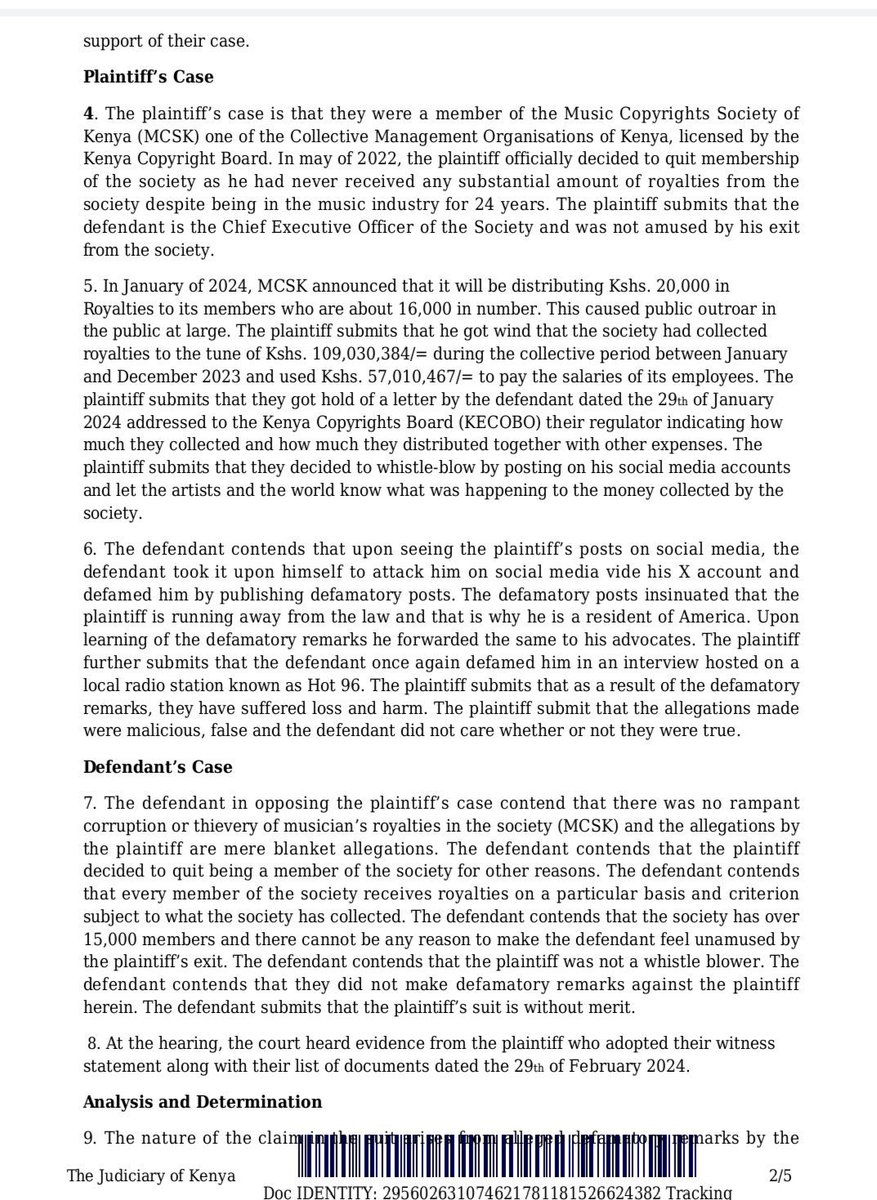
This is the defamation judgment in favour of musician Hubert Mbuku Nakitare (Nonini), delivered by the Milimani Commercial Magistrate's Court on 26 October 2026. Here is what it means.
Musician Nonini sued Music Copyright Society of Kenya (MCSK) CEO Ezekiel Mutua for defamation following a public fallout over music royalty distributions and social media attacks.
The court found that false statements published about Nonini on X had lowered his reputation in the eyes of right-thinking members of society, and awarded him KSh 3 million in damages.
That phrase, right-thinking members of society, is the legal test for defamation. A statement is defamatory when it would make ordinary, reasonable people think less of the person, or expose them to hatred, ridicule or contempt. To succeed, a claimant must show three things: that the statement was defamatory, that it referred to them, and that it was published to at least one other person. Because a written post is a permanent form, the law treats the harm as presumed, and the claimant does not have to prove a specific loss.
There is a complete defence, and it is the one that matters most here. Truth. If a statement is true, it is not actionable, however damaging. That is why the falsity of the statements was central. The remedy exists for false claims, not merely unwelcome ones.
Liability does not stop with the author. In law, anyone who publishes or republishes a defamatory statement to a third party can be sued, and that includes resharing, retweeting or repeating what someone else said. I was only sharing it is not a defence. Each republication is treated as a fresh publication.
The legal dispute worth noting. On one side, freedom of expression is protected by Article 33 of the Constitution, and social media has given ordinary people a voice they never had before. Large awards for online posts can make people afraid to speak, to criticise the powerful, or to raise matters of public concern, and public figures must accept a fair amount of hard scrutiny. On the other side, Article 33 is not unlimited. It does not protect a reputation-destroying falsehood, and the Constitution itself requires respect for the reputation and dignity of others under Articles 33 and 28. A lie that reaches thousands in seconds can do lasting harm, and a person whose name is damaged is entitled to a remedy. Where the line falls between robust, protected speech and an actionable falsehood is the question every post sits near.
Key takeaway: publishing a false and damaging statement about someone can cost you, and so can sharing one. Truth is a defence, verification is protection, and a repost is still a publication in the eyes of the law.
👉 Follow @Lexken_EMSLaw for practical legal insights on defamation and online speech.
To fellow parents whose kids started their KJSEA, KPSEA and KILEA Assesments exams, pass my wishes!!
This current School-Based Assessment (SBA) model is a good example of how Kenya's assessment system has moved away from the old one-big-exam approach. In this model, it is spread over 3 years, meaning a 'bad' day no longer decides a whole future.
🚨 The death sentence for robbery with violence can no longer be automatic. The High Court has struck down the part of the law that forced it on every offender, with no room to weigh the person or the circumstances.
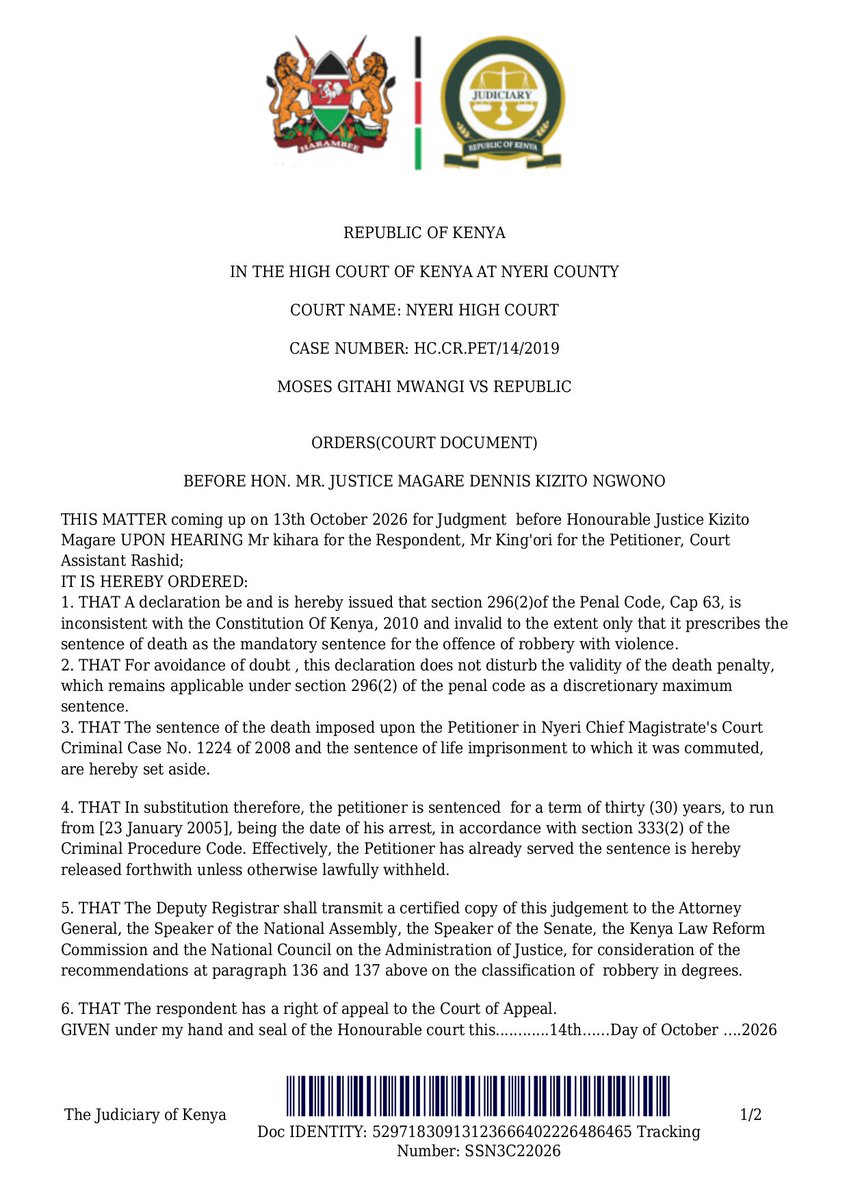
This is Mwangi v Republic [2026], in which the High Court declared Section 296(2) of the Penal Code unconstitutional to the extent that it makes the death sentence mandatory. Here is what it means.
Robbery with violence under Section 296(2) carried a single, fixed punishment, death. Whatever the facts, whatever the offender's age, role or history, the court had no choice. On conviction the sentence was death, and mitigation made no difference. The High Court has held that this is unconstitutional, not the offence and not the death penalty itself, but the part of the section that removes the court's discretion.
The reasoning runs through dignity and a fair trial. A sentence must fit both the crime and the person who committed it. When the law forbids a court from listening to mitigation and tailoring the punishment, it treats every offender as identical and strips the sentencing stage of meaning. That offends the right to a fair trial under Articles 25 and 50, which includes the right to be heard on sentence, and the right to human dignity under Article 28.
The decision follows the path opened by the Supreme Court in Muruatetu v Republic, which in 2017 struck down the mandatory death sentence for murder for the same reason. Here is the complication. In 2021 the Supreme Court issued directions clarifying that Muruatetu applied only to murder, and not automatically to other offences that carry the death penalty, including robbery with violence. Courts have since divided. Some have confined Muruatetu to murder, as directed. Others, like the court here, have held that the same constitutional logic applies with equal force to Section 296(2), because a mandatory sentence is no less a mandatory sentence when the offence is robbery.
What changes is the sentence, not the verdict. The conviction stands. The death penalty remains lawful and available. What the court gains is discretion, the ability to hold a proper sentencing hearing, weigh mitigation, and impose death or a lesser, individualised sentence as the case deserves.
The legal dispute worth noting. On one side, a mandatory penalty delivers certainty and equal treatment, and reflects a choice Parliament made that a grave and often brutal crime should carry the gravest punishment, and the Supreme Court's own 2021 directions confined Muruatetu to murder. On the other side, justice is meant to be individual, and a sentence passed without any room to consider the offender cannot easily be called fair, so it would be hard to defend striking the mandatory death sentence for murder while keeping it for robbery on the very same reasoning. Whether the extension to Section 296(2) is correct, and how the divergence between courts is resolved, is a question the higher courts will need to settle.
Key takeaway: in the view of this court, the death penalty for robbery with violence is no longer automatic. Mandatory sentencing is the target, because it denies the discretion that a fair and proportionate sentence requires. The offence and the penalty remain, but the choice now returns to the judge.
👉 Follow @Lexken_EMSLaw for practical legal insights on criminal law and sentencing.
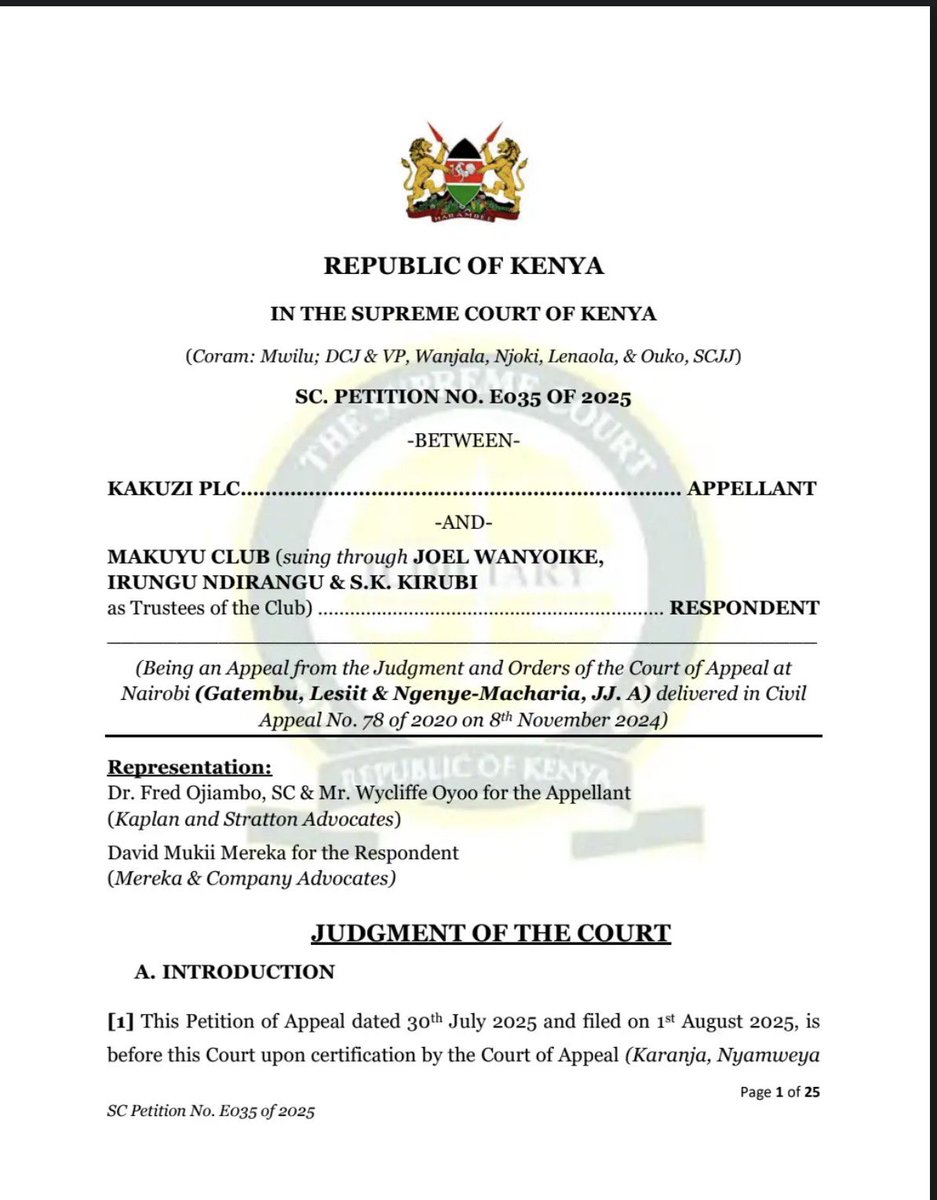
🚨 The Supreme Court provides clarity on adverse possession: a title deed alone will not save you. If someone occupies your land and you do nothing effective about it for 12 years, you can lose that portion, even where the occupation began as a gift.
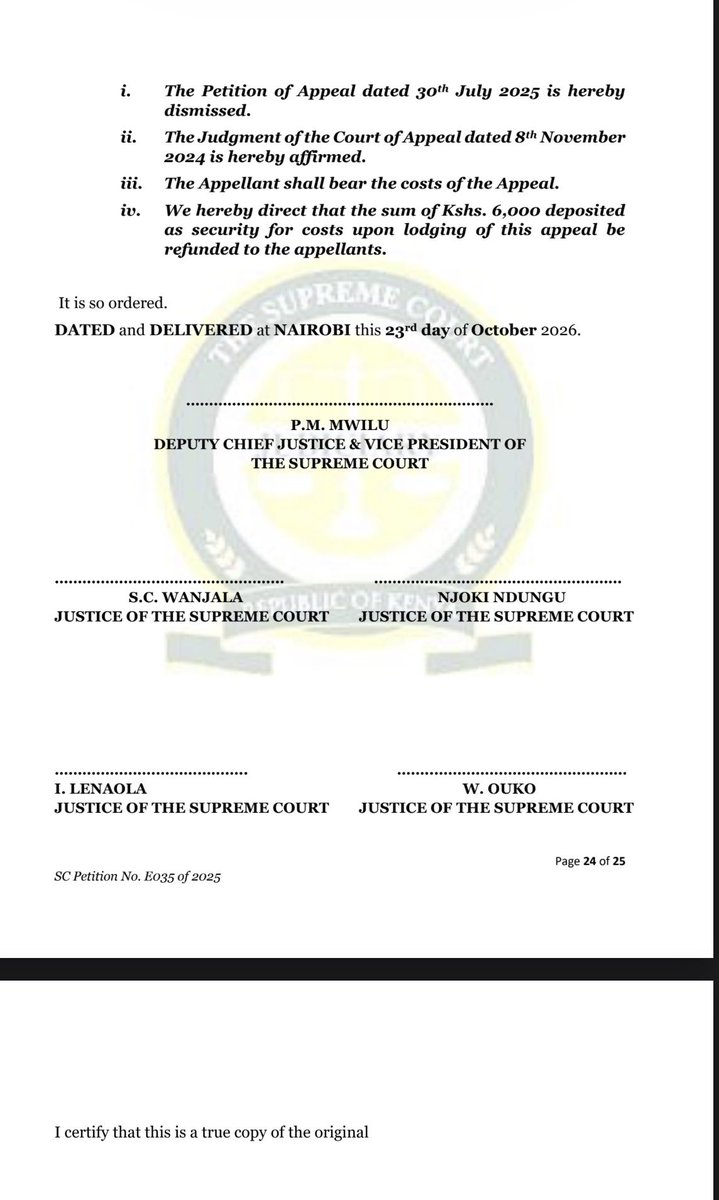
This is Kakuzi PLC v Makuyu Club, Petition No. E035 of 2025, decided on 23 October 2026. Here is what it means.
In 1934, settlers donated about 70 acres to Makuyu Club for a golf course. The Club built greens, a clubhouse and a borehole, and used the land openly ever since. The land later came into Kakuzi's ownership, by a grant to a predecessor in 1966 and a transfer to Kakuzi in 1967. The Club eventually claimed the portion by adverse possession. Kakuzi resisted, arguing that the Club had always been there by permission, so time could never run against it. The Supreme Court dismissed Kakuzi's appeal and confirmed that the Club had acquired the land.
The doctrine starts with Section 7 of the Limitation of Actions Act. An owner who does not act to recover land within 12 years of the right accruing loses the right to recover it. The occupier must be in open, peaceful and exclusive possession, without the owner's permission, intending to possess the land.
The hard question was the gift. A donation carries permission, and permission and adverse possession cannot sit together, so while the donor's consent lasts, time does not run. But this gift was never transferred and registered to the Club, which left it incomplete. The Court held that an incomplete gift does not bind a later owner. When ownership changed, the permission lapsed, and because the Club no longer had the true owner's consent, time began to run against the new owner from the date Kakuzi acquired the land in 1967.
From there the case turned on what an owner must do to stop the clock. The Court was firm. To interrupt time, an owner must take an unequivocal act, physically re-entering the land, dispossessing the occupier, or obtaining a formal acknowledgment of its title from the occupier. Mere knowledge of the occupation, letters, notices or quiet acquiescence do not count. Kakuzi did none of the effective things for about 35 years. Its attempt to formalise the Club's use through a lease came only in 2002, long after the 12 years had run, and it could not revive a title that was already gone.
The legal dispute worth noting. On one side, this can look harsh on a paper owner, especially one who tolerated a long-standing community use out of goodwill, and it puts buyers of large parcels on notice that land occupied by others can be lost if they do not act. On the other side, the law has long preferred certainty and the active use of land over titles left idle on paper, and it expects an owner to be vigilant, to assert ownership by real acts rather than passive tolerance. An owner who watches someone occupy land for decades and does nothing effective cannot later rely on the register alone.
Where the balance should fall between the security of registered title and the reward for vigilance and productive possession is the enduring question behind the rule.
Key takeaway: a gift that is never completed by transfer and registration does not bind a new owner, and time for adverse possession can run against that owner from the day they acquire the land. To stop it, the owner must act unequivocally within 12 years. Knowledge and correspondence are not enough, and inaction can cost an owner their title.
👉 Follow @Lexken_EMSLaw for practical legal insights on land law and adverse possession.
Such proposals from HE @WilliamsRuto will go a long way toward supporting the common mwananchi, i.e., easing the burden of stamp duty when getting a title deed and enjoying all its advantages, such as getting loans from banks. Parliament should expedite such proposals.
With the President's proposal on Mashujaa Day, 2026; to scrap PAYE for workers earning Ksh 32,333 or less heads to Parliament, nearly half of PAYE payers stand to benefit.