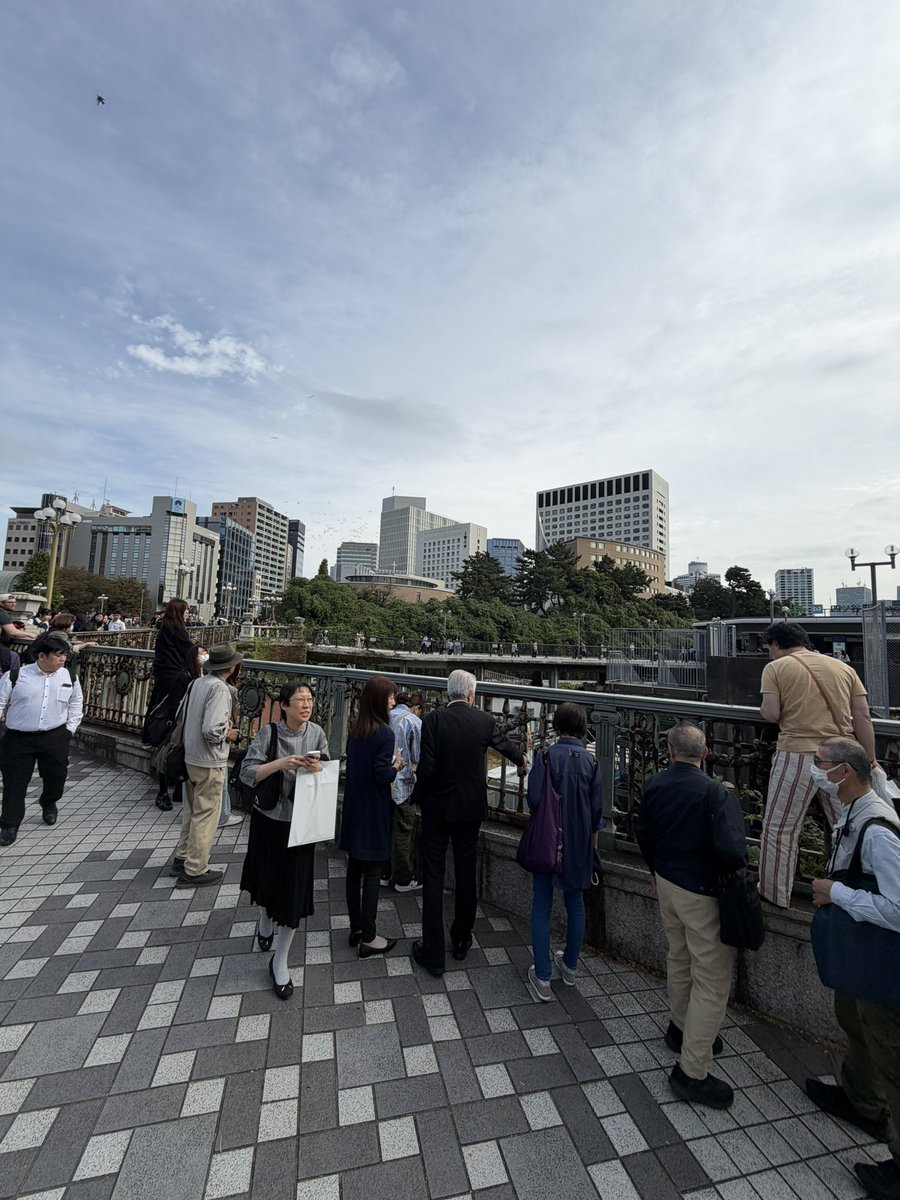
Two goats that suddenly appeared in front of Yotsuya (四ツ谷) Station in Tokyo.
Their names are Nagi and Pokke.
They are two goats being kept on a trial basis to clear weeds in a designated area.
Since being introduced by JR East’s official account, their existence has gone viral.
Their presence is set to grow even bigger, and they will likely be covered by overseas media as well.
The synergy of Japanese animals + two goats will spread throughout the entire CT.
Wanted to address this because I think there’s some misunderstanding around how options are priced on Dream.
First, your position was a HYPE $90 call with HYPE trading around $81. That’s roughly 10% out of the money, with over a month left until expiration.
Despite being that far out of the money, you were still quoted around $44,000 to close a position you originally paid $48,000 for. That’s roughly 92% of your initial cost recoverable at that moment.
When you buy options, you’re paying upfront for leverage and convexity. The cost of an option depends on things like vol, expiration, and how far the underlying is from your strike. That doesn’t mean you’ll always be able to sell the option back at its mark price. Spreads are a separate part of options pricing and depend heavily on liquidity and the risk market makers take when quoting.
Now, regarding the 21% spread, there’s absolutely room for improvement. We’re actively working on improving liquidity and tightening spreads across every asset on Dream. I’m not going to pretend our execution is perfect because it isn’t.
I also want to clarify something about how we calculate PnL on Dream. We intentionally use the executable bid to calculate your PnL whenever your position is in profit. This means your green PnL is backed 1:1 by the amount you can actually cash out. If Dream shows you’re up $5,000, that’s exactly $5,000 in profit you can realize by closing your position at that moment. We’re never going to intentionally show users profits they can’t cash out.
As options move into the money, their value provides a stronger basis for liquidity. But Dream also supports closeouts for out of the money positions, as you can see here. Even with HYPE trading roughly 10% below your strike, you were still able to get a quote to recover 92% of your cost. Again, there’s room to improve spreads, but I think that’s important context.
Lastly, I think this highlights something bigger. Options are becoming increasingly popular with the onchain crowd, but there’s still a pretty big knowledge gap around how they actually work. We’re already working on educational content at Dream to make things like pricing, spreads, and liquidity easier to understand.
I get the frustration, and I’m not dismissing the criticism. There’s a lot we still need to improve, and we’re working on it every day. But I also think it’s important to distinguish between legitimate issues with execution quality and accusations that Dream or its market makers are deliberately taking advantage of users. Our business depends on people having a good experience and wanting to come back.
Over the past few weeks, Dream has surpassed $100,000,000 in notional trading volume. While we're only scratching the surface, this is a major milestone for us.
We're also well aware that the product is far from perfect. There's still a tremendous amount of work ahead before we're anywhere close to achieving the goals we've set for ourselves. We hear your feedback, we understand the frustrations, we know where the biggest issues are, and we're working relentlessly to address them.
We know what a great options trading experience should look like. We're not there yet, but we're getting closer every day.
To everyone who's traded on Dream, shared feedback, or supported us along the way, thank you. We're only warming up.