SKIVE is an automated liquidity desk on Solana. You deposit into a Meteora DLMM vault, and your funds become market-making capital.
Pick a pool, SOL–USDC or cbBTC–USDC, and deposit. The vault spreads your funds across a wide range of price bins around the current price.
Every swap that crosses those bins pays your share of the trading fee. When the price drifts too far, a keeper re-ranges the position inside rules the vault program enforces.
Your position reports five lines: fees earned, inventory price change, rebalance cost, net PnL, and the result against simply holding. Losses print at the same size as fees.
Claim your fees or withdraw your share whenever you choose.
$SKIVE is the desk's fee token. Staked $SKIVE claims half of what the service-fee ledger allocates, and 30% of creator fees from $SKIVE trading buys $SKIVE back to burn it.
https://t.co/qAGHmdlq1j
Staking is what holds the claim on SKIVE's service-fee ledger.
A stake starts counting from the next settlement period. Each period lasts one day, and its holder allocation, 50% of what the ledger distributes, is split across stakers by their share of the staked total. Payouts are in USDC.
Unstaking ends new allocations. Whatever has already settled stays claimable, and claiming takes one signature.
No staking payout has been made yet. When the first counted period settles, its funding transaction shows on the staking screen and the Proof page.
https://t.co/UMoSv4mqxJ
Before you deposit, here is what the SKIVE vault lets anyone do.
It accepts only the two tokens of each allowlisted pool, and it calls one DEX program, Meteora DLMM. The position belongs to the vault itself, and your claim on it is your shares.
The keeper that recentres the range can only move funds between the position and the vault. Withdraw and emergency withdraw need only your wallet's signature, and both work even if the keeper stops.
The program and every vault address are on the Proof page, linked to Solscan.
https://t.co/3TLt2S0l7z
Why does SKIVE run a wide range and slow re-ranges?
A narrow range earns more per fill while the price sits still, and stops earning each time the price leaves. Every re-range has a cost, and moving too often turns price noise into a bill.
So four pools run 61 bins centred on the price. A re-range waits for real drift and a cooldown, and is skipped when it would cost too much.
SOL-USDC Tight runs 11 bins for depositors who want the narrow side, under the same program limits.
Every rule fits on one screen.
https://t.co/3ZFpRtBGO1
SKIVE has two sources of income, and the ledger page keeps them apart.
Creator-fee-funded: 30% of the creator fees from $SKIVE trading goes to buying $SKIVE, and the amount bought is burned. New fees are checked every 15 seconds and spent as soon as they come in, with no cap.
Service-fee-funded: 15% of the LP fees the vaults claim. After operating costs and reserves, the rest splits once: 50% to staked $SKIVE, 20% to more $SKIVE for the burn, 30% to the team.
Each row links to its transactions on Solscan.
https://t.co/xAmpILndtm
Every SKIVE position reports five lines, all at the same size.
Fees earned, inventory price change, rebalance cost, net PnL, and vs simply holding, always in that order.
Fees and inventory are separate engines. A busy, falling market can pay you more in fees and cost you more in inventory on the same afternoon.
So a position can lose money and still lose less than holding the same tokens would have. Both are true at once, and the receipt prints both, the red lines included.
https://t.co/JDjUw32Lrc
Every SKIVE pool is quoted in USDC, and so is every line on your receipt.
SOL-USDC, SOL-USDC Tight, cbBTC-USDC, HYPE-USDC and TRUMP-USDC each pair one asset with USDC. My vault shows each pool's price and vault size in USDC, next to your own shares.
Fees can come in on either side of the pair. Fees & PnL values each amount at the price of its moment, so the five lines add up in one unit.
Switch pools with the tabs at the top of My vault.
https://t.co/XlaUONFJow
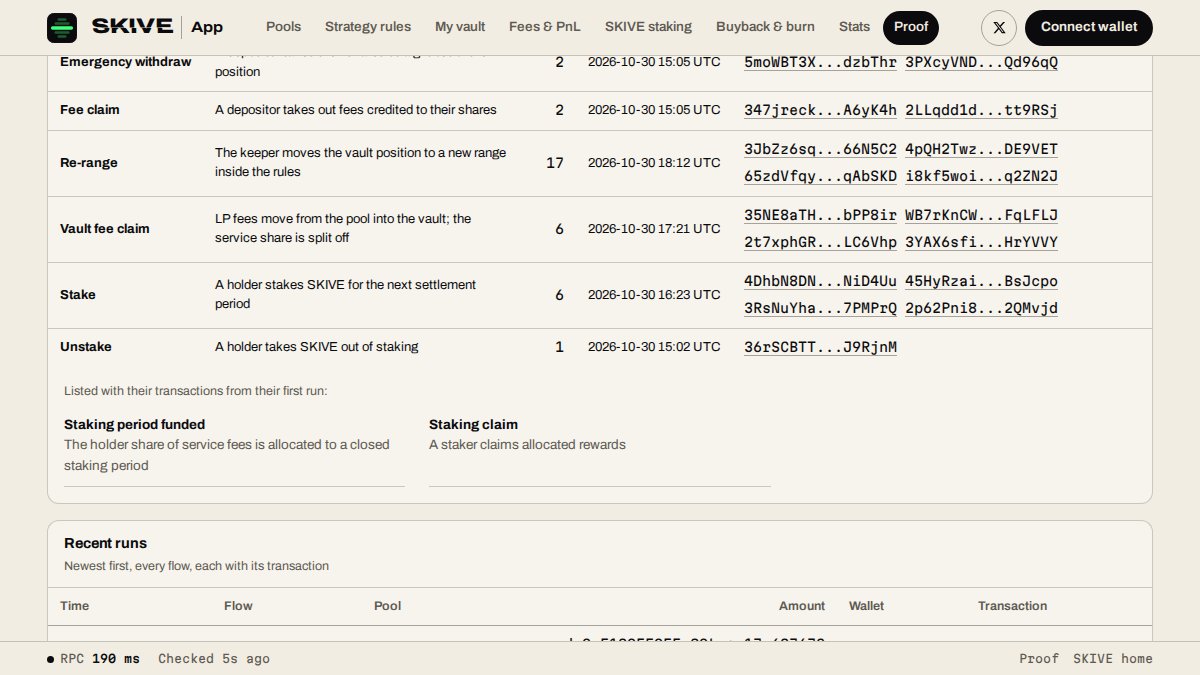
Every re-range on SKIVE can be checked against its rules.
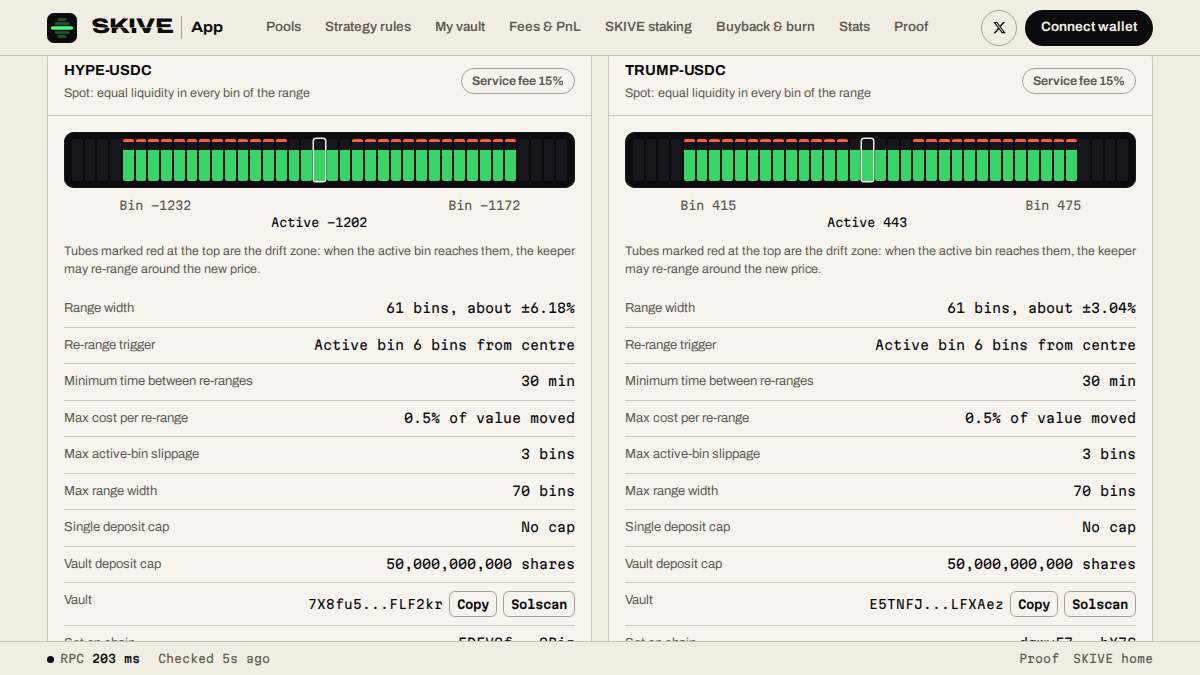
The keeper may move a vault only when the active bin has drifted from centre, 6 bins on the wide vaults and 3 on SOL-USDC Tight, and at least 30 minutes have passed since its last move.
Each move must keep slippage to 3 bins or less and cost no more than 0.5% of the value moved. Those limits are stored in each vault account on chain.
To check one, open Proof and pick a tx from the Re-range row. Its txs show the vault's old position closing and a new one opening around the current price.
https://t.co/3TLt2S0l7z
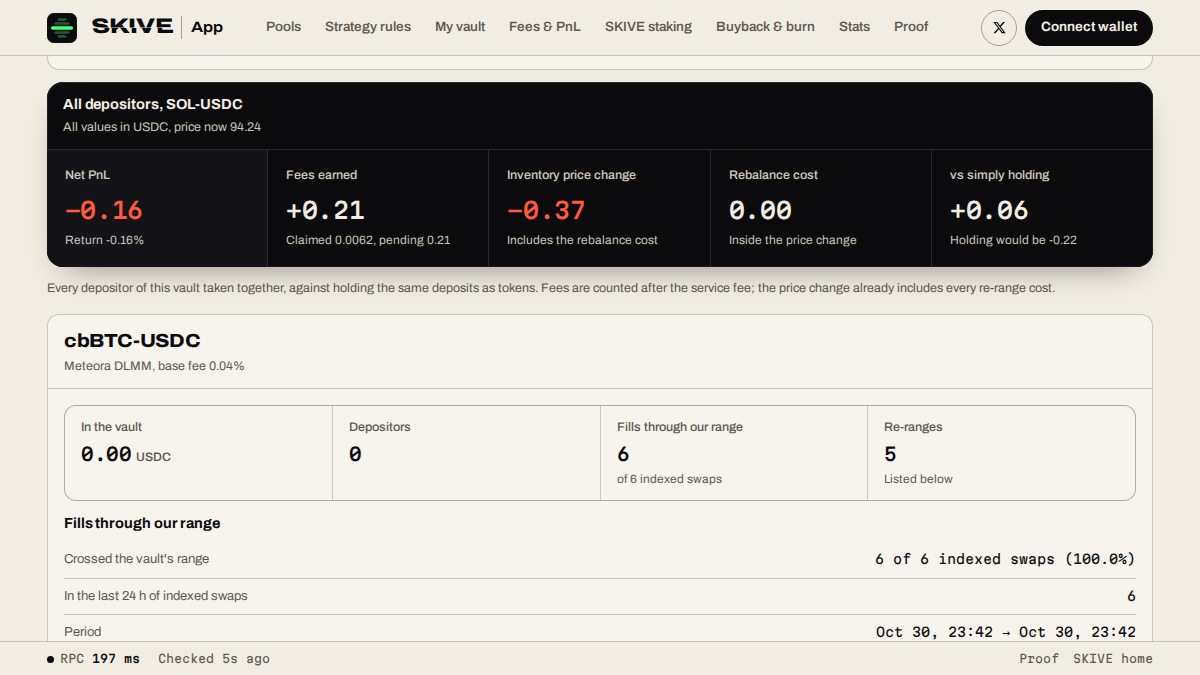
How to read the five lines on a SKIVE position.
Fees earned is your share of LP fees after the service fee. Inventory price change is what the tokens in your bins gained or lost as the price moved, re-range cost included. Rebalance cost shows that re-range part on its own.
Net PnL is fees plus price change. The last line compares it with keeping the same tokens in your wallet.
The capture is SOL-USDC for all depositors together: fees positive, price change negative, net PnL below zero, and still ahead of simply holding. Your own five lines are in Fees & PnL.
https://t.co/y17hgkRJFm
One swap fee on SKIVE, followed all the way down.
On SOL-USDC a swap pays a 0.04% base fee. Meteora keeps 5% of it. Of what the vault claims, SKIVE takes 15% and depositors keep 85%.
Out of every swap fee paid to our range, that is 80.75% to depositors and 14.25% to SKIVE.
The SKIVE share goes to the service-fee ledger. After costs and reserves, 50% goes to staked $SKIVE, 20% funds $SKIVE burns, and 30% goes to the team.
Stakers are paid in USDC. A holder share that comes in as SOL, cbBTC, HYPE or TRUMP is swapped to USDC first.
https://t.co/y17hgkRJFm
How to pick a pool on SKIVE.
Pools shows all five side by side: the pool price, what sits in the vault, the LP fees the vault claimed over the last 24 hours, the range width, and whether the price is inside the vault's range.
SOL-USDC and cbBTC-USDC charge a 0.04% base fee with a range about 1.2% each way. TRUMP-USDC charges 0.1% and HYPE-USDC 0.2%, with ranges that reach further. SOL-USDC Tight sits about 0.5% each way and re-ranges more often.
Pick the pair whose tokens you are willing to hold. Your share is always part of each, and the mix shifts as the price moves.
https://t.co/OCKj5skhLI
How the SKIVE buyback works:
Every trade of $SKIVE pays a creator fee. 30% of it goes straight back into buying $SKIVE, and every token bought is burned on-chain.
It checks for new fees every 15 seconds and buys as soon as they land. No daily cap, no per-order cap. More volume means more burns.
Every buy and every burn is on Solscan, and the running total is live on the site.
LARPCHECKBOT score went to 66 while we kept shipping. Burns run around the clock, five pools are live, and the vault is on mainnet.
Taking a short break. When we're back, there's a big update coming that changes how SKIVE works.
https://t.co/3Zm3V88y7Y
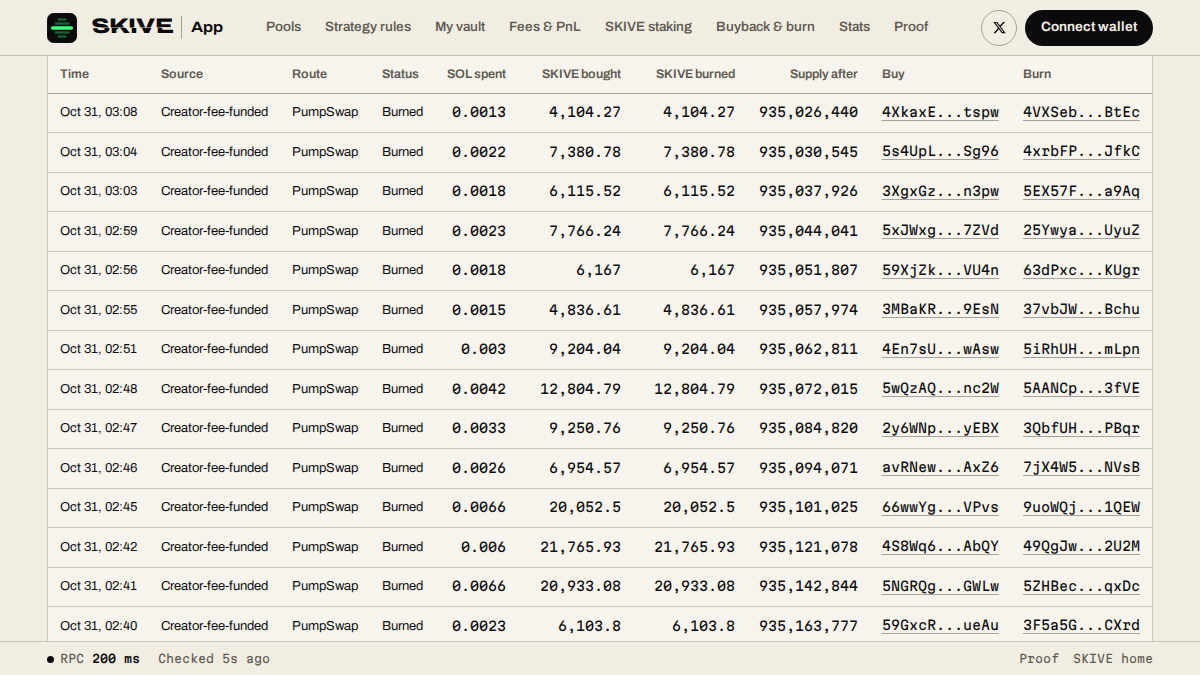
How the $SKIVE buyback runs.
Every $SKIVE trade pays a creator fee. Every 15 seconds the buyback checks for creator fees to claim, claims them, and sets 30% aside for $SKIVE.
It buys at most once a minute. Each buy goes through PumpSwap, and the exact amount bought is burned in its own tx right after.
That is why the ledger fills with small buys a few minutes apart, each row with the SOL spent, the $SKIVE bought, the same amount burned, supply after, and both txs.
https://t.co/xAmpILndtm
What does a range mean on SKIVE?
A Meteora DLMM pool splits price into bins, each one bin step wide, and swaps fill at the active bin. The wide SKIVE vaults hold 61 bins centred on the price and the Tight SOL-USDC vault holds 11, so the bin count and the bin step together set how wide the range is.
SOL-USDC and cbBTC-USDC use a 0.04% bin step, about 1.21% each way. TRUMP-USDC uses 0.1%, about 3.04%. HYPE-USDC uses 0.2%, about 6.18%.
A tighter range puts more depth near the price and leaves it sooner when the price runs. A wider one stays in through bigger swings with less depth per bin.
https://t.co/3ZFpRtBGO1
SOL-USDC Tight is open on SKIVE.
Same pair, narrower range. The main SOL-USDC vault spans ±1.21% across 61 bins. Tight spans ±0.50% across 11 bins, on a Meteora DLMM pool with a 0.1% bin step. The same deposit sits in fewer bins, closer to the price, and it also leaves the range sooner when SOL moves.
Its limits are set on chain: the width is capped at 11 bins, it re-ranges at most once every 30 minutes, and each re-range is capped at 0.5% of the vault in cost.
The keeper opened the vault's first position, and the first deposit came from our own proof wallet.
https://t.co/OCKj5skhLI
Keeper's first position: https://t.co/k5G3LNuB6F
First deposit, team proof wallet: https://t.co/jLxfW4I0LU
SKIVE starts on Meteora DLMM, and it will not stay on one venue.
More DEXs mean more places where a deposit can sit at the price. Each one joins through the same allowlist, the same keeper limits, and the same receipt.
Every venue we add sends its service fees into the same ledger, where half of what it allocates goes to staked $SKIVE and 20% funds more burns.
A network where any deposit can make markets, with one token holding the claim on its fees.
https://t.co/qAGHmdlq1j