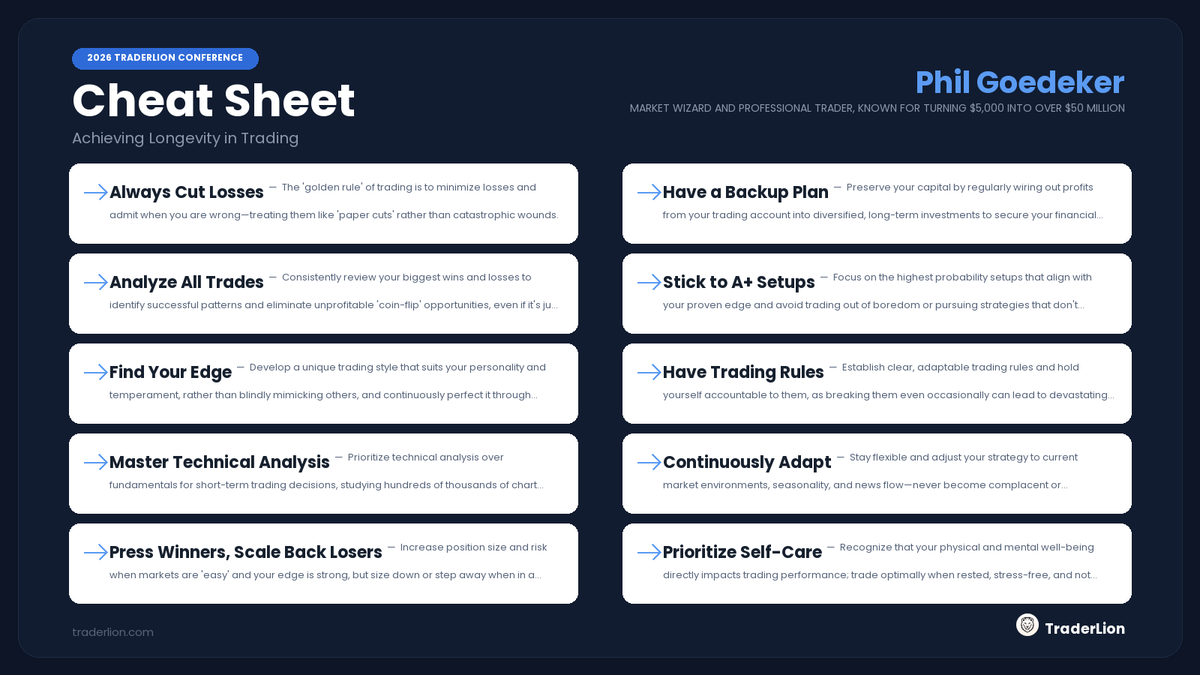
Market Wizard Phil Goedeker (@Tradestl), who turned $5,000 into over $50 million, opened the 2026 TraderLion Conference — longevity in trading, cutting losses, and what most traders get wrong.
10 lessons in one cheat sheet 👇
Professional Trader & Author of Pinpoint Trading, Shake Pryzby (@ShakePryzby1) opened the 2026 TraderLion Conference — dynamic position sizing, adapting to market conditions, and what most traders get wrong.
10 lessons in one cheat sheet 👇
Everyone fears corrections. Clement Ang sees them as the best buying opportunities in a bull market for 3 key reasons.
First, leaders diverge and show strength. Second, 'weak hands' get cleared out, leaving a cleaner market. Third, the 'spring effect' brings a strong snap-back. These are ideal conditions for the next leg up.
Corrections reset opportunity.
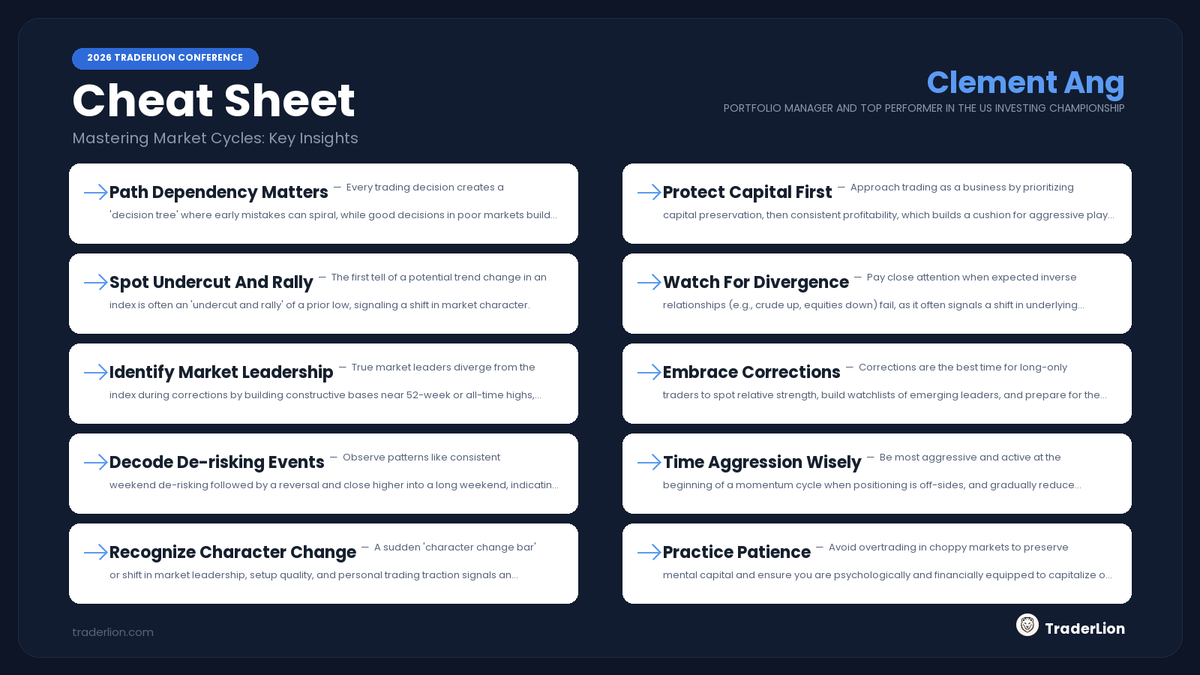
Portfolio Manager and US Investing Champion Top Performer, Clement Ang opened the 2026 TraderLion Conference — market cycles, capital preservation, and what most traders get wrong.
10 lessons in one cheat sheet 👇
I use the EMA 65 since many years. But it’s not so much about SMA 50 vs. EMA 65. There are a lot of undercuts of the EMA 65 too. And a lot of situations where the SMA 50 was retested but price never reached the EMA 65.
However, I did a lot of studies and found out that the EMA 65 and weekly EMA 13 works pretty well for me. Using technical indicators consistently is more important than the number you put into the field or the method for calculation.
I plan to go shopping next week for the LT portfolio
Here is what I think,
1. $SKHY or $DRAM
2. $NBIS
3. $CRDO
4. $AEHR
5. $LITE
6. $ASTS - maybe; should wait for $SPCX carnage
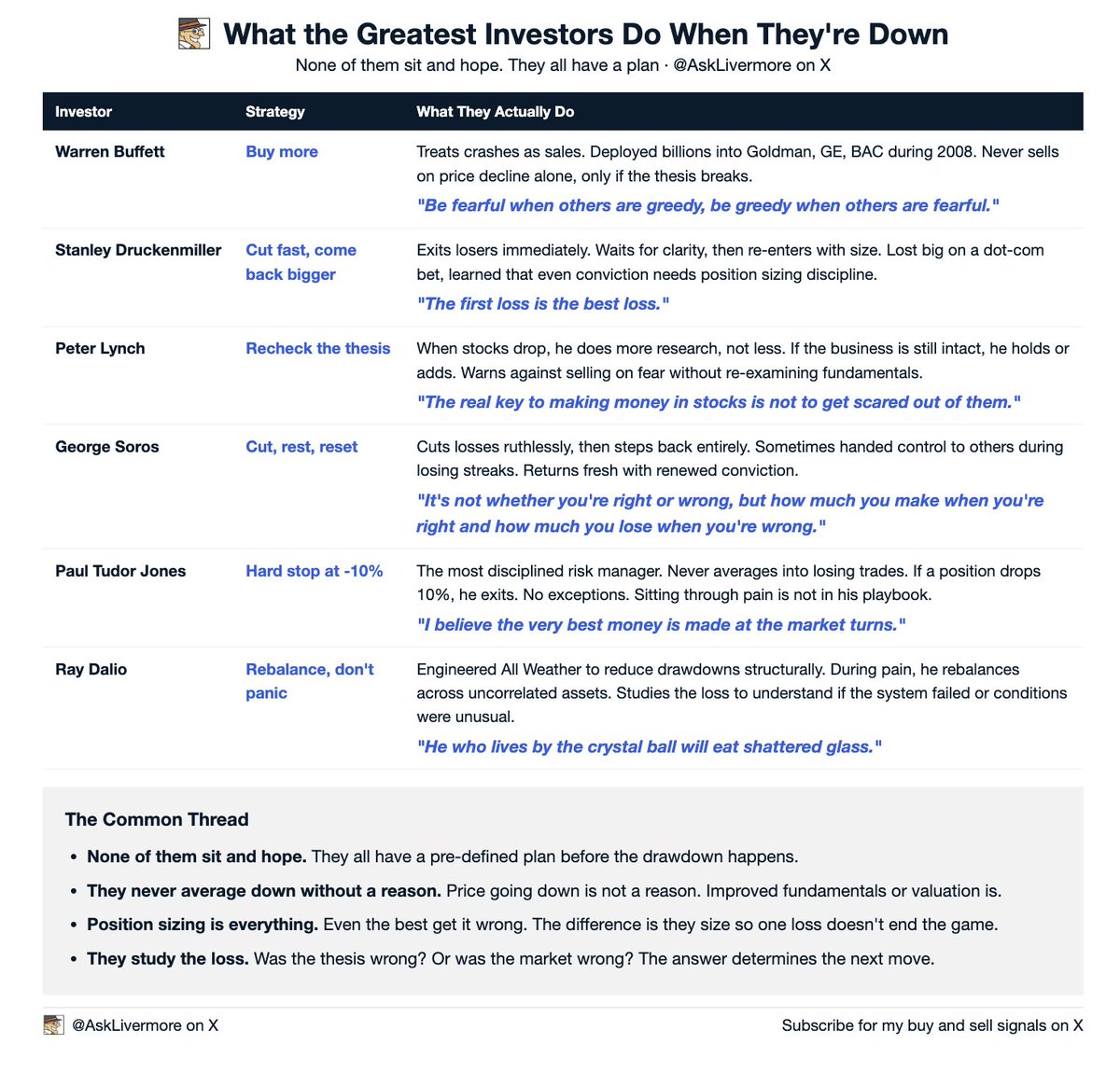
Your portfolio is down and you don't know what to do. Save this for the next time your portfolio is red. You will need it.
Here's what the 6 greatest investors of all time do when they're losing money:
1. Buffett: Buys more.
- he deployed billions into Goldman Sachs and Bank of America during 2008 while everyone else was panicking.
2. Druckenmiller: Cuts fast, comes back bigger.
- he exits losers immediately. No ego. Waits for clarity, then re-enters with conviction.
3. Peter Lynch: Rechecks the thesis.
- when stocks drop, he does more research, not less. If the business is intact, he holds.
4. Soros: Cuts, rests, resets.
- he cuts ruthlessly, steps away from the screen, then comes back fresh with a clear head.
5. Paul Tudor Jones: Hard stop at -10%.
- if a position drops 10%, he exits. No exceptions. No averaging down. No hoping.
6. Ray Dalio: Rebalances, doesn't panic.
he studies the loss. Was the thesis wrong or was the market wrong? The answer determines the next move.
The common thread across all 6:
- None of them sit and hope
- They all have a plan before the drawdown happens
THIS ONE SECRET WILL SAVE YOUR ACCOUNT THOUSANDS.
I breakdown:
• How to identify a trend change BEFORE most traders.
• How to know when the market is likely to start selling.
• When to stop buying and let the market come to you.
• Why doing less often leads to making more.
Market examples are $SPY $QQQ
$SNDK and $SMH
Master this, and you'll stop giving back months of profits in a single pullback.
Over the LAST year you will see I am warning and posting before moves happen. There is no hindsight.
I promise together we will work to becoming consistently profitable.
I'm going to give you the simplest swing trading recipe for success
Ingredients:
-200sma
-Daily or weekly chart
Directions:
1) Find stocks that have recently broken above the 200sma
2) Wait for a retest
3) If it holds the 200sma... 📈
We're pleased to announce the launch of the KraneShares Photonic and Optical ETF (Ticker: $LUMA) on the @NYSE.
AI datacenters are scaling rapidly.
Moving vast amounts of data between chips, servers, and facilities requires light-based infrastructure that can keep pace.
LUMA provides exposure to the companies building that infrastructure powering the modern digital economy, including optical interconnects, transceivers, and fiber-optic cables that move vast amounts of data at the speed of light.
LUMA is actively managed across both public and private markets, seeking to capture opportunities across the full photonic and optical value chain.
Read the full press release: https://t.co/ZmN6EPvMnF
I’d dismissed EP9 Million for years.
But hearing @PradeepBonde walk through it so passionately at the @TraderLion conference this weekend gave me the push to finally backtest it properly.
Huge thanks to Pradeep and the TraderLion team for a brilliant weekend.
Backtested 5,453 EP9M setups from 2020–2026.
Here are the biggest 'aha' moments the data revealed 👇
Q2 earnings season is here. This is the only chart you need. Save this so you can survive this quarter.
Over the last 10 years, ~80% of S&P 500 companies BEAT earnings estimates every single 2nd quarter.
But here's the catch:
- Stocks that beat? They barely move.
- Average reward: +0.8% to +1.9%
- Stocks that miss? They get destroyed.
- Average punishment: -1.8% to -5.6%
The punishment is 3-5x worse than the reward.
This is the most important thing to understand about earnings season:
1. Even with great earnings, stocks like to dip right after.
2. Have your cash ready to buy the dip on stocks with great earnings but then goes down for stupid reasons.
Let's go. 💪
Knowing How To Hold Winners Is How You Make Millions.
Save this to stop selling early.
Most traders know how to BUY.
Very few know how to HOLD.
Once you identify Sector Rotation like we did with Software, we use the Daily 8 EMA to tell show the trend is still healthy.
Instead of taking profits too early, I use these pullbacks into the Daily 8 to:
• Hold winning positions
• Add to strength
• Let the trend compound
Examples: $MSFT $NOW $CRM $SNOW
The biggest returns don’t come from finding the next hot stock.
They come from holding the right stocks long enough.
You now know how to find sector rotation EARLY with ETF’s $IGV in tweet below and now know how to hold winners.
You must LISTEN. I Will continue to HELP you.
STOP GETTING STOPPED OUT
If your stop loss keeps getting hit before the move..
You NEED This 20-min masterclass
You'll learn:
• How to know what trade to take
• How to hold winners longer
• Where your stop loss actually belongs
This is how we hit $SPY Puts for 300% TODAY
#EMA + #RSI STRATEJİSİ
EMA (Üssel Hareketli Ortalama) ile RSI (Göreceli Güç Endeksi) birlikte kullanıldığında hem trend yönü hem de fiyatın momentum gücü aynı anda değerlendirilir. Böylece daha filtreli ve güvenilir işlem sinyalleri elde edilebilir.
📈 KULLANILAN GÖSTERGELER
• EMA 20 (Kısa vadeli trend)
• EMA 50 (Orta vadeli trend)
• RSI 14
🟢 ALIŞ SİNYALİ
• EMA 20, EMA 50’yi yukarı keser.
• Fiyat her iki EMA’nın üzerinde kapanış yapar.
• RSI 50 seviyesinin üzerindedir ve yükseliş eğilimindedir.
• RSI’nın 30 seviyesinden yukarı dönmesi sinyali güçlendirir.
🔴 SATIŞ SİNYALİ
• EMA 20, EMA 50’yi aşağı keser.
• Fiyat her iki EMA’nın altında kapanış yapar.
• RSI 50 seviyesinin altındadır ve düşüş eğilimindedir.
• RSI’nın 70 seviyesinden aşağı dönmesi satış baskısının arttığını gösterebilir.
🛡️ STOP LOSS
• Alış işlemlerinde son dip seviyesinin altı.
• Satış işlemlerinde son tepe seviyesinin üstü.
• Alternatif olarak EMA 50’nin altı/üstü kapanışlar.
✅ AVANTAJLARI
• Trend ve momentum birlikte değerlendirilir.
• Yanlış sinyal olasılığı azalır.
• Günlük ve 4 saatlik grafiklerde etkili şekilde kullanılabilir.
⚠️ DEZAVANTAJLARI
• Yatay piyasalarda sık sinyal üretebilir.
• Trend başladıktan sonra sinyal verebildiği için gecikme yaşanabilir.
#NETCD #EMPAE #ISDMR #DOAS #EREGL #AKHAN #ATATR #BESTE
#GOLDA #ORZAX #BETAE #ISVEA #SOHOE #EKIM #EKDMR
U.S. Refining: Structural Scarcity, Cyclical Upside, and Terminal-Value Risk. New: 7/13/26.
U.S. petroleum refining is best characterized as a structurally tighter, higher-mid-cycle, lower-terminal-multiple cash-flow industry. The sector is no longer adequately modeled as the uniformly oversupplied, low-return conversion business that prevailed through much of the 2010s, but neither should recent margins be capitalized as a durable perpetuity. Capacity rationalization, limited greenfield investment, rising replacement costs, increasingly difficult permitting, high utilization, product-market fragmentation, and critical logistics constraints have raised the probability that industry troughs will be shorter and less severe than historical experience suggests. At the same time, declining gasoline demand, global capacity additions, environmental compliance costs, aging equipment, closure liabilities, and policy uncertainty reduce the duration of those cash flows and justify lower terminal multiples. High current free cash flow and declining terminal value are therefore compatible rather than contradictory conclusions.