Michael Crichton on scientific consensus:
“I want to pause here and talk about this notion of consensus, and the rise of what has been called consensus science. I regard consensus science as an extremely pernicious development that ought to be stopped cold in its tracks. Historically, the claim of consensus has been the first refuge of scoundrels; it is a way to avoid debate by claiming that the matter is already settled. Whenever you hear the consensus of scientists agrees on something or other, reach for your wallet, because you’re being had.
Let’s be clear: the work of science has nothing whatever to do with consensus. Consensus is the business of politics. Science, on the contrary, requires only one investigator who happens to be right, which means that he or she has results that are verifiable by reference to the real world. In science consensus is irrelevant. What is relevant is reproducible results. The greatest scientists in history are great precisely because they broke with the consensus. There is no such thing as consensus science. If it’s consensus, it isn’t science. If it’s science, it isn’t consensus. Period.”
In Buddhism we understand that every action comes with a consequence. Due to my decision to stand up for my Jewish friends I am losing a few people from my life. Today I parted company with Tony Pontius who has run my record label BGP for a number of years. I wanted to release 'We Will Dance Again' but he was unequivocal and said 'I want nothing to do with this song' and I responded 'ok, we are done'.
When someone is gutless it really does not hurt to say goodbye. My faith in humanity will not diminish and the truth will always win.
I will release it!
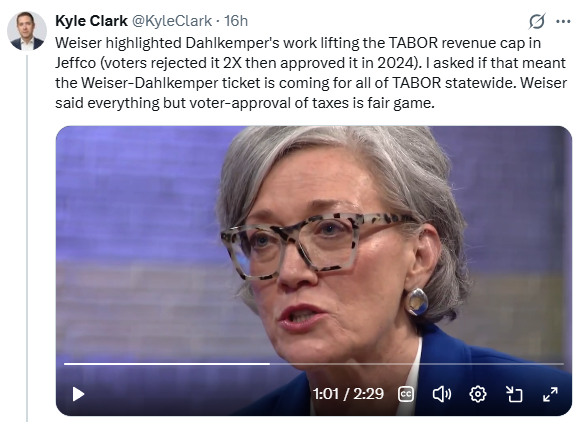
democrats controlling all the pillars of power in Colorado for most of the last 20 years has proved disastrous. Ask for the receipts.
TABOR is about the roadblock keeping democrats from decimating Colorado's economy.
They admit they want to destroy TABOR.
#copolitics#coleg
Islamic scholar in California says the quiet part out loud:
“Islam is not just a religion. It is a complete political, social, and economic system.
Anything that is not Sharia, we will not obey. We are superior to everyone else, and we will dominate the entire world!”
You’ll never see a Jew stabbing someone to death while shouting “Baruch Hashem,” or a Christian shouting “Praise the Lord.”
Always starts with “Allahu Akbar.”
The @denverpost just spent 1,200 words trying to solve an alleged mystery I can solve in just 3 words.
The question? How did Colorado lose its competitive edge? Why is the state in such steep decline?
The Post wastes 1,200 words diplomatically dancing around one elephant in the room -- an elephant named Jared Polis https://t.co/kroXE2LZ46
But I can solve the mystery of Colorado's business climate decline in just three words: One. Party. Rule.
The piece wrings its hands over job losses, plunging business rankings, and fleeing startups, while performing Olympic-level gymnastics to avoid naming the obvious culprit: one-party Democratic rule, complete with a billionaire “business wiz” governor who’s been at the helm for eight long years.
Instead of confronting reality, the Post treats us to the usual ritual: quotes from concerned business leaders, vague nods to “headwinds,” and glowing coverage of Gov. Jared Polis bravely announcing . . . another task force and listening tour (as if we don't know what's really gone wrong in Colorado).
Because nothing says “decisive leadership” like waiting until the final months of your term -- after the state shed 6,200 payroll jobs in just 18 months, ranked 12th-worst nationally in total job losses and 14th-worst in percentage terms, and watched its startup ecosystem suffer the largest numeric decline in the country -- to finally ask businesses what’s wrong.
The numbers paint a brutal picture: Colorado has tumbled to 25th in CNBC’s “America’s Top States for Business” (from perennial top-10 darling, including #1 in 2011), dragged down by a pathetic 49th in cost of living, 38th in cost of doing business, and 32nd in infrastructure. The ALEC “Rich States, Poor States” index has it at a dismal 29th, a sharp fall from recent years and a far cry from its second-place ranking in 2008. Companies are bolting for greener pastures, talent recruitment has become a nightmare amid sky-high housing costs, and even the departure of big names like Palantir barely scratches the surface of the quiet erosion in entrepreneurial energy.
Yet the Post frames this as some mysterious fog that rolled in, rather than the predictable result of years of accumulating mandates, regulatory piling-on, and a political culture that vilifies the private sector, decries the profit motive, and treats business as an ATM for funding pet "progressive" priorities.
The Post does note, almost in passing, that Colorado has shifted from purple to solidly blue since 2011. But heaven forbid they connect the dots. Polis, the polished entrepreneur-turned-governor, gets portrayed as the thoughtful reformer riding to the rescue, not the architect of (or willing participant in) the very policy environment -- workplace mandates, housing strangulation, infrastructure neglect, a business-bashing legislature -- that made the state less competitive. Eight years of solid Democratic majorities in the legislature, a steady barrage of "progressive" meddling, and a general attitude that innovative companies should just be grateful to locate in this beautiful people’s republic -- and the Post acts shocked, shocked, that the state is now hanging out “under the bleachers” with the also-rans.
The elephant isn’t just in the room -- it’s been trampling the state’s business climate for nearly a decade, passing bills, ballooning budgets, and appointing rogue regulators to runaway commissions, while the media politely averts its gaze. Colorado didn’t suddenly become expensive, regulated, and complacent by accident. It chose this path, repeatedly, at the ballot box and in the State House. The Post’s greatest contribution here is providing cover: acknowledge the decline just enough to seem serious, then pivot to process theater and hope readers forget who’s been in charge.
#copolitics #coleg @GovofCO
We live on a largely pleasant, yet historically cool world, where average temperatures hover around 15C.
This current baseline includes the 1.4C rise since the start of the Industrial Revolution 250 years ago. We are rarely reminded Earth's climate is roughly 10 degrees 'colder' than the long-term global average of 18C to 26C across hundreds of millions of years.
A warmer climate would not be a crisis, and never has across the history of biological life.
Humans and our unique, symbolism-based culture evolved against this cooling, drying backdrop of the Late Cenozoic Ice Age, which has lasted 34 million years since the glaciation of Antarctica. We are currently in its coldest phase — the Quaternary glaciation — which has endured for 2.58 million years.
Almost all human civilisation - and our acute sense of modernity - arrived during a brief, 11,700-year warm interglacial oasis known as the Holocene. This demonstrates that we are an 'ice age adapted' species, as are all modern mammals. Yet the current climate crisis is built around an institutional dogma, which ignores this vast geological history, operating as if the earth works just like a greenhouse, which it doesn't.
It's all complex. While orbital cycles dictate the 'macro' climate epochs of the Earth over millennia, the current debate focuses entirely on the 'micro' trend of the last 250 years. Our planet is constantly responding to the orbital aberrations identified by Milutin Milanković.
Over the short term, this changeability comes from natural variability in solar radiance, ocean currents, atmospheric water vapor and volcanic activity; over the deeper long term, it is guided by the ponderous tectonic creaking of continental plates.
The world's oceans, water vapor and clouds contribute 50% to 70% of atmospheric warming. The geological record reveals that only after the oceans — especially the Southern Ocean — have warmed for centuries does dissolved CO₂ outgas from the deep waters, a process unfolding over 5,000 to 10,000 years.
To focus exclusively on a trace gas like CO₂ is to ignore the true scale and power of these natural systems. Furthermore, the narrative completely missed the biological utility of this gas: NASA satellite data has shown a significant increase in global green foliage over recent decades, largely driven by elevated CO₂ levels acting as an airborne fertiliser. This green wave, alongside booming global agriculture, was entirely unanticipated by backers of the crisis agenda.
Today, this narrative runs directly counter to thermodynamic reality: we simply cannot run a modern economy without high-density fossil fuels, a baseline power that wind and solar cannot replicate.
To pretend otherwise is to forget our place in the natural world, where we live largely by chance, and only as invited guests — not as Overlords.
Listen to North Korean defector Yeonmi Park explain how her grandparents were promised much of what Mamdani and the Democratic Socialists of America are promising today:
- Free healthcare
- Free housing
- Free education
- A government that will take care of everyone
In return, they surrendered their freedom.
Tyranny rarely arrives looking cruel. It arrives smiling, speaking softly and promising compassion.
Liberals, I beg of you, don’t listen to conservatives if you don’t want to.
Listen to the North Korean defector.
It will not be different this time.
This is how it begins.