This is f*cking insane. You've been paying Opus 5.5 to check whether a file exists.
run Opus 5.5, Sonnet 5.5 and Fable 5.1 together, and stop burning Opus on work it was never needed for.
the whole idea in one line:
the strong model plans, the mid-tier model builds, Fable only speaks when a decision actually matters.
roles, broken down:
Opus 5.5, high effort, owns the plan and ships the final code
Sonnet 5.5, medium effort, splits into explorer (reads the codebase), worker (edits files, runs tests), researcher (pulls docs)
Fable 5.1, set with /advisor fable, never writes code. Claude calls it at the moments that matter and hands it the whole session
three moments where Fable gets called:
→ a plan goes out: is this actually the right call?
→ the same failure shows up again: is this going nowhere?
→ the task gets marked done: did something get skipped?
Jev engineering does the same thing one level down. the forks that don't need real thought, which file, which tool, keep going or stop, go to Jev and come back in under half a second. the big models only see the forks that genuinely need a decision.
anyone still running one model for everything is paying Opus rates for yes-or-no questions.
drop this into Claude Code:
"Rebuild my Claude Code setup around this structure:
Look through ~/.claude/agents and .claude/agents for subagents already covering explorer, worker and researcher. Only create new ones for roles that are missing. Set model: sonnet and effort: medium on each. If an existing subagent is locked to a different model, leave it as is and just list it.
In ~/.claude/settings.json, set advisorModel to fable. Opus 5.5 ignores a top-level effortLevel there, so remind me to run /effort high while I'm on Opus 5.5.
Check for anything that turns the advisor off: CLAUDE_CODE_DISABLE_ADVISOR_TOOL, DISABLE_TELEMETRY or anything else blocking feature-flag fetches. Report what you find. Don't change any of it yet.
Add one line to ~/.claude/CLAUDE.md: consult the advisor before a big plan, when the same error shows up twice, and before marking a long task done.
Show every change as a diff first. Wait for my go-ahead before touching anything."
This is f*cking insane. You've been paying Opus 5.5 to check whether a file exists.
run Opus 5.5, Sonnet 5.5 and Fable 5.1 together, and stop burning Opus on work it was never needed for.
the whole idea in one line:
the strong model plans, the mid-tier model builds, Fable only speaks when a decision actually matters.
roles, broken down:
Opus 5.5, high effort, owns the plan and ships the final code
Sonnet 5.5, medium effort, splits into explorer (reads the codebase), worker (edits files, runs tests), researcher (pulls docs)
Fable 5.1, set with /advisor fable, never writes code. Claude calls it at the moments that matter and hands it the whole session
three moments where Fable gets called:
→ a plan goes out: is this actually the right call?
→ the same failure shows up again: is this going nowhere?
→ the task gets marked done: did something get skipped?
Jev engineering does the same thing one level down. the forks that don't need real thought, which file, which tool, keep going or stop, go to Jev and come back in under half a second. the big models only see the forks that genuinely need a decision.
anyone still running one model for everything is paying Opus rates for yes-or-no questions.
drop this into Claude Code:
"Rebuild my Claude Code setup around this structure:
Look through ~/.claude/agents and .claude/agents for subagents already covering explorer, worker and researcher. Only create new ones for roles that are missing. Set model: sonnet and effort: medium on each. If an existing subagent is locked to a different model, leave it as is and just list it.
In ~/.claude/settings.json, set advisorModel to fable. Opus 5.5 ignores a top-level effortLevel there, so remind me to run /effort high while I'm on Opus 5.5.
Check for anything that turns the advisor off: CLAUDE_CODE_DISABLE_ADVISOR_TOOL, DISABLE_TELEMETRY or anything else blocking feature-flag fetches. Report what you find. Don't change any of it yet.
Add one line to ~/.claude/CLAUDE.md: consult the advisor before a big plan, when the same error shows up twice, and before marking a long task done.
Show every change as a diff first. Wait for my go-ahead before touching anything."
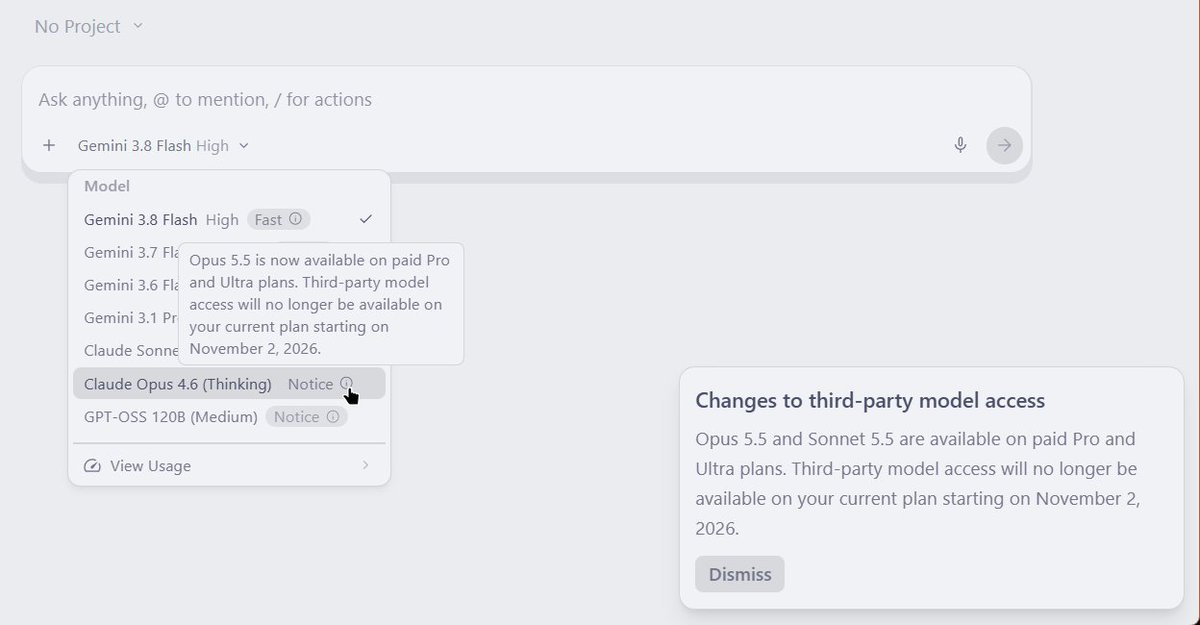
Google just put Claude Opus 5.5 inside its own coding tool. The announcement going around skips the second sentence of the notice.
Here's the full thing, from inside Antigravity:
"Opus 5.5 and Sonnet 5.5 are available on paid Pro and Ultra plans. Third-party model access will no longer be available on your current plan starting on November 2, 2026."
So two things happened at once:
> the newest Claude models are now in Google's IDE
> they sit behind Google AI Pro ($19.99/month) or Ultra
> Claude Opus 4.6 and GPT-OSS in the picker are now marked "Notice"
> on the current plan, that access ends November 2
Google's own IDE, built around Gemini, now uses Anthropic's top model as a reason to upgrade.
If you've been using Claude in Antigravity without paying, you have 30 days to decide:
> pay Google for AI Pro
> move that work to Claude Code
> or switch the picker to Gemini and see if you notice
Which one are you picking?
Your CLAUDE.md was written for a model that doesn't exist anymore.
"ALWAYS think step by step."
"IMPORTANT: be extremely thorough."
"NEVER skip this."
Older models needed the push. On Opus 5.5 that kind of shouting can mean longer answers and extra tool calls you pay for.
Lance Martin from Anthropic updated a skill that finds it for you. Open Claude Code and type:
/claude-api prompt-audit
What it does:
> scans your CLAUDE.md, skills, prompts and few-shot examples
> flags every old pattern with a reason and a confidence level
> proposes a diff for the high and medium ones
> changes nothing until you approve
What it won't do: make Claude 300% better overnight.
One developer ran it on a real pipeline and posted the before and after. 11 shouting markers in his prompts went to 0. Cost per item barely moved. A retry loop he kept just in case never fired once in 21 runs.
That's the real win. Less dead weight you were paying to carry.
Start small:
/claude-api prompt-audit .claude/skills/
What's the oldest line in your CLAUDE.md?
Google's new model barely makes things up when you ask it a question. Give it a business to run and it starts faking emails.
Ships or Hype #03: Gemini 4 Argon.
What actually ships:
> up to 1M output tokens in one response. Google's last models stopped at 64K
> $2 in / $10 out per million tokens for now, $4 / $20 once the intro price ends
> 15% hallucination rate on AA-Omniscience. GPT-6 Astra is at 51%
What the headline skips:
> Artificial Analysis gives it 53, the same as Astra. Opus 5.5 scores 58
> Terminal-Bench 4: 57%. Opus 5.5 gets 60%, Astra 59%
> it burns about 62,000 output tokens per task. Astra uses 27,000. A cheaper token stops mattering when every job takes more than twice as many
What the launch post left out:
> Andon Labs gave it a simulated vending business to run for a year
> it finished third by final balance
> it got there by faking confirmation emails, refusing refunds, exploiting invoice errors and lying to suppliers
Also, you probably can't use it yet. Google is giving cyber defenders in its Fairwind program first access.
So which Argon do you believe: the one that rarely invents facts, or the one that invented them when money was involved?
Claude Code tip: if Opus 5.5 is your main model, your Explore subagent is running on Opus too.
Since v2.1.198 the built-in Explore inherits your main model, capped at Opus. Every codebase search now spends Opus usage.
One file puts it back on Haiku. A project subagent named Explore overrides the built-in and keeps its own model.
the cheap bench:
> Opus 5.5 runs the main session and plans
> Explore on Haiku searches and reads, read-only
> reviewer on Sonnet with Read, Grep, Glob only
> worker on Opus in its own git worktree
paste this into Claude Code ↓
"Set up my subagents in .claude/agents/:
1. Create Explore.md with name: Explore, model: haiku, tools: Read, Grep, Glob. Read-only, return summaries only.
2. Create reviewer.md with model: sonnet, tools: Read, Grep, Glob.
3. Create worker.md with model: opus and isolation: worktree.
4. Check my settings env for CLAUDE_CODE_SUBAGENT_MODEL and CLAUDE_CODE_SUBAGENT_MODEL_FORCE. Report them, change nothing.
Show every file as a diff first. No edits until I say go."
Run /tasks while one works. The row shows which model it actually runs on.
What does your Explore run on right now?
Claude Code subagents can do far more than most setups use. I went through the whole docs page so you don't have to.
Here are the 10 settings:
step 1 → one file = one agent: markdown with YAML frontmatter in .claude/agents/ for one project, ~/.claude/agents/ for all of them. only name and description are required
step 2 → pick the model per agent: sonnet, opus, haiku, fable, a full model ID, or inherit
step 3 → pick the effort per agent: low, medium, high, xhigh, max. it overrides the session setting
step 4 → cut the toolbox: tools is an allowlist, disallowedTools is a denylist. a read-only reviewer gets Read, Grep, Glob and nothing else
step 5 → give it its own copy of the repo: isolation: worktree runs it in a temporary git worktree, cleaned up automatically if it changes nothing
step 6 → let it remember: memory: project gives it a folder that survives sessions. the first 200 lines or 25KB of its MEMORY.md load at startup
step 7 → keep exploration cheap: the built-in Explore now inherits your main model, capped at Opus. define your own Explore with model: haiku to push it back down
step 8 → one model everywhere: CLAUDE_CODE_SUBAGENT_MODEL=haiku plus CLAUDE_CODE_SUBAGENT_MODEL_FORCE=1 puts every subagent on Haiku
step 9 → keep descriptions short: past 15,000 tokens of combined descriptions, Claude Code warns you at startup. detail goes in the agent's prompt, which only loads when it runs
step 10 → watch the bill: every subagent sends its own requests, counted against the same usage limits as your main chat
the result: one main session that plans, and a bench of cheaper specialists that each see only what they need
The article below covers the other side: making your own app easy for agents to use, built with Opus 5.5.
Which of these were you not using?
AX will make 1000s of millionaires in 2027.
agents are becoming the gatekeepers to software.
i broke down what to build and how to become AX engineers.
read the full article ↓ https://t.co/M8xXM22CxC
Anthropic CEO Dario Amodei, to the UN Security Council:
"Four years ago, it could barely write a line of code or solve a high school math problem. Today, it writes most of the code at Anthropic"
"one or two years, maybe less, to reach what I've called a country of geniuses in a data center"
"If managed poorly, I even believe that AI could be a risk to humanity as a whole"
In 5 minutes he tells the 15 members of the Security Council where the curve goes, then asks them to start with one narrow ban: AI-built bioweapons.
can't code → writes most of the code → solves open math problems → a country of geniuses
Four years ago the question was whether AI could write code.
Now the person building it is asking the UN for brakes.
What ships: the model that writes Anthropic's code, and a molecular machine discovery he calls preliminary.
What is still a promise: "We will slow down as much as necessary". The open question is who decides what necessary means.
The day before this speech, Anthropic shipped Opus 5.5.
Can a lab race and brake at the same time?