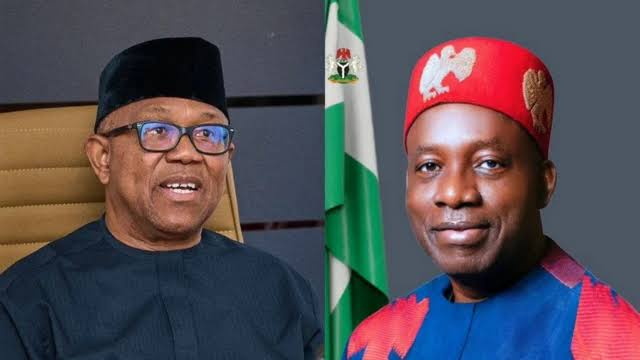
APC went to Anambra state to campaign today.
After dancing, they began to talk about Peter Obi.
From Shettima to Soludo to Oshiomhole all passed mics to talk about the man they claim is a social media candidate and irrelevant.
After that, no single completed project/achievement for NIGERIANS was mentioned.
No single completed project/achievement for the SE or Anambra was mentioned.
No new project was approved even if it's audio.
Nothing Nothing!! A whole ruling party.
God forbid bad thing!!
NIGERIANS, GO AND VERIFY (4)
Building a Healthy Nation: Our Health Sector Record in Anambra
Peter Obi
In the previous instalment of this series, I discussed our investments in education and explained why we considered human capital development central to the progress of Anambra State. Another sector that received considerable attention under our administration was healthcare. We understood that education gives people the tools to build their future, while good healthcare enables them to live healthy and productive lives.
When we assumed office in 2006, the healthcare system in Anambra faced serious challenges. Our health institutions required rehabilitation, medical equipment was inadequate, many communities lacked accessible primary healthcare facilities, and several medical training institutions had not secured accreditation. We therefore decided to approach healthcare as a comprehensive development priority, rather than concentrate resources on a few prominent hospitals.
Under our Anambra Integrated Development Strategy (ANIDS), we invested simultaneously in primary, secondary, and tertiary healthcare, medical training, maternal and child health, medical equipment, and partnerships with religious and private institutions.
Our approach was simple: healthcare should be accessible to people wherever they live, and the quality of treatment they receive should not depend on their status or whether they live in a city or a rural community.
Building a Teaching Hospital and College of Medicine
One of our most significant achievements was the establishment of the Chukwuemeka Odumegwu Ojukwu University Teaching Hospital at Awka.
We initiated, constructed, equipped, and secured accreditation for the institution, building it virtually from scratch. When I discovered that the state university was admitting medical students without having a teaching hospital through which they could complete their training, possibly with the intention of assigning them elsewhere, I considered the situation unacceptable. We therefore embarked on the construction of a modern teaching hospital to address this deficiency.
We constructed more than 25 buildings and provided facilities for the College of Medicine, laboratories, pathology, accident and emergency services, pediatrics, male and female wards, special wards, consultant clinics, and other essential departments.
We also provided vehicles, including ambulances and staff buses, to support the hospital and the College of Medicine as part of the accreditation requirements.
The objective was not merely to build another hospital but to establish an institution capable of providing specialist healthcare while training the next generation of Nigerian medical doctors.
Rehabilitating General Hospitals
We also recognized that a teaching hospital alone could not meet the healthcare needs of the population. General hospitals had to function effectively because they provide the essential link between primary healthcare and specialist treatment.
We rehabilitated and resuscitated 15 general hospitals across the three senatorial zones of Anambra State. We undertook substantial improvements in their buildings, wards, equipment, and general facilities.
In 2013, we provided ₦400 million for the ongoing renovation of 11 selected general hospitals, alongside other healthcare interventions.
Our intention was to ensure that people did not have to travel unnecessarily long distances to obtain basic secondary medical care.
Taking Primary Healthcare to the Communities
We believed that the best healthcare system is one that prevents illnesses and treats people early, rather than one that waits until minor health problems become emergencies.
That informed our extensive investment in primary healthcare. We built over 120 primary healthcare centers across communities in the 177 autonomous communities of Anambra State and rehabilitated existing facilities.
🚨 Just In!
At this point, APC should abandon physical campaigns and continue on Zoom instead.
This is getting out of hand!
I say it again: No party has ever experienced this level of rejection in our political history!
And this is happening LIVE in Kaduna! 😳
Our analysis of the 2023 elections in Rivers State shows why publishing only polling-unit results on IReV is not enough.
In Obio/Akpor, the polling-unit sheets on IReV give the Labour Party HOR candidate 67,320 votes. The declared result gives him 18,766. Those two records cannot both be right. Somewhere between the polling unit and the declaration, during collation, 48,554 of his votes disappeared while his opponent's total rose by 24,357.
Collation is meant to add up polling-unit results, not override them.
The public cannot see where this happened, because the ward and constituency collation sheets have never been published.
We are not asking INEC to replace its collation process. We are asking it to publish every document that process produces, so that no figure can be changed between one stage and the next without anyone being able to see it real time.
NIGERIANS, GO AND VERIFY (3)
Building the Future Through Education
Peter Obi
In the first two instalments of this series, I explained how we approached the task of building strong institutions and laying a solid foundation for the development of Anambra State. One of the most important institutions we invested in was education.
For me, education was not a political game or a convenient political promise. Even before I ventured into politics, I had always regarded it as the foundation of meaningful development and the most enduring investment any government can make in its people. I believe that the future of any society depends largely on the quality of its educational institutions, teachers, learning environment, and opportunities available to its young people.
This conviction informed our decision to invest across the entire educational spectrum, from primary schools to universities, technical institutions, and adult education.
Basic and Secondary Education
One of our first major decisions was to return mission and privately owned primary and secondary schools to their original proprietors while retaining government support. We also provided billions of naira to assist in rehabilitating the returned schools, restoring the partnership between government and religious institutions that had historically contributed to educational excellence.
This policy attracted international attention. Professor Paul Collier, the Oxford economist and World Bank consultant, led a World Bank-commissioned study of Anambra’s educational transformation. His team examined our decision to return schools to their original missionary owners while retaining government responsibility for funding teachers��� salaries and supporting infrastructure. The team described the partnership model as a revolution in public service delivery and recommended it as a model that could be replicated by other Nigerian states and developing countries. We believed then, as we do now, that government does not necessarily have to own every institution to discharge its responsibility effectively. What matters is ensuring that every child has access to quality education.
For those who claim that we built no schools, I invite them to verify our records. We constructed five-classroom blocks in virtually all of the 177 communities in Anambra State, one of the most extensive community-based school infrastructure programmes undertaken by any state government. The town union chairmen and community leaders of that period can attest to this.
We also renovated hundreds of dilapidated schools, including some where trees had literally grown through abandoned buildings. Comprehensive Secondary School, Onitsha, and Oraukwu Grammar School are examples.
Beyond infrastructure, we distributed approximately 40,000 computers to schools, including more than 22,500 HP laptops. We equipped secondary schools with Microsoft Academies and connected schools across the state to the internet. We supplied generators, established and stocked libraries, revived school sporting activities, and installed boreholes in over 300 schools, including all girls’ schools. We also provided funding to support sporting activities in all our secondary schools.
These technology investments attracted remarkable international recognition. Mr Fabrice Campoy, Managing Director of the Personal Systems Group at HP Inc., described our procurement and distribution of over 22,500 HP laptops as the biggest project of its kind in the Middle East and Africa. Similarly, Mr Ken Spann, then Country Manager and Head of Microsoft Nigeria, described the establishment of Microsoft Academies in more than 500 Anambra secondary schools as the most extensive deployment of its kind in Africa at the time.
NIGERIANS, GO AND VERIFY (2)
Building the Institutions of the State
Peter Obi
In Series 1, I explained the philosophy that guided our administration in Anambra State: governance as a public trust, anchored on character, competence, capacity, and compassion. I also introduced the Anambra Integrated Development Strategy (ANIDS), our comprehensive framework for achieving balanced and sustainable development across all sectors.
But a development vision, however noble, cannot succeed without strong institutions to drive it. Before the government could effectively deliver on its promises in education, healthcare, infrastructure, security, and other sectors, we had to first restore the machinery of government itself. We could not build a prosperous state on a cracked and unstable foundation.
This was why one of our foremost priorities under ANIDS was to rebuild, strengthen, and reposition the institutions of government. When I assumed office, the physical and administrative architecture of governance was in a deplorable condition. Our task was not simply to construct buildings but to restore the institutions, systems, and structures through which government could function effectively.
We therefore began systematically rebuilding the infrastructure of governance across the executive, legislature, judiciary, civil service, and local government system.
Restoring the Seat of Government
The Government House in Awka, the state capital, had been vandalised and burnt by reactionary forces in 2004. We therefore had to rebuild, re-equip, and furnish it, restoring its dignity and functionality as the seat of executive government.
In the same vein, we rehabilitated the Governor’s Lodge in Amawbia and constructed a new Governor’s Lodge in Onitsha. These investments were intended not merely to provide accommodation but to strengthen executive presence and facilitate effective governance across the state’s major administrative and commercial centres.
Strengthening the Legislature and Judiciary
We rehabilitated the Anambra State House of Assembly Complex in Awka, providing our lawmakers with a more conducive and decorous environment in which to discharge their constitutional responsibilities. We also provided legislators with vehicles to facilitate the effective performance of their legislative duties.
We recognised that a functioning democracy requires strong institutions, including an effective legislature and an independent judiciary, each operating within its constitutional mandate.
In strengthening the judiciary, we provided brand-new vehicles to High Court judges. This was the first time such provision had been made for them in the history of the state. We also provided vehicles to magistrates for the first time since the creation of Anambra State.
These interventions were intended to strengthen the administration of justice, improve mobility, and enable judicial officers to discharge their responsibilities more effectively.
Rebuilding the Civil Service: The Chief Jerome Udoji State Secretariat Complex
Before our administration, many Ministries, Departments, and Agencies (MDAs) operated from scattered rented apartments, while civil servants lacked a centralised and decent working environment. This untidy arrangement undermined coordination, efficiency, and the dignity of public service.
We addressed this situation by constructing the two-phase, ultra-modern Chief Jerome Udoji State Secretariat Complex, comprising Blocks 1 and 2. The project brought the MDAs together under one roof, improved administrative coordination, and provided civil servants with a more suitable environment in which to serve the people.
The complex was named after Chief Jerome Udoji, the first indigenous Chief Secretary (the equivalent of today’s Secretary to the State Government) of the Eastern Region during the First Republic. This was also a recognition of his contribution to public administration and the civil service tradition.
NIGERIANS, GO AND VERIFY (1)
Introduction: Governance as a Public Trust
Peter Obi
When I took office as Governor of Anambra State, our beloved state was at a critical juncture. Leadership had become increasingly disconnected from the people, and many of the essential institutions needed to support a modern society were weak, ineffective, or absent altogether. We understood that governance could not continue according to established habits. It needed to be reconceived as a solemn public trust founded on transparency, prudence, accountability, and demonstrable results.
Our governing philosophy rested on four principles: character, competence, capacity, and compassion. We understood that leadership was not a platform for self-promotion, political slogans, or the pursuit of personal acclaim. Its purpose was to improve the circumstances of ordinary citizens. It meant converting public resources into concrete benefits and ensuring that government’s foremost responsibility was to serve the people. Achieving this demanded more than good intentions; it required a clear vision, careful planning, and disciplined execution.
Among our earliest findings was that the state lacked a unified development plan to direct its priorities and determine how resources should be allocated. We therefore promptly created the Ministry of Economic Planning to establish the institutional foundation for deliberate, coordinated, and sustainable development. After completing the necessary groundwork and consultations, we launched the Anambra Integrated Development Strategy (ANIDS).
At that time, the Millennium Development Goals (MDGs) were being pursued worldwide across eight clearly defined priorities: eliminating extreme poverty and hunger; achieving universal primary education; advancing gender equality and empowering women; reducing child mortality; improving maternal health; combating HIV/AIDS, malaria and other diseases; promoting environmental sustainability; and fostering a global partnership for development.
We adopted ANIDS as our overarching development philosophy and strategic framework for advancing these objectives, tailoring them to the distinctive circumstances, needs and development priorities of Anambra State. Instead of viewing the MDGs as remote international benchmarks, we worked to convert their aims into practical policies, programs and measurable results that would produce tangible improvements in the lives of our people.
We also undertook a deliberate effort to redefine the state’s identity, changing its public image from ‘Home for All’ to ‘The Light of the Nation’. This was not merely a change in slogan; it reflected our resolve to restore public confidence in government, renew civic pride and show that Anambra could serve as a model of purposeful leadership and development.
The ANIDS Blueprint: A Comprehensive Framework for Development
ANIDS served as the foundation for our commitment to broad-based and balanced development. We did not accept the idea that government could focus on a single sector while leaving others behind. We recognized that education, healthcare, infrastructure, security, agriculture and capable public institutions were mutually dependent. Advancement in one area could not be sustained without commensurate progress elsewhere. Accordingly, we pursued development across every sector, guided by defined priorities, disciplined planning and prudent stewardship of public resources.
Central to this vision was the restoration of the dignity of the Anambra person. We understood that dignity could not be restored through rhetoric alone. It was evident in the condition of roads and other infrastructure, the availability of healthcare, the quality of education, the performance of public institutions and the way government treated its workers, pensioners and traditional institutions.
Soludo Pulls Down Obi, Victor Umeh’s Billboards Across Anambra, Bars Senator From Featuring Peter Obi’s Image On Campaign Banner https://t.co/MfYkoOnDN3
If Nigeria was left to journalists and lawyers it would have gone to hell.
Thank God for social media and content creators
Thank God for non-lawyer activists
The only coalition Nigeria’s opposition needs is a coalition against INEC impunity and electoral irregularities.
Whatever their differences, opposition parties should unite now to pressure @inecnigeria. Demand an independent audit of the voters’ register, timely publication of polling-unit results on IReV, and public access to signed collation sheets.
We Cannot Expect INEC to Clean Up the Voter Register That Was Compromised by Its Own Officials - Ezekwesili
According to INEC's data, 54 of its officials across the country compromised the voter register. How do you then expect the same institution to tell you it has cleaned up the register? INEC cannot investigate itself; the one accused cannot become a judge in its own case.
Dr. Oby Ezekwesili, Founder, School of Politics, Policy, and Governance
NDC-NCC PRESS STATEMENT
FOR IMMEDIATE RELEASE
November 17, 2026
HOW TINUBU’S ADMINISTRATION PRESIDES OVER AN OPAQUE ₦11.2 TRILLION PIPELINE SECURITY BILL THAT DOUBLES THE ENTIRE MILITARY BUDGET WHILE STARVING OUR ARMED FORCES AND INSECURITY CONTINUES TO ESCALATE
The Nigeria Democratic Congress (NDC) National Campaign Council is deeply concerned about the audited financial disclosures from the Nigerian National Petroleum Company Limited (NNPCL), which reveals an opaque balance sheet of ₦11.2 trillion in "other receivables from the Federation," tied to energy security costs and unverified off-budget deductions.
We note that this ₦11.2 trillion claim is more than double the entire ₦4.91 trillion budgeted for all defence and security agencies in 2025, and over triple the ₦3.10 trillion allocated directly to the Ministry of Defence for the Army, Navy, and Air Force combined.
While insecurity continues to escalate across Nigeria, with citizens abducted, slaughtered on farmlands, and forced to pay crippling ransoms, this administration presides over books showing trillions tied to protecting oil conduits, even as our Armed Forces remain starved of modern weaponry.
Strip away the accounting jargon, and this ₦11.2 trillion expenditure looks like nothing more than a massive political patronage slush fund disguised as "energy security." Are patronage pay outs to political allies now worth more than Nigerian lives?
Securing our pipelines is vital, yet modern energy producers protect assets at a fraction of this cost using fiber-optic sensors, surveillance drones, satellite radar, and transparent Host Community Trusts, while equipping their national military to respond rapidly. Instead of 21st-century technology and empowering our Armed Forces, where 75.9 percent of the 2026 core ₦3.15 trillion budget goes to personnel and only 14.7 percent (₦464 billion) to capital weapons, after just 7 percent of the 2025 Defence Capital Budget was released, this government chose opaque patronage.
The Nigeria Democratic Congress demands the following: an immediate forensic audit of the ₦11.2 trillion NNPCL energy security balance, exposing every kobo paid to private contractors versus legacy deductions. Second: full disclosure of military releases for capital equipment and troop welfare across 2025 and 2026. Third: an end to off-budget deductions, ensuring all oil revenues enter the Federation Account for National Assembly appropriation.
A government that prioritizes opaque political patronage over human life while insecurity continues to escalate has lost its moral legitimacy. The NDC urges Nigerians to vote for the Obi/Kwankwaso ticket to dismantle the criminal system in Nigeria. The Obi/Kwankwaso ticket believes that Nigeria must work for all, and not a few.
Signed:
Dr. Chiogo Constance Ikokwu
Spokesperson, NDC National Campaign Council
@THISDAYLIVE@ARISEtv@vanguardngrnews@MobilePunch@daily_trust@GuardianNigeria@DailyTimesNGR@LeadershipNGA@BlueprintNewsNG@channelstv@AIT_Online@NTANewsNow@NewsCentralTV
Who is watching the watchmen at INEC?
Whilst I was interviewing her on Arise Prime Time, former Education Minister Dr Oby Ezekwesili sounded a grave warning: Nigeria cannot have credible elections in 2027 under the current INEC leadership.
Her words are blunt: “INEC cannot investigate INEC. Impossible.”
Following the news that AI-generated photographs and duplicate records have found their way into the voters’ register through insider sabotage, she's demanding an independent Electoral Rescue Team to audit and clean up the register before it becomes the foundation of the 2027 election.
Think about what is at stake: phantom voters, compromised records, a nation asked to trust an electoral process whose credibility is already under question - and the survival of Nigeria’s democratic order.
If Nigerians cannot trust the list of people entitled to vote, how can they trust the outcome in 2027?
This is an urgent national democratic crisis. The time to act is now...not after the damage is done.
Even the very few roads he did were washed off after the first rain. Very inferior quality roads. Soludo is a big mistake. Being "educated" doesn't equate being wise.
Ọrụ atụ egwu!
Roughly translated as "Not afraid of work."
That's the popular praise song supporters of Prof. Soludo, the governor of Anambra State, sing for him.
Having heard this praise many times, I had high expectations going to Anambra. Prophet Odumeje, the Indabosky, had invited Fari and me as honoured guests at the celebration of his birthday and his ministry's 30th anniversary. We had also arranged for an interview with him. Something I had long wanted.
But from the time I landed at Chinua Achebe International Airport to when I got to the hotel in Onitsha, I had to recheck the meaning of Ọrụ atụ egwu because of the condition of the roads.
The last time I saw roads this bad anywhere in Nigeria was when Orji Uzor Kalu was governor of Abia State.
For the few days we spent in Onitsha, we used keke to get around. My brothers and sisters from Anambra, please correct me if I'm lying: I could not see one good road.
The roads weren't just bad, they were death traps. The potholes are so deep they could be called water wells.
The roads were so bad that we chose to trek from our hotel to Odumeje's church instead of using our driver.
Now, this is not the most disappointing part.
Prof. was also a guest at Odumeje's church. When he stepped in, I heard people singing the same praise song. What gladdened me was that louder voices were singing "Ọrụ atụ egwu, mana ụzọ adịrọ n'Onitsha," meaning, "He's not afraid of work, yet there's no road in Onitsha."
While the praise singing was struggling to survive, the Obidients took over the hall. "Obi! Obi! Obi!" filled the air, as loud as the speakers that were tearing my ears off.
I could see Odumeje's frustration that his anniversary and birthday had been turned into something else. But one thing made me proud of Odumeje: the Indabosky sat on his royal chair without batting an eyelid when Prof. walked in. I expected him to run out to welcome the 001 of Ndi Anambra, but he didn't.
When Prof. was given the mic, he started by saying he's not like "some people" who turn churches into campaign grounds, and that he doesn't do politics in the house of God. That would have been commendable. But while he was bragging about keeping politics out of the house of God, the praise singers he came with had taken over one part of the church with their big party flags and drums.
Watching this contradiction, I sat back in my chair and blamed myself for ever expecting anything different.
Onitcha has become worse than it was about 8 years ago when I last visited.
The only thing that has gotten better is the militarization of the entire place. There are tout-like checkpoints every two pothole away on the road. You would just be trying to find the spot to put the leg of your Keke and you would see a solo hoodlum with pump action gvn harassing poor motorists on a hot afternoon.
Anyways, in my hotel room, I saw a big notice on the wall that reads “Smoking of cigarettes and Indian hemps are strictly prohibited in this room.” But checking the waste bin in the same room, there was heaps of dried half smoked and wrapped Igbo in it. Contradictions seems to be a thing here. Maybe I don’t understand.
-KAA
#kaa_truths