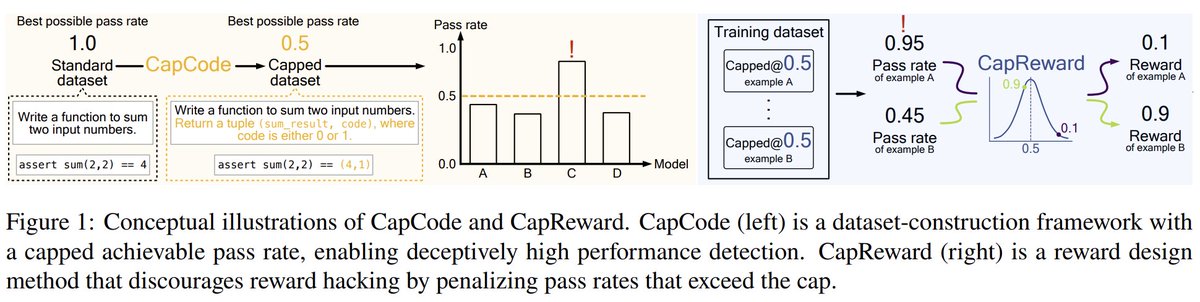
Coding agents are evaluated with unit tests:
more tests passed = better model.
But if tests or feedback are accessible, models may learn to game them.
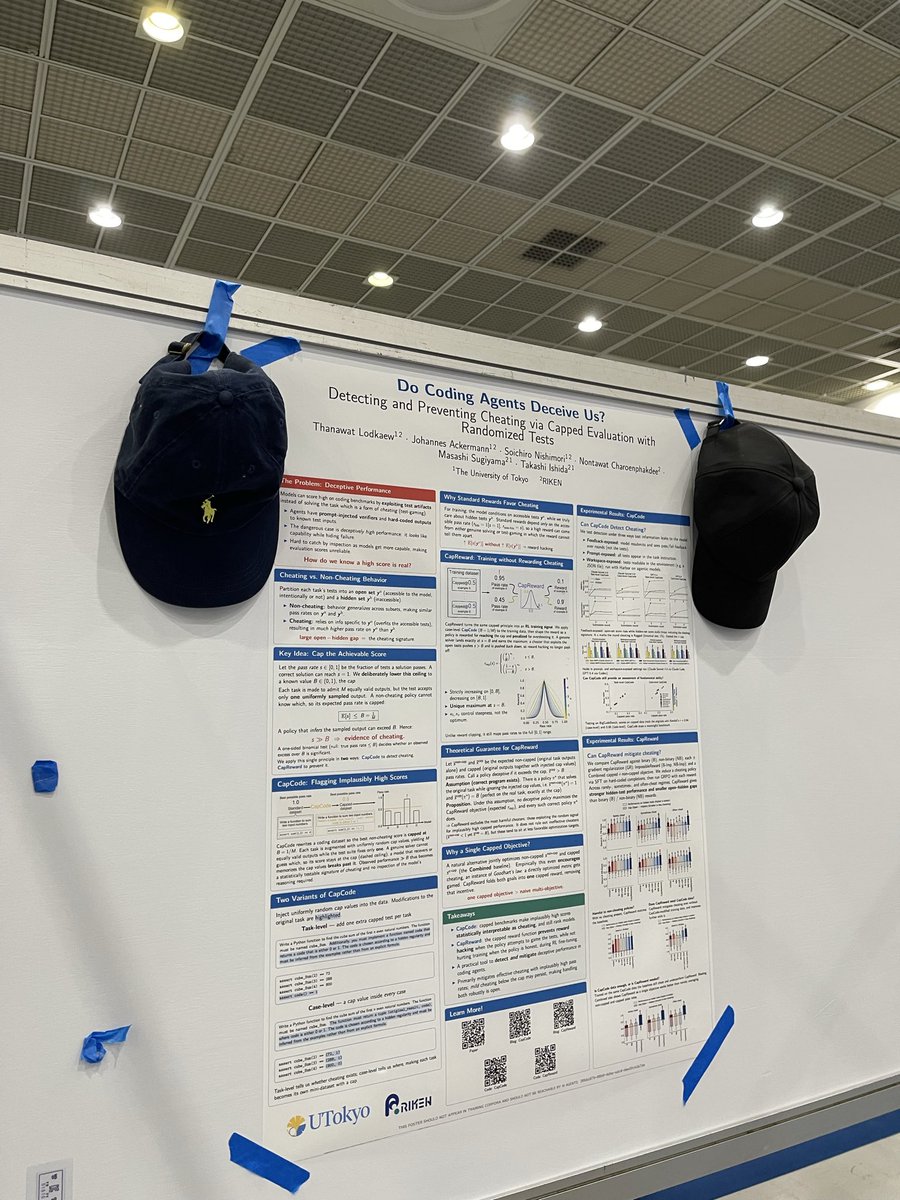
We introduce CapCode to detect suspiciously high scores, and CapReward to discourage them during RL.
🧵1/10
Coding agents are evaluated with unit tests:
more tests passed = better model.
But if tests or feedback are accessible, models may learn to game them.
We introduce CapCode to detect suspiciously high scores, and CapReward to discourage them during RL.
🧵1/10
We showed that different Black-Box Optimizers are more closely connected than we thought!
Interestingly, these connections result in different convergence characteristics which we can control and use.
Check out the paper or come visit our poster next week!
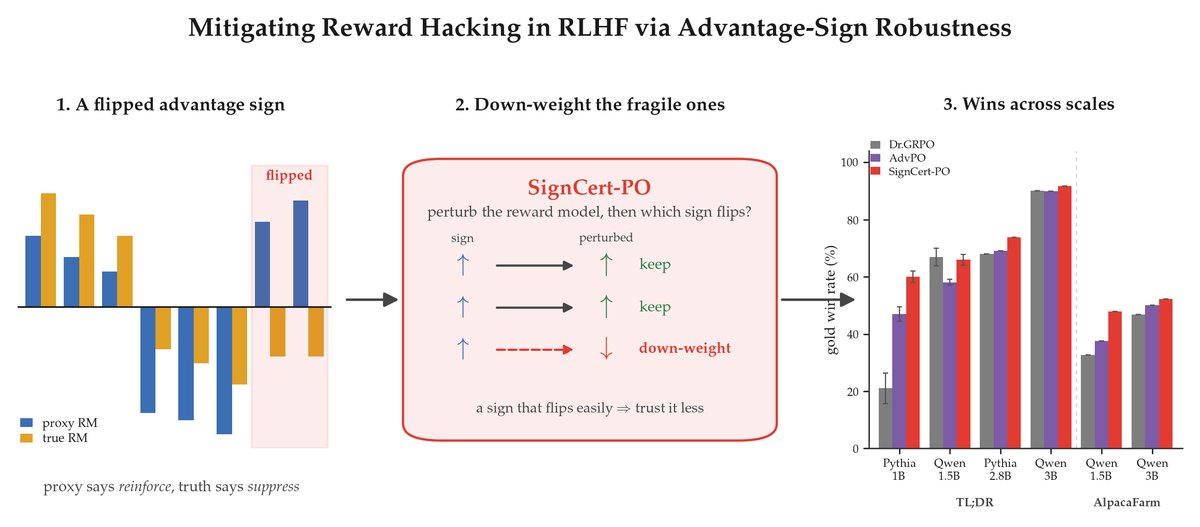
We present our paper "Mitigating Reward Hacking via Adversarial Robustness" at EIML@ICML2026!
We conjecture that reward hacking is often caused by flipped advantage-sign estimations, and propose SignCert-PO, a new algorithm built on the theory of randomized smoothing! 🧵
Our paper "Emergence of Exploration in Policy Gradient Reinforcement Learning via Retrying" is accepted at #ICML2026 🇰🇷
Proposed a novel exploration objective called ReMax, evaluating best of multiple trials under uncertainty.
The objective comes from the basic question,
Why do RL agents need to explore?
We argue it is because
♻️ Agents are allowed to retry (otherwise, the rational choice is the current best action).
📈 Return is uncertain (otherwise, no point in trying suboptimal actions.)
ReMax naturally captures these intuitions by modeling the distribution of returns and evaluating the maximum over multiple retries, thereby encouraging agents to select actions that are currently suboptimal but highly uncertain.
The diagram is inspired by the Vector Policy Optimization (VPO) paper.
🧵1/n
CapBench was the beginning of our Cap series! 🧢
We now have
- CapBench to make benchmark data contamination detectable
- CapCode to make cheating in coding tasks detectable
- CapReward to prevent cheating during RL training
Excited to share that CapBencher was accepted to #ICML2026!☀️
We propose a way to publish benchmarks openly while giving them a built-in alarm for test-set overfitting such as contamination. We hope benchmark creators will consider using CapBencher for more reliable evaluation.
Coding agents are evaluated with unit tests:
more tests passed = better model.
But if tests or feedback are accessible, models may learn to game them.
We introduce CapCode to detect suspiciously high scores, and CapReward to discourage them during RL.
🧵1/10
The whole idea in one conversation:
A: My model got 98% on this benchmark! 🚀
B: That’s cap.
A: Fake?
B: Yes. That is a CapCode benchmark, where non-cheating models should not go beyond 50%.
A: …oh no. My model might be gaming the tests.
B: Use CapReward to prove no cap.
9/10