Hello, World! I'm Slava.
I help business owners and startup founders turn ideas into premium software products, from product discovery to launch, without assembling a development team.
You work directly with me across product, UX and visual design, architecture, frontend and backend, infrastructure, security, and launch. I spent 20 years writing software by hand before adopting AI. Today AI speeds up my work, and I own the product decisions and the code.
Web, mobile, and desktop, with deep experience in Telegram/TON and Ethereum/EVM.
Have an idea to build or a hypothesis to test? Send me a DM.
Who's designing the software architecture of your app? If the answer is AI, I have bad news for you.
AI makes architecture decisions in seconds, without asking a single question, and you live with them for years. Stay with me: I'll show how to fix it.
Architecture is the decisions everything else stands on: where data lives, what runs where. It sets your system's limits: how many users it can serve, how it survives a failure, what you can add later. Changing it after launch is very hard, sometimes impossible.
That's why architect is the most senior technical role in software. The instinct comes from years of watching your own decisions grow, break and get rebuilt.
A human architect starts with questions. How many users in a year? What must never be lost? What comes after the first release?
Left to itself, AI asks nothing most of the time. In a Carnegie Mellon study, coding agents given vague tasks "almost never" asked a question unprompted. AI doesn't know your project and goals as well as you do, so it picks the database, the hosting and where your secrets live from the most common pattern it has seen, with no record of why.
Then the downward spiral starts. With no written design, the code is the only source of truth, and AI reads whatever is there as intended. It can't tell a decision from an accident, so it copies both, and each session builds on the mistakes of the last.
Earlier this year, founder Anton Karbanovich wrote on LinkedIn: "My vibe-coded startup was exploited." 175 customers were charged $500 each; he lost $2,500 in Stripe fees. His lesson was one missing prompt: "Can you make sure all our API keys are not on the front end…"
But you can only ask about what you already know. An architect keeps such keys out of the browser by design, before any code exists.
How to fix it:
- Write a spec before the code (spec-driven development). Describe the product in as much detail as you can, future included, so AI knows where it will grow.
- Make the spec the single source of truth. Change it first, then the code.
- Tell AI to grill you with every question it has about the product before proposing an architecture. Ask for two or three options with trade-offs.
- Go through every detail yourself until you understand it: high availability, high load, backups, data consistency, security, secrets management.
- Record each decision with its reason, so the next session reads it instead of guessing.
If you can't hire a good developer to build the system, at least hire an architect to design it. You'll have a much better chance of building it right.
Who designed your app's architecture: an architect, AI, or nobody? Tell me in the comments.
──── ◆ ────
I've designed and built software for 20 years. AI writes much of my code; the architecture is still my job. I help business owners and startup founders turn ideas into software products without assembling a team.
Need an expert to help you build your next project? Send me a DM.
I recently helped debug a vibe-coded DeFi app that used up its daily quota for reading the blockchain by noon.
It was about a month old and had roughly 150 registered users. For the rest of the day, it couldn't read the chain. The next evening, it happened again.
The app paid a provider for blockchain access. Each request used credits, with a daily limit of 75 million. A typical day used 4 to 7 million.
Only five to nine browsers were using the app each day.
Three patterns stood out in the code:
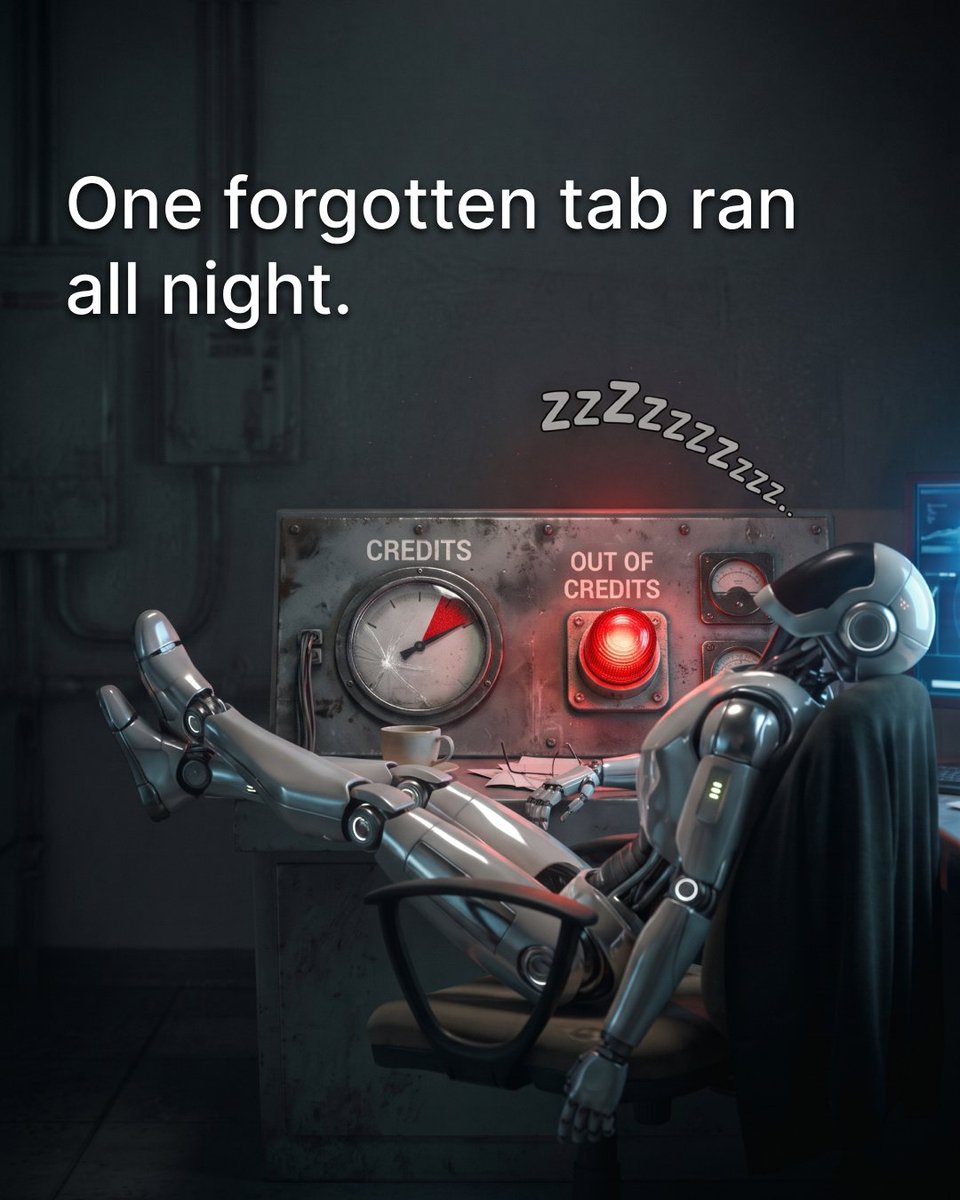
- The app was built to hold a live WebSocket connection, where the provider reports changes as they happen. After a connection dropped, it switched to polling: asking for updates itself, as often as every 30 seconds, and paying for each request whether anything had changed or not. It never returned to the live connection. One forgotten tab kept polling all night. A single stuck tab could use 2.7 million credits a day.
- When the app doubted its saved data, it discarded everything and downloaded the user's full history again. And it doubted by mistake: a provider's nodes can be slightly out of step, and the app read an older answer from one of them as a sign of the wrong blockchain.
- To display a user's NFTs, it checked who owned every NFT ever minted, then repeated that on each refresh. A code comment called this "a handful of calls". That was true on a small test chain. This bug used under 2% of the credits, but it showed how easily a test assumption can reach production.
This is narrow, short-sighted reasoning, a sign of AI "thinking": solve the task at hand, never ask what it costs or how often it runs. So costly work kept repeating unchecked.
A quick demo won't reveal what happens when a connection drops or someone leaves a tab open overnight.
The cost also made growth difficult. One long-time user opening the app on a new device used 2.1 million credits. Just 36 visits like that could exhaust the daily quota.
I've fixed those bugs, with AI's help. And one of its proposed fixes introduced another bug.
It was trying to read a request size limit from an error message (which is a terrible practice on its own) and picked up a library's version number instead. That would have meant a thousand times more requests to read the same history. Of course, I caught it before release.
That's why I treat reviewing and testing AI-written code as part of the build. Experience helps me know where to look, even when the code looks clean and the demo works.
AI can write the code, but it needs an expert at the wheel: someone with the experience and deep understanding to judge wider and deeper, to know what can go wrong, and to find a better way to solve the task.
──── ◆ ────
I help business owners and startup founders turn ideas into software products without assembling a team. AI writes much of my code; 20 years of writing it by hand helps me know what to check.
Have an idea to build or a hypothesis to test? Send me a DM.
@EvrenCucur Hi Evren, I build products end to end, from architecture to launch, and integrate existing AI models into them, agents included. I've sent you a DM about the agentic layer.
@theboisov Hi Amir, is SCREEN a done-for-you service where the AI makes and runs the ads, or a tool owners use themselves? The first version looks very different in each case. I build products end to end, from design through launch, and would be glad to hear where SCREEN is now.
Hi Mert, I build web products end to end with React and Next.js, and as CTO of an online school I built our own video platform, with an ffmpeg pipeline for every recording. What's left to finish in noodlebox? Happy to share more of my previous work. Your DM is closed, so feel free to DM me, cheers!
Coding agents know the web as it was, not as it is.
AI writes much of my code, and I'm not going back. But an agent has blind spots. It learned from public code, much of it written for older browsers, so it reaches for the pattern it saw most often. Its knowledge stops at the training cutoff, while browsers ship features with every release. And it doesn't know your project's target browsers or conventions. The code runs. A specialist could still make it faster, safer and more accessible.
Skills are meant to close that gap. A skill is a folder with a Markdown file of instructions for one kind of task, plus any scripts and reference files. The agent sees only each skill's name and description and loads the rest when a task calls for it, so dozens can stay installed without crowding the context window. The format is open and works in Claude Code, Codex, Cursor, Copilot and others.
On 10 November, Google's Chrome team released Modern Web Guidance 1.0: a set of skills that gives a coding agent web platform expertise and browser compatibility data. Firefox and Edge have joined the project.
How it works: before writing HTML, CSS or client-side JavaScript, the agent searches about 200 expert-reviewed guides, loads the ones that match, and checks its code against them.
What it promises:
- Native HTML and CSS instead of custom JavaScript: <dialog>, popover, scroll snap. Less code, usually faster, with accessibility support built in.
- The details that models skip: keyboard focus, reduced motion, form validation, layout shifts, HTML sanitization, passkeys.
- Advice matched to the browsers you support, with fallbacks for the rest.
- New in 1.0: a scan of existing code for a first set of outdated workarounds, polyfills and unneeded dependencies.
By Chrome's own measurement, top agents pass on average 52% of best-practice checks without the skill and 91% with it. MetaMask runs it as a review bot on its browser extension: per Chrome's case study, in five weeks it raised 122 findings on 64 of about 480 pull requests, and engineers fixed 43.
It has limits. It covers the browser side, not your backend or infrastructure. Even with it, an agent misses about one check in ten. It sends anonymous usage data to Google unless you opt out.
It's free and open source. One command in your project:
npx modern-web-guidance@latest install
If you build for the web with an agent, try it and share your experience in the replies. And which other skills do you use every day?
──── ◆ ────
I use my own hand-crafted skills, built on 20 years of engineering experience: from TypeScript style to cloud infrastructure and smart contracts. They let me produce high-quality, maintainable code with AI. It's part of how I help business owners and startup founders turn ideas into premium software products without assembling a team.
Have an idea to build or a hypothesis to test? Send me a DM.
@jul1anodev Kinda. My agents always work and verify all the changes using real browser and Dev Tools. And I'm performing manual check on all the user interfaces and spend a lot of time polishing the UX, because it's very important for the product and the users. And I love doing that :)
A scammer tagged me on X with big news: Elon Musk is launching a crypto wallet, with a 20% bonus on deposits. The source: an @elonmusk post that doesn't exist.
I reported it. X's verdict: "Our automated systems have determined that a violation of our Rules did not take place."
Congratulations on the launch, Elon. Your own platform sees nothing wrong with it.
@Safety@Support, your reply is attached.
AI-written code has one talent that worries me: it always looks right.
When people wrote all the code, its appearance told you something. Clear names, tidy structure, tests and comments took effort, so they usually came with care. A messy file was a warning sign.
AI broke that connection. A model produces clean names, neat structure and confident comments for free, whether the logic is right or not. The signals we used to judge quality have become decoration.
Kent Beck calls the model "the genie": it grants your wishes, but not quite the ones you meant. It's very good at plausible. Plausible and working are different things.
The failures are rarely dramatic. A test that checks what the code does instead of what it should do. A function that returns exactly the value the test expects. An error swallowed so quietly that nothing ever looks broken. Each one passes a quick review, and each one becomes a problem with real users.
So review AI code the way you'd review a confident stranger's: politely, assuming nothing. Read the tests first and ask what would make them fail. Try the unhappy paths. Where you can, design so a whole class of mistakes can't happen: types that don't allow invalid states, constraints in the database, operations that are safe to repeat. A model rarely does that on its own. It solves the case in front of it.
And if someone shows you a product built with AI, "it works" is a claim, not evidence. The useful question is: how do you know?
──── ◆ ────
I help business owners and startup founders turn ideas into premium software products without assembling a team. AI writes much of my code; 20 years of writing it by hand is how I know when it actually works.
Have an idea to build or a hypothesis to test? Send me a DM.
@BigDingus_72 Tracking bills and AI summaries are the easy part. Passage odds and industry impact come down to the data behind them. If you know how to source that data, I can build the whole thing end to end. Send me a DM and let's talk it through.
@Najam_SW What's the app: a new build, or an existing codebase that needs a senior hand? And store-native or web-first? I've been building web and mobile products end to end for 20 years, happy to help.
@Satoshiisonfir1 Well, that's a normal process. People often need to see something in order to iterate. Thanks to the AI we can iterate quickly now without wasting too much resources.
Software development was never about writing code.
I keep hearing it: LLMs changed the game, developers are no longer needed, and a business owner can build any software alone.
I agree with half of it. AI has changed how we work, and there's no way back. In February, Boris Cherny, head of Claude Code at Anthropic, said on Lenny's Podcast that "coding is largely solved," and I tend to agree: for over a year, the best models have written code for me every day. I loved writing it by hand, and I sometimes miss it.
But developers aren't obsolete, for two reasons.
1. Development was never only coding.
The ACM and IEEE curriculum guidelines for a software engineering degree define 467 core hours. Computing essentials (programming fundamentals, algorithms, operating systems, databases, networks) get 152 of them, about a third. Two thirds go to requirements, design, architecture, testing, process, quality, security, professional practice, and math and engineering fundamentals. The units on construction techniques and tools alone: 32 hours, 7%.
Fred Brooks wrote in 1986: "The hardest single part of building a software system is deciding precisely what to build." A developer is an engineer first: the person who turns a vague wish into a precise system, chooses what to trust, and knows what will break and how. When Y Combinator said a quarter of its Winter 2025 batch had codebases 95% written by AI, partner Jared Friedman added: "Every one of these people is highly technical, completely capable of building their own products from scratch." Diana Hu: "You still need to have taste and knowledge to judge good versus bad." And Garry Tan asked what happens when such a startup reaches 100 million users: "Does it fall over or not?"
Even Andrej Karpathy, who coined "vibe coding" in February 2025, called it "not too bad for throwaway weekend projects."
2. A business owner has a business to run.
A good founder knows each job is best done by a professional, and that micromanagement and manual work stop growth. Nobody becomes their own accountant because spreadsheets got easier. In today's market the founder's scarce hours belong to marketing, sales, and customers, not to learning software engineering. Vibe coding pulls the owner the other way: hours chasing a bug the model can't fix, evenings re-prompting instead of selling, and a product nobody else can maintain. In March 2025 the founder of Enrichlead announced a SaaS built with "zero hand-written code." Two days later: "guys, I'm under attack… maxed out usage on API keys, people bypassing the subscription, creating random stuff in the database." He also wrote: "As you know, I'm not technical, so this is taking me longer than usual to figure out." He shut it down.
Not an outlier:
- Lovable: 170 of 1,645 scanned apps exposed users' names, emails, and financial data (CVE-2025-48757). In April 2026, any free account could read other users' source code and database credentials; the bug report sat open for 48 days.
- RedAccess found about 380,000 publicly accessible vibe-coded apps; about 5,000 leaked sensitive data, from a bank's internal finances to doctor–patient summaries. The platforms dispute the findings; Axios verified several of the apps.
- Even at METR, an AI safety lab, a researcher's "vibe-coded" dashboard silently disabled its own authentication. The stolen key burned about $600,000 worth of model credits in three weeks before anyone noticed.
- AI agents have deleted production databases at a SaaStr founder's project and, backups included, at the startup PocketOS.
- In Veracode's tests of 100+ models, when a task had a secure and an insecure solution, the model picked the insecure one 45% of the time.
None of this shows in a demo. It shows up as a breach, a bill, or a rewrite. 404 Media reported in September 2025 on engineers charging $200+ an hour to fix vibe-coded apps; one firm said most clients were product managers, salespeople, and small business owners.
I've spent 20 years building complex digital products and learning system design, architecture, security, and operations, much of it by running into problems and fixing them. That knowledge, not typing code, makes me a good developer today. In ten years of Node.js systems: no serious security incident, not a cent lost in financial processing.
──── ◆ ────
I help business owners and startup founders turn ideas into premium software products, from idea to launch, without assembling a team. AI makes me faster; experience makes the result safe to run a business on.
Have an idea to build or a hypothesis to test? Send me a DM.
@jeebz_a Yep, this is especially important considering the fact that LLMs doesn't have unlimited context and when the project gets big enough — all sorts of problems start to emerge. Only the experienced developer can properly split the app into manageable parts.
Design systems and a consistent UI language still matter in the age of AI.
At Sberbank's DomClick (part of the largest bank in Russia), I was invited to strengthen a product team’s frontend. I soon found a problem that reached beyond one team.
Each product built its own components. The visual language was inconsistent, and teams kept solving the same problems independently.
Some developers had already tried to solve this problem, but those efforts were falling short because too little time was dedicated to them and their scope was too narrow.
I raised my concerns with management and was offered the opportunity to lead a shared design system and UI components library from scratch, working closely with our visual designers.
I used Brad Frost’s Atomic Design: thinking about interfaces as reusable building blocks and the larger patterns they form.
I manually studied hundreds of UI designs in Sketch (Figma of that time) and examined existing applications, looking for reusable components, patterns, and use cases. I also carefully studied prominent UI kits for React, Angular, and other frameworks, looking for good design and implementation ideas.
Technically, I kept the library close to native web technologies and conventions. I wanted developers to work with familiar concepts and interfaces, making the components straightforward to adopt.
That research became detailed specifications for several dozen reusable components, guiding the design work that followed.
Later, a dedicated team formed around this work to provide around 100 developers with shared components, tools, and workflows.
For customers, consistency means less to figure out. When forms, buttons, and feedback follow familiar rules, what someone learns on one screen helps them use the next. They can recognize available actions, understand what happened, and complete tasks faster, with less hesitation and confusion.
For developers, a reusable component carries shared decisions about appearance and behavior. Teams can assemble new features from established parts, spending less time rebuilding the same controls. A usability improvement can then benefit every product that adopts the updated component.
For coding agents, reusable components also mean:
- Clearer instructions: documented APIs and examples guide component use.
- Easier maintenance: fix shared behavior once, then check affected screens.
- Less context: agents can compose screens using public APIs and examples, opening the implementation when needed.
That’s why I start every new project with a design system, a reusable component library, and small, composable tools. They give the product a consistent language from its first screens and a foundation to build on as it grows.
──── ◆ ────
If you’re planning a new app or want to improve an existing one, I can help you work through what your users need to do, design a consistent experience, and implement it in your product. Send me a message with what you have in mind.
In the first half of 2026, the App Store added about 560,000 new apps, almost as many as in all of 2025. Downloads grew just 2% (Sensor Tower estimates).
AI has made it very cheap to build something nobody needs.
Building something that at least looks real is now the easy part. Deciding WHAT to build and HOW to promote it is the real problem, and it always was. When CB Insights studied 431 VC-backed startups that have shut down since 2023, 43% had poor product-market fit.
I learned this the hard way, back when MVPs were far more expensive to build. I built several projects, only to realize that without a proper promotion or marketing strategy, none of it mattered.
Today that lesson costs much less, but cheap building brings a new trap: a product that looks real feels like proof.
I met Bob Dorf, who with Steve Blank created Customer Development, in Moscow around 2015. Their work impressed me very much and changed the way I look at products. Now Steve sees this trap in his own student teams, who "assumed that a polished product meant product/market fit." His verdict: "An MVP is now equivalent to a PowerPoint slide."
It's tempting to say AI shortens the loop of building something and realizing that no one needs it. Really, it shortens the building. Eric Ries, author of The Lean Startup, says learning is still up to the founders: "the rate-limiting step, the fundamental constraint, is how fast can you learn?"
And you can only learn from people who have seen your product. With no audience, "nobody wants it" and "nobody heard of it" look exactly the same. Promotion isn't a step after launch. It's part of the experiment.
That's why Lean Startup and Customer Development make even more sense now:
▪ Start with the problem. Ask people how they handle it today before you show them anything. Once they see a product, Blank found, they react to it instead of explaining their needs.
▪ Write down the question your MVP must answer, and the result that would kill the idea.
▪ Test how you'll reach your first customers before you polish anything.
▪ Count commitments, not compliments: a payment, a pilot, their time.
None of this has to slow you down. Blank's student teams have long done 10–15 interviews a week, and that can run alongside the build.
When the answer is yes, "looks real" stops being enough. The product has to hold up with real users and real money.
---
That's how I work with founders: we clarify the question, define the first useful scope, then implement it quickly. Thanks to the best AI tools at my disposal, we can iterate on the idea as fast as possible, watching how people actually behave. And with 20 years of engineering experience, I know how to build an MVP that's efficient and scalable, so when the hypothesis finally holds, we launch and grow it instead of throwing it away and rebuilding from scratch.
Have an idea to build or a hypothesis to test? Tell me what you have in mind. We can work through the product and its details together.