🚨 Due to high demand, I created a new (and much improved) version of the Econ Journal Matchmaker.
New tool here:
https://t.co/kvrQQmo5SG
#EconTwitter Please help spread the word by reposting. 🙏
More details below 👇
Pseudo-Substitutability: A Maximal Domain for Pairwise Stability in Matching Markets with Contracts
Nadia Guiñazú, Noelia Juarez, Paola Manasero, Pablo Neme, Jorge Oviedo
https://t.co/nynviM4YVr [𝚎𝚌𝚘𝚗.𝚃𝙷]
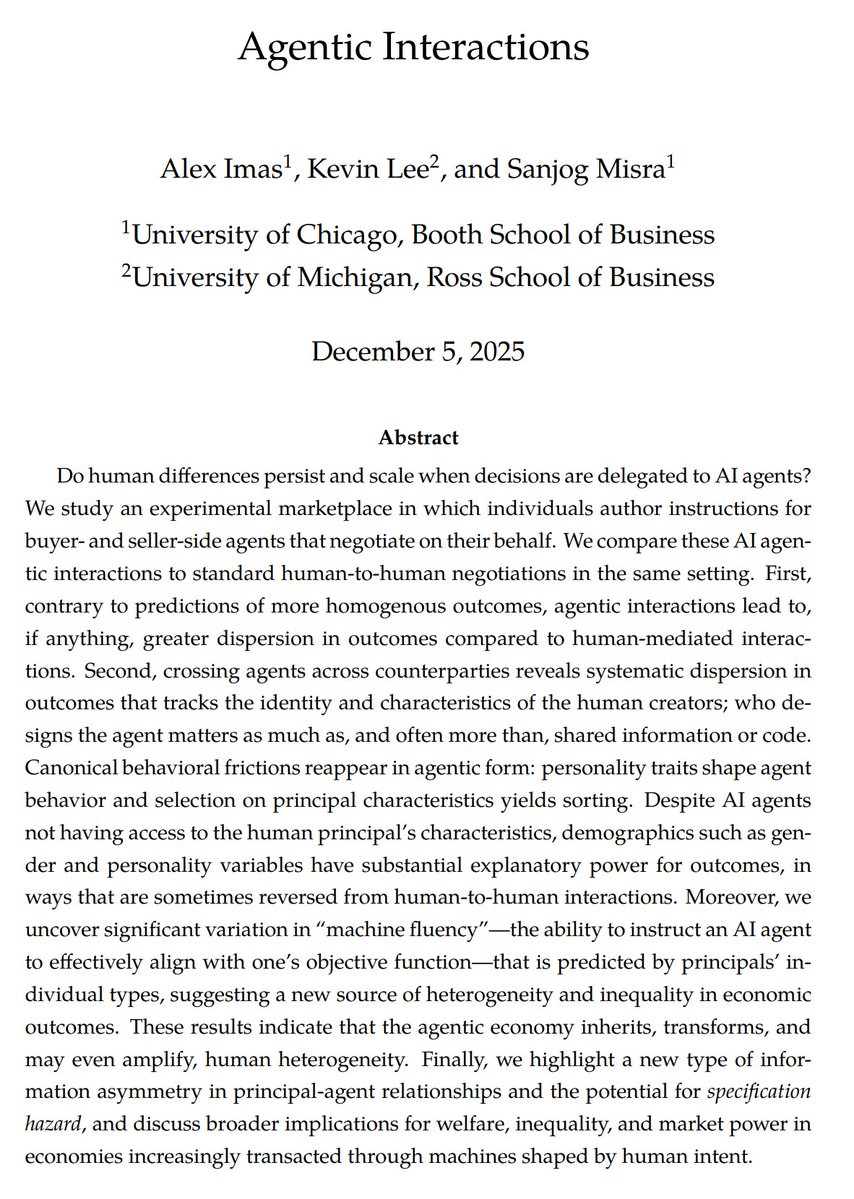
What will economic outcomes look like as transactions become delegated to AI agents?
Will human differences be smoothed away, leading to more homogenous outcomes, or will they be recreated and potentially even amplified?
Will AI agents mitigate inequality, or will it persist and potentially take on new forms?
Will AI agents eliminate information asymmetry in principal-agent relationships, or introduce new frictions?
New paper with K. Lee and @sanjog_misra provides some early answers:
1) AI-agentic interactions, if anything, generate more dispersion and heterogeneity in economic outcomes than human-human benchmarks.
2) Dispersion of agentic interactions can be directly traced back to non-instrumental traits and biases of human principals doing the prompting. Hypothesis of greater homogeneity from (AI)agentic interactions does not seem to hold.
3) There are substantial differences in “machine fluency” —the ability to write prompts that align the agent with the principal’s objective. Some principals are better at maximizing agentic outcomes than others. Principal characteristics predict performance of agent, suggesting new source of inequality.
4) Some traits have similar relationship to outcomes as human-human interactions, but others reverse, e.g., gender difference in negotiated outcomes.
5) Principal-agent relationship changes: prompt now acts as contract. But black-box objective function of agent implies new type of contract incompleteness, which we broadly term “specification hazard.”
As economic activity shifts to autonomous agents, primary source of market distortion may shift from information asymmetries between parties, to principals’ mental models of the AI agents that they are delegating to.
📢Excited to announce: EC'26
📅 When: July 6–10, 2026
🍝 Where: Rome, Italy
General Chair: Stefano Leonardi
PC Chairs: Alex Teytelboym & Matt Weinberg
Hope to see as many of you there!
@AcmSIGecom@econD47#ACMEC26
Economics Lettersに論文が掲載されました。
学校選択のマッチングで、応募側の志望順位に応じて受入側が優先順位を変え得る場合(例:第一志望を高く評価)、安定性と耐戦略性が両立不可能であることなどを示しました。
School choice with rank-dependent priorities https://t.co/K7vevxBjOR
WINE 2025 will be held Dec 8–11 at Rutgers University!
📍 Rutgers, NJ, USA
📝 Paper submission deadline: July 3
🌐 https://t.co/RcvsPncGUo
Calls for tutorials & graduating bits coming soon—stay tuned!
@ycam24 My main concern is: what is the justification for continuing to run the current system rather than DA? I have seen some discussions on Twitter (e.g., https://t.co/bQhxPLlSq5) but haven't found any formal evidence yet.





![January's tweet photo. Pseudo-Substitutability: A Maximal Domain for Pairwise Stability in Matching Markets with Contracts
Nadia Guiñazú, Noelia Juarez, Paola Manasero, Pablo Neme, Jorge Oviedo
https://t.co/nynviM4YVr [𝚎𝚌𝚘𝚗.𝚃𝙷] https://t.co/x4KyjFy2bm](https://pbs.twimg.com/media/HGZwdrraYAAgrNj.png)
![January's tweet photo. Dutch Auctions in Matching Markets with Waiting Costs
Thomas Pitz, Vinicius Ferraz
https://t.co/MuBJrHWeja [𝚎𝚌𝚘𝚗.𝚃𝙷]
💬Code: https://t.co/LYG5YfU6I8 https://t.co/ELylXkfy0U](https://pbs.twimg.com/media/HF1fUfxXUAAzxZi.png)
![January's tweet photo. Lexicographic Robustness and the Efficiency of Optimal Mechanisms
Ashwin Kambhampati
https://t.co/ml3TXIWeCM [𝚎𝚌𝚘𝚗.𝚃𝙷] https://t.co/5RPCwqwxTQ](https://pbs.twimg.com/media/HFW4fnKbAAAj4xk.png)
![January's tweet photo. The Economics of No-regret Learning Algorithms
Jason Hartline
https://t.co/ZVOtHCHcSq [𝚎𝚌𝚘𝚗.𝚃𝙷 𝚌𝚜.𝙶𝚃] https://t.co/mClHRCgVgO](https://pbs.twimg.com/media/G_415IyWgAAxE6e.png)