No banner across the top of your books. No usage telemetry. No account to sign into.
The software does not know you exist, which is the correct amount for accounting software to know about you.
Fixed assets have their own register in SlowBooks Pro: purchase, type, accumulated depreciation and book value per asset, with one button to run the period's depreciation across all of them. https://t.co/AzlxDExXPh
The register now catches a payee you haven't entered as a customer or vendor and asks, right there, whether to add them — before you've even saved the entry. https://t.co/AzlxDExXPh
"Compare to same period last year" — one checkbox on the P&L and Balance Sheet adds a prior-year column with $ and % change, and a prior-year number still drills into its own transactions. https://t.co/AzlxDEyvEP
2.28.0: sub-accounts print under their parent on the P&L now — Hotel indented under Travel, with a family subtotal — instead of a flat list with no relationship between the lines. https://t.co/AzlxDExXPh
Progress billing is coming in the next release: an application for payment off the schedule of values, with work this period, stored materials, retainage held and released, change orders, and lien waivers.
Laid out our own way, not the AIA form itself. Maybe one day. (Licensing)
SlowBooks Pro 2.28.0: every account now carries one of QuickBooks' own fifteen detail types, and your Balance Sheet groups by Current, Fixed and Other Assets automatically. Same chart, more structure. https://t.co/AzlxDEyvEP
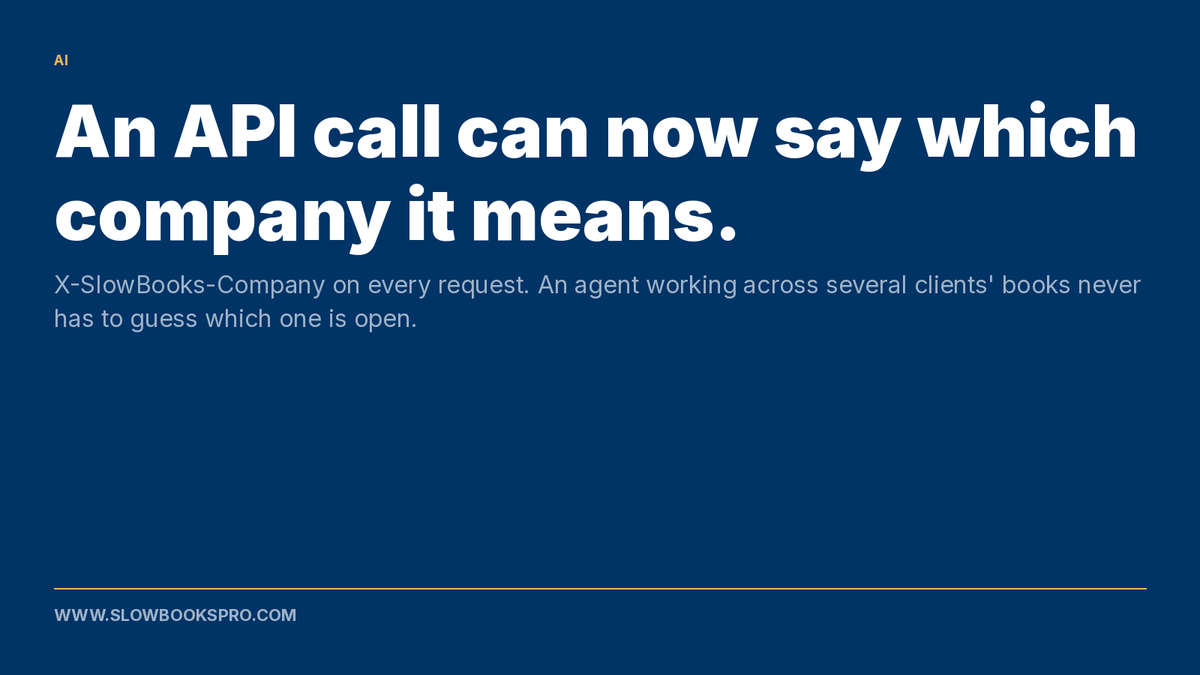
2.25.0 also means an API call can now say which company it means. Point an agent at your install and it works on the right set of books, not whichever one happened to be open. https://t.co/AzlxDExXPh
@awayslice Happy to help.
Email [email protected] with which QuickBooks made it (Desktop on Windows or Mac, or Online) and the message SlowBooks shows.
Quick check first: dates All, default columns, All accounts as a filter (not an Account column), saved as CSV.
A safety rail for software an AI agent can operate.
An invoice that would put a customer over their credit limit is refused outright, with the limit and balance named. Going over takes a second, explicit flag. Nothing quietly decides the limit didn't matter today.
The twelve-dollar balance nobody is ever going to collect, times forty customers, is a real chunk of a bookkeeper's afternoon.
One number, one click: every open invoice under it is written off, each to its own credit memo, with a list of what was skipped and why.
Trent is building something awesome with SlowBooks Pro!
Unfortunately, his website (and UI) don't match the quality of his software. Great websites are hard!
He asked me for a roast, and a roast he got ;)
Enjoy @308Greenfield
A check that pays several things — or a loan payment that is principal and interest in one line on your statement — used to mean picking one category and living with it being wrong.
Now it is one entry with several lines, and it tells you what is left to place as you go.
The bottom row of the register is always ready for the next entry. Date, payee, memo, category, amount — Enter posts it and the next row is waiting.
No dialog to open first. The dialog is still there if you prefer it.
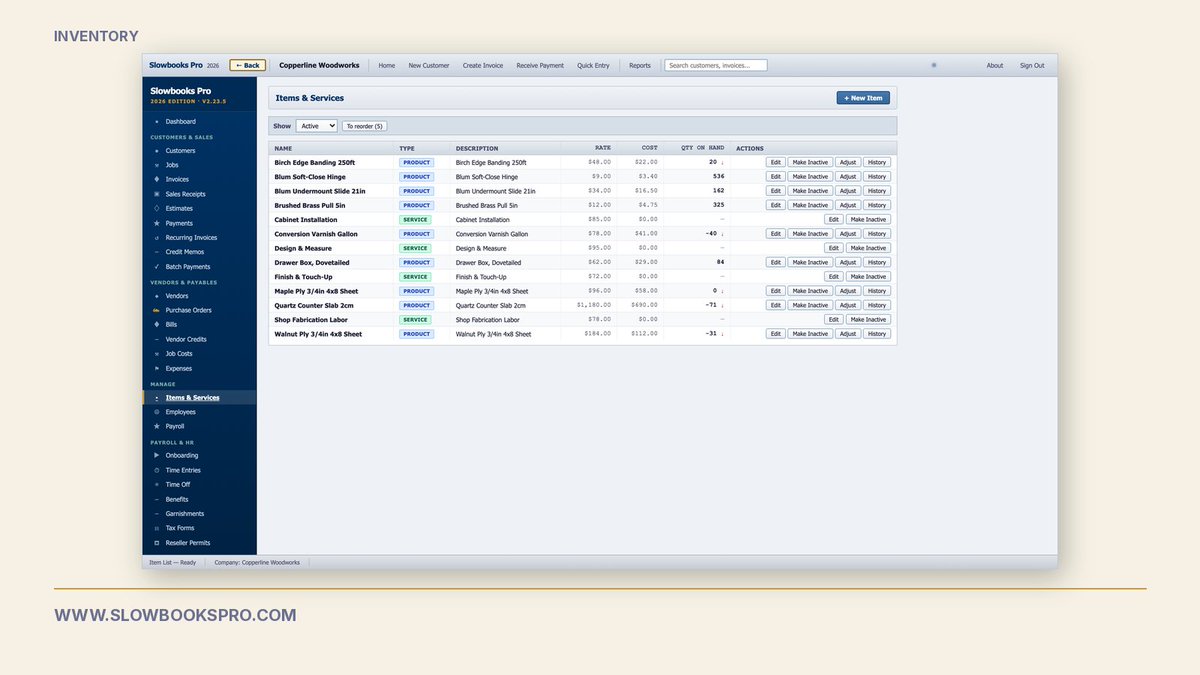
Inventory's already in: perpetual stock tracking, weighted-average cost, automatic COGS entries, reorder points with a low-stock list, count adjustments.
Payments go through your own Stripe: Pay Online link on every invoice, posts to the books by itself. We take no cut, you pay Stripe's rates. https://t.co/ULkO99CUk4
Perpetual inventory: the count on this page is the count on the shelf.
An inventory item carries two accounts — what it credits when sold, what it debits as cost — which is the difference between a real gross margin and a guess.