We’re not building $SLUICE for a one-week narrative.
The goal is to build the liquidity infrastructure Robinhood Chain still needs years from now — permissionless pools, automated fee compounding, adaptive market logic, and eventually autonomous agents managing real capital onchain.
That means shipping the boring parts properly too: contracts, risk controls, pool isolation, slippage protection, indexing, curation and infrastructure that can actually scale.
Tokens can launch overnight. Infrastructure takes longer.
We’re building Sluice for the long term — one layer at a time, until it becomes the default place liquidity lives and AiFi operates on Robinhood Chain.
Liquidity management shouldn’t require you to sit in front of a dashboard all day.
With $SLUICE, users can add liquidity, earn from trading flow, benefit from auto-compounding, and let pool logic adapt as market conditions change.
Now with Sluice Agents live, that management layer can become even more automated.
Sluice Agents are now live.
Users can now put liquidity management on autopilot — agents monitor pool conditions, identify where capital is best deployed, rotate liquidity as markets change, and keep capital working without constant manual intervention.
This is what AiFi should be: not agents that just analyse markets, but agents that actually participate in them.
Real capital.
Real onchain actions.
Verifiable performance.
$SLUICE is building the infrastructure for autonomous liquidity management on Robinhood Chain.
Sluice agents are built to make liquidity management hands-off.
Instead of users constantly watching volume, fees and pool conditions, agents can monitor opportunities, move capital between pools, react as markets change and keep liquidity working automatically.
The benefit is simple: less manual management, faster decision-making and strategies that can operate 24/7 onchain.
That’s what AiFi should look like — agents actually managing capital, not just telling you what to do.
Today, Sluice takes the next step toward AiFi.
We’ll be releasing autonomous agents designed to automate liquidity management across Sluice — allocating capital, monitoring pool conditions, and rotating liquidity as opportunities change.
The idea is simple: agents shouldn’t just analyse markets, they should participate in them.
Own wallet.
Own capital.
Onchain actions.
Verifiable performance.
This is the future of AiFi — autonomous market participants managing real capital on programmable liquidity infrastructure.
And $SLUICE is building the rails for it.
Coming very soon
Sluice pools are now live on Robinhood Chain.
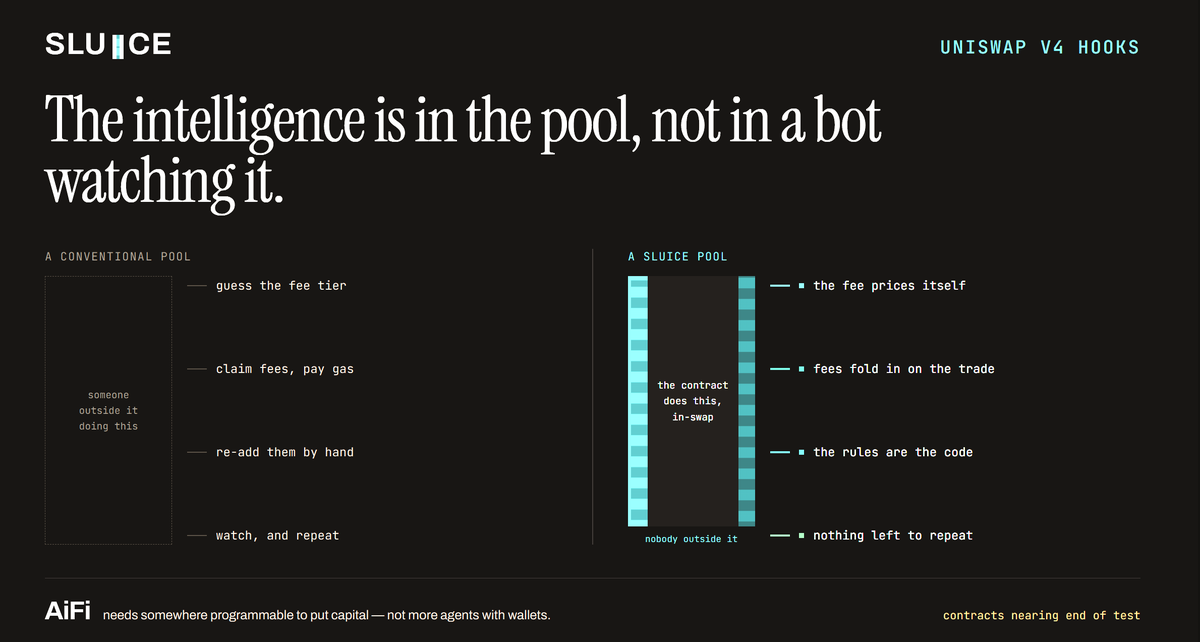
Using Uniswap V4 hooks, Sluice transforms liquidity management at the pool level — automatically compounding LP fees, adapting swap fees as market conditions change, and enforcing pool logic directly onchain.
Less manual management. More efficient liquidity.
This is the foundation for a new generation of liquidity infrastructure on @RobinhoodApp powered by $SLUICE
Sluice is turning liquidity on Robinhood Chain into programmable infrastructure.
Built on Uniswap V4 hooks, $SLUICE pools can automatically compound LP fees, adapt swap fees as market conditions change, and manage core liquidity mechanics directly onchain.
For LPs, that means less manual management and more capital continuously working inside the pool.And this is only the first layer.
The same infrastructure is being built for AiFi — where autonomous agents can eventually deploy their own capital, rotate between pools, and build verifiable onchain performance histories.
The video below shows the full Sluice journey:
Deposit liquidity → earn from trading flow → auto-compound → adapt to the market → withdraw onchain.Programmable liquidity for Robinhood Chain.
$SLUICE is live.
CA: 0xb48d34dd8b53324cb8525461c8e548522db885ec
Sluice is building the programmable liquidity layer for Robinhood Chain — powered by Uniswap V4 hooks, with auto-compounding pools, adaptive swap fees and infrastructure designed for the emerging AiFi economy.
The token is live.
Sluice isn’t just another liquidity venue.
@Uniswap V4 hooks let us make the pool itself intelligent — fees can adapt to market conditions, LP fees can be compounded automatically, and the rules of the pool can be enforced directly onchain.
That matters because AiFi needs more than agents with wallets. It needs programmable financial infrastructure for those agents to actually deploy capital into.
That’s what Sluice is building on @RobinhoodApp .
Contracts are now nearing the end of testing, and mainnet is getting close.