John chapter 4 opens with a sentence that is easy to skim past: "And he had to pass through Samaria." Every first-century Jew reading that would have stopped. He did not have to. Jews traveling between Judea and Galilee routinely took the long way around, crossing the Jordan and adding days to the journey specifically to avoid Samaria. The hostility ran centuries deep. Samaritans were considered half-breeds and heretics, descendants of the mixed population left after Assyria conquered the northern kingdom, keepers of a rival temple on Mount Gerizim that Jewish forces had destroyed a century before Jesus was born. Jews and Samaritans did not share meals, did not share vessels, and rabbinic sources say a Samaritan woman in particular was to be regarded as perpetually unclean. When John writes that Jesus "had to" go through Samaria, the necessity was not geographic. It was a divine appointment with one person.
Notice the time. Jesus, wearied from the journey, sits down beside Jacob's well at "the sixth hour," noon, the hottest point of the day. This matters because no one drew water at noon. Women came to the well in the cool of early morning or evening, together, and the well was the social center of village life. A woman coming alone in the midday heat was a woman avoiding other women. She had arranged her whole day around not being seen. And that is exactly where Jesus was waiting.
He speaks first, and His opening is a request for help: "Give me a drink." The woman is startled, and John explains why for his readers: Jews have no dealings with Samaritans. A Jewish man, a rabbi no less, speaking alone to a Samaritan woman and asking to drink from her vessel was breaking three social walls at once: of ethnicity, of religion, and of gender. His own disciples, returning later, were stunned to find Him talking with a woman at all. Jesus began by placing Himself in her debt, asking something of a person everyone else considered beneath asking.
Then the conversation turns. He tells her that if she knew who was asking, she would ask Him, and He would give her living water. She takes it literally, and gently mocks Him: You have no bucket, and the well is deep. Are you greater than our father Jacob, who gave us this well? She has no idea she has just asked the central question of the Gospel. Jesus answers that everyone who drinks from this well will thirst again, but whoever drinks the water He gives will never thirst, because it will become in them a spring welling up to eternal life. She wants it, still thinking of buckets: Give me this water, so I do not have to keep coming here. Even her request reveals her: she wants to stop having to come to this well at noon.
And then Jesus says the thing that changes everything: "Go, call your husband." She answers, "I have no husband." His reply is devastating and tender at once: "You are right in saying you have no husband, for you have had five husbands, and the one you now have is not your husband. What you have said is true." He knows. He knew before He sat down. He knew when He asked her for a drink. Whether those five marriages ended in death or divorce, whether she was the one who was discarded, the text does not say, and a woman in that world could not divorce a man, so it is at least possible she had been cast off again and again. Whatever the story, she was living outside marriage now, and the whole village knew it, and that was why she came at noon.
Jesus names her shame out loud, and then keeps talking to her. That is the miracle of this scene. He does not use what He knows to dismiss her. He uses it to show her that He is not a stranger she can manage with clever answers. She responds the way people often do when exposed: she changes the subject to religion. Our fathers worshiped on this mountain; you Jews say Jerusalem. It is a real theological question, and Jesus takes it seriously, telling her that the hour is coming when true worshipers will worship neither on Gerizim nor in Jerusalem, but in spirit and truth. Then she reaches for the one hope both peoples shared: "I know that Messiah is coming. When he comes, he will tell us all things."
And Jesus says to her: "I who speak to you am he."
Stop there and take in what just happened. In the entire Gospel of John, this is the first time Jesus openly declares Himself to be the Messiah. He did not say it to the crowds. He did not say it to Nicodemus, the learned Pharisee who came to Him by night in the chapter just before. He did not say it to His own disciples. He said it to a Samaritan woman with five failed marriages, alone at a well at noon, a person that every religious authority of the day would have considered the least worthy to receive it. John places the two conversations back to back on purpose: the respected male teacher of Israel, who leaves confused, and the outcast foreign woman, who leaves transformed.
Then comes the detail that closes the scene. The woman, John writes, left her water jar. The thing she came for, the reason she had walked to the well in the heat, the vessel Jesus had asked to drink from: she abandons it and runs into the town. And the woman who had arranged her life to avoid being seen goes straight to the people she had been hiding from and says, "Come, see a man who told me all that I ever did." Her shame had become her testimony. The very thing she hid was now the thing she announced, because someone who knew all of it had not turned away.
The village comes out to Him, and they beg Him to stay, and He stays two days, and John records that many believed, telling the woman, "It is no longer because of what you said that we believe, for we have heard for ourselves, and we know that this is indeed the Savior of the world." That title, the Savior of the world, appears here, in a Samaritan town, on the lips of people Israel despised. The first community outside Israel to receive Jesus was reached through a woman the town had shunned.
There is one more piece worth knowing. The well is still there. Jacob's Well sits at the foot of Mount Gerizim near ancient Shechem, in the modern city of Nablus, a deep shaft cut into rock, roughly a hundred and thirty feet down, exactly the "deep" well the woman described. Pilgrims have drawn water from it since at least the fourth century, and its location has never been seriously disputed. You can lower a bucket into the same water today.
To the world, religion is for the respectable, the clean, the ones with their lives in order. But the first person Jesus ever told that He was the Messiah was a woman with a history everyone whispered about, and He went out of His way, days out of His way, into enemy territory, in the heat of noon, to sit and wait for her.
He knows everything you ever did. All of it. And He is still sitting at the well, asking you to come and talk. The shame you have organized your life around hiding, He already knows, and He has not left. He is not waiting for you to fix it first. He is offering you water that ends the thirst.
Leave the jar. Go tell someone.
Jesus is the Savior of the world, the Living Water. Thank You, Jesus.
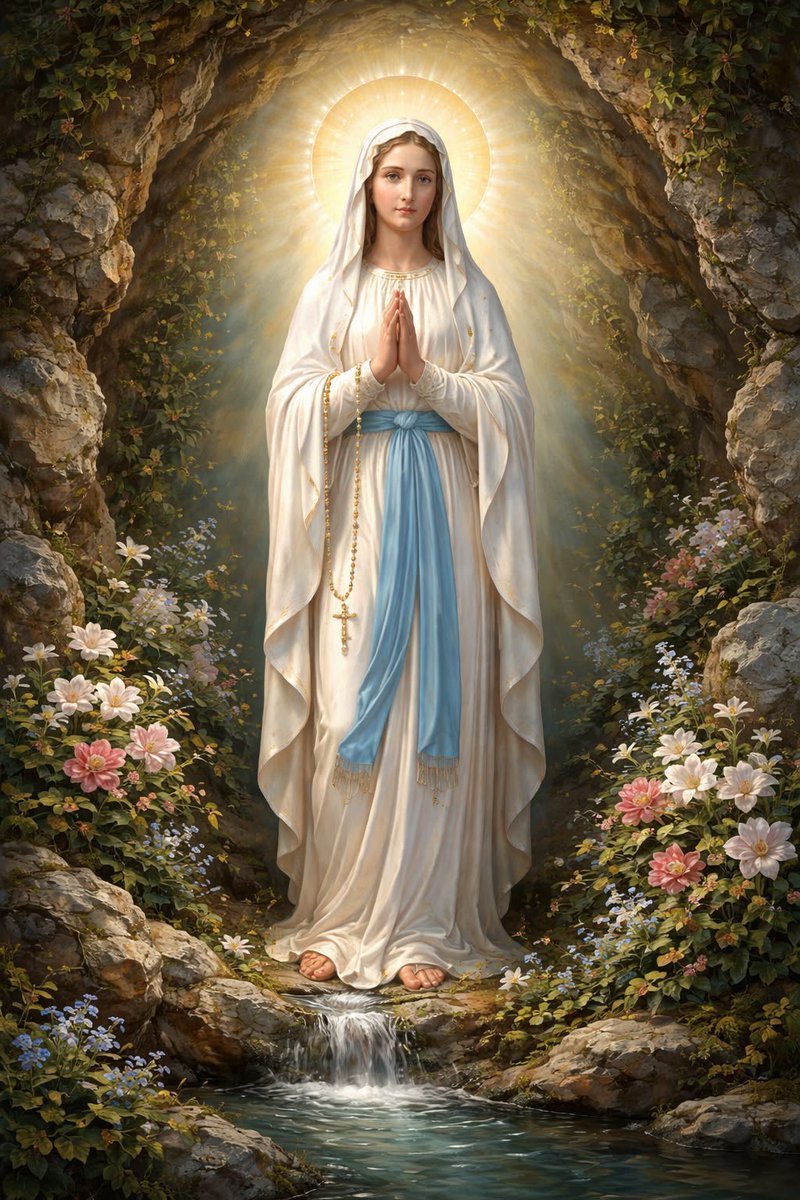
🙏 When Everything Feels Like an Obstacle, Pray to Our Lady of Lourdes
Our Lady of Lourdes, tender Mother of mercy,
I come before you today with a heart that is tired, worried, and in need of your loving intercession.
You know the burdens I carry.
You know the fears I have not spoken aloud,
the tears I have hidden,
and the situations that seem to have no clear way forward.
When everything feels like an obstacle, Mother Mary, please stay close to me.
Look upon the need I carry today:
[Place your urgent petition here.]
Our Lady of Lourdes,
bring this need before your Son, Jesus.
Ask Him to make a way where I cannot see one.
Bring healing where there is sickness,
peace where there is anxiety,
strength where I am exhausted,
and hope where I have begun to lose heart.
Please watch over those I love.
Protect our families and our homes.
Guide the hands of doctors and caregivers.
Give wisdom to those who must make difficult decisions.
And comfort everyone whose heart is frightened or weary.
Mother Mary, when the answer does not come quickly,
help me remain faithful.
When the door seems closed,
help me remember that God can open a door I cannot yet see.
Teach me to place my deepest fears into God's hands
without surrendering my hope.
Our Lady of Lourdes,
Health of the Sick and Comforter of the Afflicted,
carry my prayers to Jesus.
Ask Him to strengthen my faith,
quiet my heart,
and give me the grace to trust His perfect timing.
And if the path ahead is different from the one I imagined,
give me the courage to walk it knowing that I am not alone.
May the healing, peace, and love of Christ surround you today. May Our Lady of Lourdes keep you beneath her maternal care, and may God make a way through every obstacle standing before you. 🤍