Yesterday in Parliament, the Cabinet Secretary for Health, Aden Duale, failed to assure the country that the government’s decision‑making on the Ebola question is within the law and fully under control. The Constitution demands both legality and respect for court orders and public participation.
Listening to him, the message is clear, the court will have its say but the executive will enforce their way.
When a High Court has already issued conservatory orders suspending an Ebola‑related facility, any suggestion that the Executive can press on regardless converts being within the law into a slogan to justify disobedience. Constitutional obedience is not optional and it is not subject to administrative convenience.
Kenyans are entitled to clear, honest answers. Who authorised these arrangements, on what legal basis and with what safeguards for public health and sovereignty? Dismissing concerns as mere alarm while sidestepping these questions undermines public trust in both the Ministry of Health and Parliament’s oversight role.
The right to health under Article 43 must be read together with Articles 10, 94, 95 and 165 on constitutionalism, public participation and the authority of the courts. You cannot promote public health by eroding the very legal framework that protects Kenyans from arbitrary executive action.
@Ade_Dohyeen @Shad_khalif This is beautiful. A lasting marriage is not always about doing things the way the world expects, but about two people understanding each other deeply enough to create a love that works for them. I long for that kind of love - honest, peaceful, intentional and lasting.
The sooner we all realize that no one is immune & that governance affects everyone, that silence is not an option and that no amount of personal success will shield us from systemic collapse, the sooner we might actually demand better. #RejectFuelPrices
Advocates must uphold dignity, integrity & honour at all times. Senator Karen Nyamu’s remarks were unfortunate and fell below the standards expected of a public figure and Advocate. @LawSocietyofKe should take appropriate action to safeguard the integrity of the profession.
In a moment meant to inspire a young, female Grade Ten learner visiting the Senate on a learning program, introduced with genuine enthusiasm by the Speaker , Senator Karen Nyamu rose not to engage, but to smear. Her demand for 'clarification' as to what 'specific service' this student was there to offer, followed by a vile allusion to sexual favors, is beyond disgraceful.
Does Senator Nyamu's mind operate so singularly within the transactional degradation of such 'favors' that she projects this depravity onto an innocent schoolgirl?
Nike spent ten years trying to break the 2-hour marathon. They named a project after it. They built special shoes. They paid the greatest marathoner alive to chase it. Yesterday, a Kenyan runner finally did it in 1:59:30, wearing Adidas.
Sabastian Sawe used to be a pacemaker. A pacemaker is the kind of runner you hire to set the speed for the first few miles of a race and then drop out before the finish. In January 2022, Sawe got booked to do exactly that at a half-marathon in Spain. He'd never raced more than three miles in his life. He stayed in for the full 13 and won the whole thing. Adidas signed him not long after. Four years later, he became the first human ever to run an official marathon under 2 hours.
Nike, meanwhile, started this whole project in 2016 with a public goal called "Breaking2." They paid for the shoes, the pacemakers, the science labs, and Eliud Kipchoge himself. Kipchoge ran 1:59:40 in Vienna in 2019, but the event was a closed-course exhibition with rotating pacemakers and a pace car projecting a green laser line onto the road. The sport's governing body never recognized it as a real race. It didn't count.
Then Nike's running business cratered. Digital sales fell 26% in one quarter. Their share of footwear sold at Dick's Sporting Goods went from 39% to 32% in five months. On Running grew from $330 million to $1.8 billion between 2020 and 2025. Hoka nearly quadrupled. Roger Federer left Nike for On. Nike's board fired the CEO in October 2024.
Adidas spent the same period building a better shoe. The new Adizero Adios Pro Evo 3 took three years to develop. It weighs 97 grams, about 3.4 ounces, lighter than a deck of cards. A Wall Street Journal-cited study found that wearing a shoe 3.5 ounces lighter saves a runner around 57 seconds across a marathon. Sawe beat the third-place finisher by 58 seconds.
Adidas also did something Nike never did for Kipchoge. They wrote a $50,000 check to the official anti-doping body for track and field, asking it to test Sawe more aggressively than any other runner alive. He got tested 25 times in the two months before last year's Berlin Marathon, and Adidas signed up to fund this for the length of his contract. The logic: the moment Sawe ran a marathon this fast, the world was going to ask if he cheated, especially after his countrywoman Ruth Chepngetich got a 3-year doping ban in 2025. Adidas got out ahead of it.
The shoe retails at $500 and is barely available. Adidas's Adizero shoes won half of all major marathon races in 2024. Yesterday in London, four of the top five finishers wore the same Adidas shoe. Yomif Kejelcha crossed the line 11 seconds after Sawe and also broke 2 hours. The top three runners all beat the previous world record.
Nike's only response was an Instagram post. Three sentences long: "The clock has been reset. There is no finish line." That was their entire public reaction to losing a 10-year moonshot to their biggest rival.
BREAKING VIDEO: Kenya’s Sabastian Sawe becomes the first person ever to win a regular marathon in under two hours, setting a new world record at the London Marathon in 1:59:30!
Kenyans invented running™
Justice Mohammed Khadhar Ibrahim was appointed a Judge of the inaugural Supreme Court of Kenya on 16th June 2011 after an open and competitive interview.
Hon. Justice M.K. Ibrahim served as the Supreme Court representative to the Judicial Service Commission having been elected on 17th May 2022. He also served as the Chairperson of the Judiciary Committee on Elections, following his appointment on 16th August 2021 by the Chief Justice.
He studied law at the University of Nairobi before entering private practice. He joined the firm of Messrs Waruhiu & Muite Advocates in November 1982 and was subsequently admitted to the Roll of Advocates on 11th January 1983. He was the first from among the Kenyan Somali community to be admitted to the Bar as an Advocate. He progressed in the firm, becoming a salaried partner in 1985 and a full partner in 1987.
He went on to establish his own practice, Mohammed Ibrahim & Associates, in 1994. The firm subsequently expanded to become Ibrahim & Isaack Advocates in
The firm litigated civil and constitutional cases and specialized in banking law, company law, bankruptcy, commercial law, property law, conveyancing and insurance law.
The judge invested heavily both personally and professionally in securing rights for minority groups, particularly the Somali community, in Kenya. He fought against the discrimination of Kenya Somalis when the Government gazetted the use of “pink cards” which were secondary identity cards issued upon provision of further proof of verification of citizenship, and which was used to relegate Somali community to second class citizens.
He had a strong commitment to social justice and while in private practice took on pro bono activities and community service, even in the face of great difficulties. As a result of his opposition to aspects of the one-party regime, he was detained without trial in July 1990 and spent one month in solitary confinement in Kamiti Prison for giving legal advice and supporting pro-democracy champions.
He was an active member of the Law Society of Kenya and in 1994 he was elected to the Council for a term of one year. He worked with Kituo Cha Sheria and served as a member of the board of the Legal Education and Aid Programme (LEAD). He was a founding trustee of the human rights organization, Mwangaza Trust, until 1994. He was a past member of Lawyers Committee for Human Rights and a current member of the Kenya Magistrates and Judges Association.
He was appointed as a Judge of the High Court on 221d May 2003 and first served at the Civil Division of the High Court, Milimani, Nairobi from June until July 2003, when he was transferred to the Commercial Division of the High Court at Milimani. In 2004 he was appointed to the newly established Judicial Review and Constitutional Division of the High Court, where he served until his transfer to the Eldoret High Court in January 2006.
He was Resident Judge at Eldoret between 2007 and 2009 where he heard matters for the entire North Rift Valley, occasionally assisting the High Court Kisii. In July 2009, he was transferred to the High Court at Mombasa, where he also served as Resident Judge until his elevation to the Supreme Court of Kenya.
Innalilahi wainna ilayhi rajiun.
Kenya becomes the first country in the world to win all Distance Events at the 2025 World Championships.
800m - Lilian Odira
1500m - Faith Kipyegon
3000m steeplechase - Faith Cherotich
5000m - Beatrice Chebet
10,000m - Beatrice Chebet
Marathon - Peres Jepchirchir
I dared to try 💜
#Breaking4 was about showing the world that we have to push ourselves. This one was for all the young girls and women out there to show that you have to believe in yourself in everything you do.
Kenyan police cornered peaceful protesters in a blocked alley, beat them up, then teargassed them.
"Larry ukienda tutauliwa," one of them said. "If you leave, we'll get killed."
Police brutality during protests against police brutality
You wake up at 5AM not to build hospitals, not to fix roads, not to feed children .
But to wrap Parliament in wire like a crime scene.
You barricade the city like you’re under siege. But the only thing you’re hiding from is the truth.
You don’t fear bandits. You don’t fear cartels. You don’t fear the murderers in government.
You fear the teacher who speaks out. The youth who stands up. The mother who says ‘enough.’
That’s who you fear. Because you know ; once the people wake up, you can’t govern them with lies anymore.
Kenyans are not asking for too much.
They just want to wake up, work hard, feed their families, and sleep without fear.
But even that has become a privilege.
Today, millions are one illness away from ruin. One job loss away from hunger. One protest away from a bullet. School fees have become a punishment. Food is now a luxury.
And yet, the government lectures them about “sacrifice” from the comfort of tax-funded offices and five-star hotels.
The mama mboga is overtaxed.
The boda rider is overpoliced.
The student is overcharged.
The protester is overbeaten.
The sick are overlooked.
The dead are unmourned.
Kenyans are being suffocated , not just by poverty, but by policy.
By leaders who rob them in the name of reforms.
By politicians who remember them only when it’s time to vote, and forget them the moment the votes are counted.
This regime fears accountability. It fears the image of children running from teargas more than the violence itself.
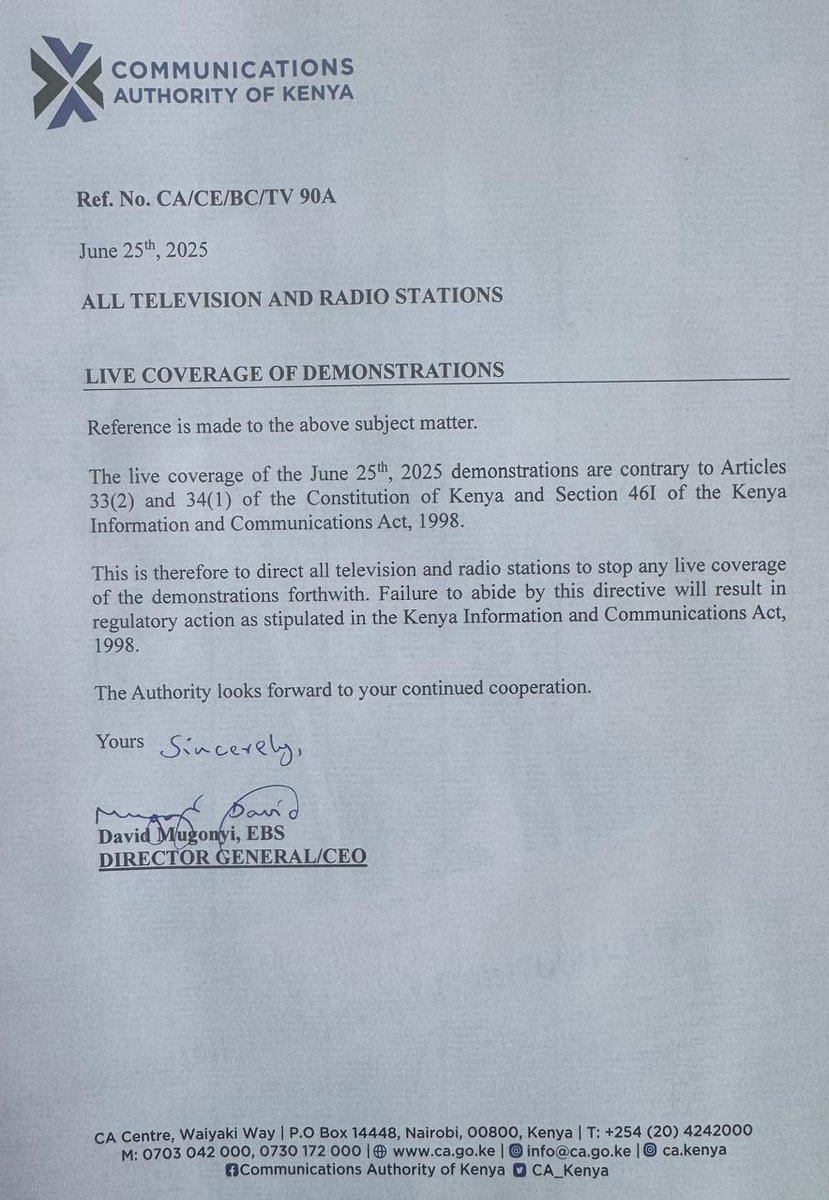
@WilliamsRuto, if your leadership can't withstand live cameras, it has no legitimacy.
Gagging the press won’t stop the truth , it will only expose your fear.
Kenyan police have turned Nairobi into a war zone, using tear gas, flash bangs and water cannon trucks indiscriminately against mostly peaceful protesters.
PS: Please don't crowd around my team when you see us. It makes our signal terrible like this