Some market history: Bear market rallies
The Nasdaq produced nine major rallies averaging 23% each while it plunged 78% from its March 2000 peak of 5,049 to its October 2002 low of 1,114.
- The rallies were real, and they were big. Spring 2001 is the clearest example. The Nasdaq crumbled 68% to 1,638.80 on April 4, 2001, then leapt 33% in the following two weeks and 41% a month later. Each one felt like the bottom when it happened. The arithmetic is brutal. The nine rallies added a combined 4,886 points, yet the index still fell 3,935 points, or 78%, from peak to trough.
- A 20% bounce does not mean a new bull market. Every rally except two cleared the textbook 20% threshold, and all of them failed. Rallies were often followed by drops of 25% to 43%, so the biggest bounces led to the worst falls.
- Lower interest rates did not save it. The bubble collapsed even as the Fed was frantically cutting rates from 6% to 1.25%. That matters today because many people treat Fed easing as a floor under the market.
- Price alone could not tell the rallies from the real bottom. The bounce off the October 2002 low looked like all the others. What changed was the fundamentals. Valuations had reset and earnings had stopped falling. Watching earnings revisions and valuations tells you more than the size of a bounce does.
- Recovery took a very long time. The Nasdaq didn’t get back to its March 2000 peak until May 2015. For a portfolio heavy in high-multiple tech, that is the risk worth sizing against.
One caution, this is not to compare it with todays market. In 2000 the index leaders had little or no earnings. Today’s leaders have very large real profits, so the pattern can rhyme without repeating. The useful lesson is about how markets behave in a bear market. It is not a forecast on today's market.
$QQQ $VOO
Gold at 13 months low, bitcoin fallen six weeks in a row, and the dollar at its strongest
- A December rate rise is priced at 97.4%. Not likely. Priced. And two Fed officials have said 25 basis points may not be enough.
- October was the seventh consecutive month in which prices rose faster than wages.
- The thirty-year mortgage is 7.11% and Fannie Mae expects 7.5% through 2027. A year ago it was 6.24%.
- Gold is at a thirteen-month low, bitcoin has fallen six weeks in a row, and the dollar is at its strongest since April 2025. All three say the same thing.
- October retail sales land this morning. September came in at 0.8% and the consensus for October is 0.2%.
- Nvidia reports tonight, Anthropic prices tomorrow and trades Thursday, and Trump, Xi and Putin meet in Shenzhen on Wednesday.
One housekeeping note, daily market update letters has spent too much of the past week on $NVDAompany $NVDA . That was where the news was, but a market letter that becomes a single-stock tracker stops being useful. So today is a market update, and Nvidia gets the space it deserves rather than the space it has been taking.
https://t.co/G0icJ6ACIS
https://t.co/G0icJ6ACIS
Anthropic (ANT): Richer than Facebook on day one
Anthropic prices its IPO on Wednesday. I spent the weekend with the prospectus.
I went in expecting to write about growth. I came out writing about a number on page one of the commitments table that almost nobody is talking about.
I also lined the IPO up against Microsoft in 1986, Google in 2004 and Facebook in 2012, using what each was valued at on day one and what became of it. One of those comparisons flatters Anthropic. Another one should worry anyone buying at the open.
My valuation and my odds are in the piece. They don’t agree with each other, and I explain why.
https://t.co/fyPFzGfevb
$NVDA $MSFT $META $GOOGL
MercadoLibre (MELI) deep dive: growth, margins and Latin America
MercadoLibre closed at $1,491.49 on Friday 13 November 2026. That is 42.9% below its record close of $2,613.63 on 30 June 2025, and it follows three weeks in which a lot happened at once.
On Sunday 25 October Brazil re-elected Luiz Inácio Lula da Silva with 51.8% of the vote, after he had trailed Flávio Bolsonaro in the first round. On Monday the Ibovespa fell 13.88% and the dollar rose 8.21% against the real. MercadoLibre fell 7.8%. On Wednesday 4 November it reported third-quarter revenue up 45% to $10.75bn, an operating margin of 6.3% and diluted EPS of $8.83, below the $9.27 to $9.41 range of consensus figures quoted after the print. On Thursday 5 November it fell 12.0% on a day the S&P 500 fell 4.4% and the Nasdaq Composite 5.5%.
So the question is a fair one. Is this a great franchise on sale, or a business whose margin problem and home markets deserve a lower price?
My answer has two halves, and both matter. The business is in good shape. Growth is still above 40% FX-neutral, the shopping and payments habits it is paying for are showing up in the numbers, credit quality on the measures that matter most is stable, and on its own trading history the stock is close to the cheapest it has been in years. The price, meanwhile, already treats MercadoLibre almost as if it earned its money in the United States. Put through my model, $1,491.49 implies a discount rate of 10.77%, against 11.07% for a US company with the same beta. If you think MercadoLibre has earned that treatment, the stock is about fairly priced today with real upside in the scenarios. If you charge it a normal premium for Brazil, Mexico and Argentina, it is expensive. The rest of the piece is the evidence for each side, so you can decide where you stand.
Read the full piece here:
https://t.co/IeWZCrs7ha
$MELI
HE CALLED HER A DEER IN THE HEADLIGHTS. SHE'S NOW THE CEO
- Jensen Huang resigned yesterday. His chief financial officer, Colette Kress, is interim chief executive. Before he went, he had belittled her in front of the finance team over a disagreement about how Nvidia funds its own customers.
- Nvidia fell as much as 14.3% during the session and closed down 4.34%. Sixth straight weekly decline, 29% off, $1.6 trillion of market value gone.
- The stock lost 11% this week. About nine of those points arrived before the resignation did.
- Nebius grew revenue 571%, beat consensus, raised its capital spending by billions, and fell 17.7%.
- AMD is up 44.7% in five sessions and trades on 126 times trailing earnings. Nvidia’s multiple is at a 14-year low.
- There is an almost exact precedent for a chip company losing its chief executive this way and handing the job to its finance chief. It took two years to work through, and not well.
Everything above is the easy part. The reasoning, the numbers behind it, why I am giving Michael Burry this one, and what I think it means for Tuesday are in the link below.
$NVDA
https://t.co/2o9SiC36rT
Can Jensen survive the VP allegation ?
For two weeks the story was espionage. The New York Times reported on 29 October that Huang had a close relationship with Alice Huang, a Megaspeed executive whom US officials reportedly assessed in a classified memo to be an asset of China’s Ministry of State Security. Then came reporting on a network of companies allegedly used to acquire restricted chips, congressional demands for a closed-door briefing, and a board inquiry into whether Huang was targeted by a foreign intelligence operation.
The board’s response to all of that, on 8 November, was to back him.
Then on Wednesday the Times reported something much smaller and much more actionable. Huang also had a relationship with Kimberly Powell, Nvidia’s vice president of healthcare, who reports directly to him. Five current and former employees were cited. When a Times reporter reached Huang, he reportedly said “I don’t think you should be talking to me directly,” and hung up.
Within hours the board was meeting about his job.
Think about why the second story moved the board when the first one did not.
Read on:
https://t.co/gb0eWYRl7u
$NVDA
COREWEAVE BEAT EVERYTHING
Yesterday I set a test, and I want to settle it before anything else.
I wrote that CoreWeave’s 2032 bond yield was the cleanest available referee. Forty-two analysts rated the stock a Buy with a target near $131 while it traded at $46, and the bond they were all reading the same filings about yielded above 16%. If that yield dropped below 14.5% after the numbers, the credit market had overreacted. If it held above 16%, the lenders had the better argument.
The bond market is closed today. It is Veterans Day, equities trade and Treasurys do not, and the referee I nominated has the day off.
So I cannot score it the way I said I would, and I am not going to pretend otherwise.
But the company answered the question for me, and it gave a better answer than a price would have.
The quarter was a genuine beat, and bigger than the headline
Start with what actually happened, because the beat was not marginal.
$CRWV
https://t.co/ltEijAbTKp
Grab (GRAB): Every segment makes money now
On Monday 2 November 2026 Grab Holdings reported its third quarter. Revenue rose 27% to $1.11 billion. Adjusted EBITDA rose 74% to $237 million, a 21.3% margin. Financial Services, the lending and digital banking arm, made $12 million, which management called its first profitable quarter. For the first time, deliveries, mobility and financial services were all profitable in the same quarter.
Management raised its 2026 adjusted EBITDA guide to $790 million to $800 million, from $720 million to $740 million in August and $700 million to $720 million in February. It also said it had bought back $400 million of stock in September and October and would finish another $500 million by September 2027, cancelling the shares.
The stock had closed at $2.71 on 26 October and again on 30 October, its lowest closes of 2026. It rose 5.5% on 2 November, 9.1% on 3 November and 7.7% on 4 November, and closed at $3.44 on Monday 9 November. That is still 31% below where it ended 2025 and 47% below its 2025 closing high of $6.45 on 22 September 2025.
So the question for this piece is simple. After a 27% bounce in six trading days, is Grab still cheap, or has the market already paid for the good quarter?
My answer is that it is still cheap, and the reason is less exciting than the quarter. The price now sits on top of about $4.7 billion of net cash, 34% of the market value, and an operating business that the market values at about 13 times the EBITDA it has already earned. My discounted cash flow value is $4.06, 18% above the close, using a cost of equity of 13%. The bear case I built, with growth slowing to 10% and margins slipping back, ends 2028 at $3.37, almost exactly where the stock trades now.
$GRAB
https://t.co/YIPhit5w34
NVIDIA FELL 4%. NASDAQ HAD ITS BEST DAY IN MONTHS.
Monday produced a combination that has not been available for about two years.
Nvidia closed at $178.67, down 4.27%, having been off as much as 8% during the session. The Nasdaq Composite rose 2.74% to 25,253.14. The S&P added 2.35% to 7,549.94, the Dow gained over 1,000 points to 52,389.75, and the Russell 2000 led everything with 3.15%.
Roughly three quarters of listed companies rose.
For most of the past two years, the index effectively was Nvidia. A 4% fall in the largest constituent did not leave room for a 2.74% gain in the thing that contains it. On Monday it did, and that is a more interesting development than anything in the Nvidia story itself.
The money did not leave. It moved sideways.
Read on :
https://t.co/5VizPP5p01
Friday bounce is real, but the low isn’t in
Here is the part worth more than any opinion, mine included.
Since May 1994 the Philadelphia Semiconductor Index has fallen 7% or more in a single session 49 times. Of the 48 with three months of subsequent data, the record is unusually consistent.
In 44 of 48 cases, or 92%, the index traded below its drop-day close at some point within the following three months. The median low over that window was 13.3% below the drop-day close. In 26 of 48, more than half, it fell at least another 10%. Only four of 48 saw the drop day itself mark the low.
So the probability that Thursday was the bottom is roughly one in twelve.
Now the other side, because the same dataset says something different about direction.
One month later the index was higher about two thirds of the time, with a median gain of 5.7%. Three months later it was higher in 32 of 48 cases, median gain 7.0%. Twelve months later it was higher 57% of the time, median 12.6%.
Separately, CBOE data shows the S&P 500 averaged a 3.0% gain in the month after past extreme VIX spikes, and was positive in seven of eight cases.
Read the complete article here:
https://t.co/jrMnGwX9CW
The market isn’t saying AI is over. Follow the Power, Not the Panic.
I spent the last two days doing what I call the mental somersault. Forget the headline, play the scenario forward on AI, and ask who actually ends up getting benefitted and who gets hurt. This is where I landed.
Data centers are not going to stop. AI is not going to stop. What is going to change is who pays for the electricity. The AI trade isn’t dead. It got an electricity bill, and the market is still working out who gets stuck with it. My answer is that the cash-rich builders pay it, the debt-funded ones can’t, and the companies that sell on-site power and electrical gear collect it.
For three years the deal was simple. A hyperscaler picked a site, the local utility built the substation and transmission, and the cost landed on everyone’s power bill. That deal is ending. Voters noticed their bills going up, and politicians on both sides noticed the voters.
So the next phase of AI will be built under a new rule. Bring your own power, or pay the full cost of the grid you use. If I’m right, power doesn’t stop being the bottleneck. It becomes the product.
https://t.co/CGzy85Ecgt
THE AI BUILDOUT JUST LOST ITS FIRST ELECTION
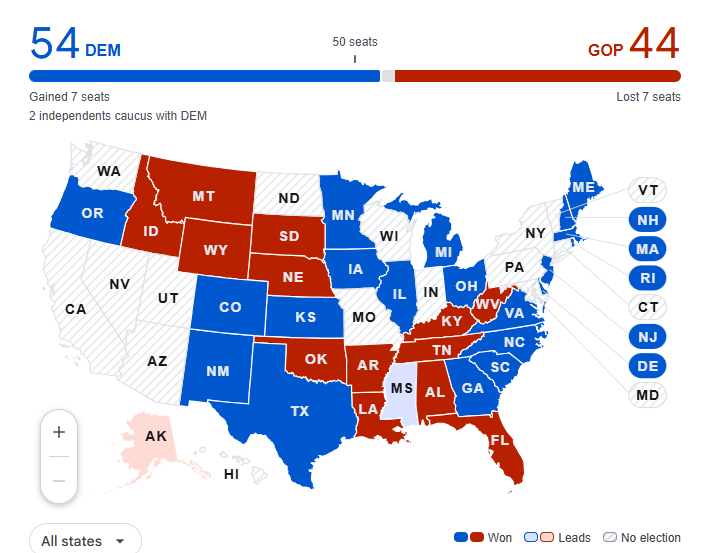
Democrats took the House and the Senate, though the final margins will take weeks to settle. Futures fell about 1.5% on the news overnight, then spent the small hours climbing back, and as I write they are up. Dow futures about 1.3%, S&P and Nasdaq near 0.9%. A six-hour round trip to slightly better than where it started.
Everybody is reading the wrong ballot.
While the networks counted Senate seats, voters in roughly fifty local referendums across thirteen states were voting on whether to allow data centres in their towns. They mostly said no. Of the thirty-five decided ballot votes tracked by one count, limits were leading in thirty.
And in Texas, which accounts for more than a quarter of all planned US data centre capacity through 2030, voters elected a governor who campaigned on halting new data centre construction.
That is the thing that changed last night.
Read my analysis of election results on AI buildout here:
https://t.co/edCLN2i9uo
The index went nowhere, but the market changed sides
On Friday the S&P 500 closed at 7,580.07.
On 29 May it closed at 7,580.06.
Five months. One cent.
In between it fell to about 7,266 in June, set a record near 7,818 on 6 October, and then gave it all back, including a 1.8% drop on Friday that was its worst day since June. If you had looked away in May and glanced back on Friday you would conclude nothing happened.
Almost everything happened.
The rotation finally came
The equal-weight S&P 500 rose 4.5% over those same five months while the cap-weighted index earned a penny.
October is where it broke open. The index fell 0.9%. Equal weight gained about 4.9%. That 5.8-point gap is the widest monthly outperformance by equal weight since April 2009.
Underneath, if you look by sector energy up 13.8%, consumer staples up 10.9%, technology down 8.2%, communication services down 9.9%.
Bespoke’s historical work makes the scale clear. The swing from September, when equal weight trailed by 4.6 points, to October was more than ten points, the largest monthly reversal in either direction since at least 1990. Equal weight has beaten the cap-weighted index by five or more points in a month only four times in history 1999, 2000, 2002 and 2009.
Read on here:
https://t.co/hXyfCCJwG0
$MSFT $META $GOOGL $SPY $AMZN
Adyen ($ADYEY): the payments company you use every day but have never heard of, now 40% cheaper
Adyen is a Dutch payments company, founded in Amsterdam in 2006 by Pieter van der Does and Arnout Schuijff, who had built and sold a payments business before. The name is Surinamese for “start over again”. It listed in Amsterdam in June 2018 at EUR 240 a share. Most people have used it without knowing, when you pay Uber, Spotify or Microsoft, there is a good chance Adyen moved the money.
https://t.co/fyP3FSg1ys
Reddit ($RDDT ): Google can take the visitors. It has not yet taken the revenue.
On Thursday 29 October 2026, after the close, Reddit reported the best quarter in its history by almost every financial measure. Revenue was $895.0 million, up 53% from a year earlier. Adjusted EBITDA was $402.3 million, a 44.9% margin. Net income was $283.3 million and free cash flow $362.6 million. Both revenue and adjusted EBITDA came in above the guidance Reddit had given in July.
On Friday 30 October the stock closed at $91.73, down 29.22% from $129.60. On my own daily series since the March 2024 listing, that is the worst single day the stock has had, beating the 20.98% fall of 31 July 2026, which followed the previous print. Reddit has now lost 66.1% from its record close of $270.71 on 18 September 2025 and 60.1% since the end of 2025. The last time it closed lower was 8 April 2025.
Reuters attributed the fall to Reddit’s warning that Google’s AI-powered search is cutting referral traffic and could shrink its user base. That warning came from the CEO himself. On the call, Steve Huffman said: “Our search referral traffic was down meaningfully in Q3, with the decline accelerating later in the quarter.” He added that in October “search traffic has dropped by more than 1 million referrals on average per week”, and that if the trend held, total daily users could fall in the fourth quarter by a “low double-digit percentage” from the current base of 130 million. Asked what changed, he was blunt: “The biggest one is the AI Overviews or AI Mode.” And “The reality is the AI Mode does not drive traffic.”
So this piece starts from the question the market answered on Friday 30 October. Reddit’s growth has two engines that both depend on other companies. The first is logged-out traffic from Google search. The second is licensing its archive of human conversation to AI labs, Google and OpenAI among them. Is Reddit a durable platform with content nobody else has, or a business whose traffic and pricing power are set by Google’s algorithm and Google’s AI answers?
My answer, worked through below: Google sets Reddit’s user count, and it may well set the 2027 user count lower than most forecasts made before 29 October assumed. It does not, on the evidence Reddit itself has given, set much of Reddit’s revenue. The data-licensing engine is smaller than its headlines and its contracted revenue runs out at the end of 2027. The price at the 30 October close assumes something close to a permanent impairment of both. The numbers say that is too pessimistic for the business as it is today, and about right if the logged-in core starts to shrink too.
https://t.co/gfrla11R4P