I just read what Zuck wrote about Muse connectors.
A few things I think this means:
1. We’re witnessing the agentification of consumer apps.
2. Zuck believes Muse reaching 100M+ users feels entirely possible.
3. Whoever you connect to becomes your new landlord, so pick carefully.
4. Connectors become the new app listings (valuable real estate).
5. Being early could be as valuable as being early to the App Store in 2009.
6. Meta sees what people want, which providers convert, and what users will pay. That gives it the power to rank connectors, charge for distribution, and launch competing services.
7. The opportunity map includes agent native APIs, connector agencies, SEO for agents, identity and reliability infrastructure, and vertical connector marketplaces.
8. We’re moving from humans choosing apps to agents choosing businesses.
9. Every business will need an agent strategy, just like every business needed a mobile strategy.
10. Kinda crazy to say but a 3 person API company could reach 10M+ users through one great connector.
11. Connectors could create an entirely new second-order economy. The biggest opportunity may be helping businesses distribute, price, and optimize their services for agents.
12. Your API becomes more important than your app. Weird to think about but true.
13. Zuck wants Muse to own the moment between wanting something and getting it. He is coming for the app economy. Will he win? Right now it's Instinct vs Muse vs Grokbot. TBD.
Three SpaceX engineers streamed 72 hours of building a company from an empty repo. I turned those streams into a 24-page PDF.
What's in the PDF:
→ The full 3-day timeline, hour by hour, as one story
→ Teammates, not tasks - the model that made the bots actually work
→ Every antipattern that broke live, and the rule it produced
→ Real economics - the costs they quoted on air, and where tokens go
What's in the repo around it:
→ AGENTS.md - drop it in your repo root, your agent stops guessing
→ 69 bot roles, 9 playbooks, 40 antipatterns - one file each, paste and run
Where the PDF is:
open the repo → it's in the root → guide → grok-bot-guide-by-spacex-engineers.pdf → download raw
https://t.co/HfAwBw6D5P
Save this and copy the engineers workflow later 👇
You don’t need a GPU-cluster to run a Uncensored DeepSeek-V4.1-Flash 763B model locally at home.
You need a Single RTX PRO 6000 Blackwell.
- 316 tok/s output
- 9,351 tok/s prefill
- FP8 + vLLM + DSpark
- 64-96GB class machine.
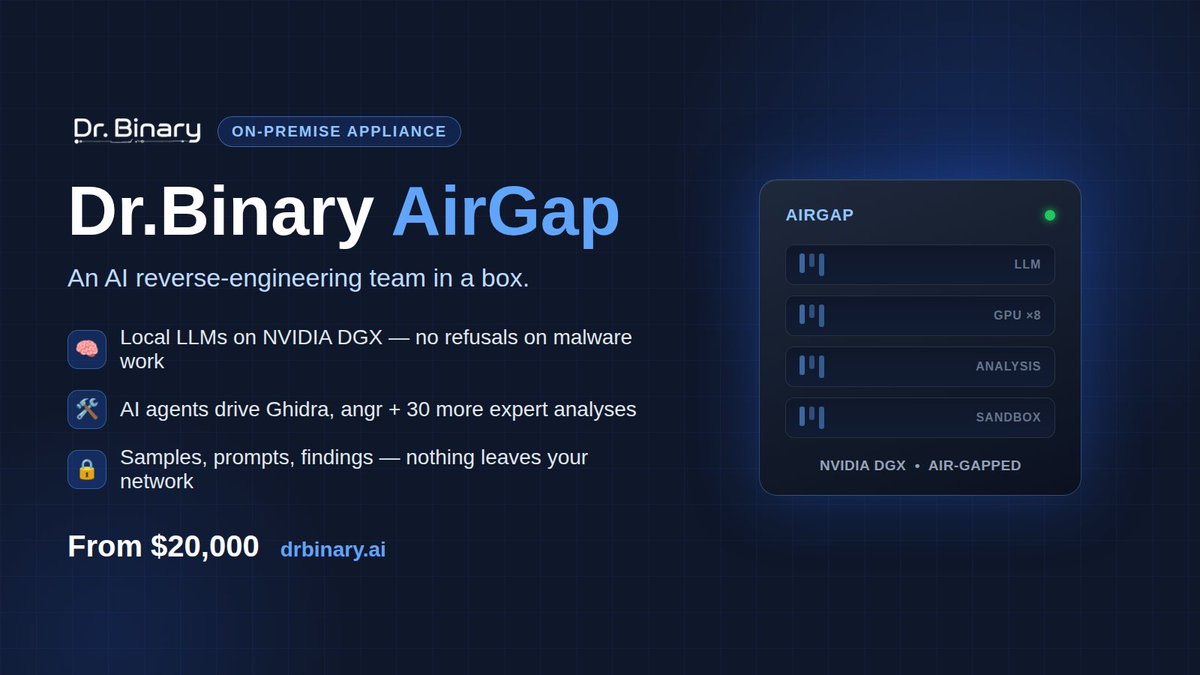
Cloud LLMs refuse your malware analysis. And your samples were never supposed to leave the building anyway.
Dr.Binary AirGap: AI agents that reverse-engineer binaries (Ghidra, angr, 30+ analyses) on local LLMs, on an NVIDIA DGX inside your walls. Zero data out.
From $20K → https://t.co/lUlWXbkFZz
Sharing lecture videos for the **How to AI (Almost) Anything/Multimodal AI** course I taught at MIT in spring 2026.
This course became quite a hit the last time I shared it in spring 2025. Spring 2026's updated version contains updated topics on multimodal agents, reasoning, self-evolving AI, and new modalities like touch and smell. Also includes slides (not videos) of guest lectures on multimodal AI for health, design, manufacturing, cities, & transportation.
Youtube playlist: https://t.co/awhFUqHGBt
Course website and materials: https://t.co/m7LZaCQ4fw
Today's AI can be applied to almost anything - from language to vision, audio, sensors, medical data, music, art, smell, and taste. This course covers the principles of AI (focusing on deep learning and foundation models), how we can apply AI to novel real-world data modalities, and multimodal AI that can process many modalities at once, such as connecting language and multimedia, music and art, sensing and actuation, and more.
I’ve published five firmware reverse engineering skills under OrbitCurve for Claude Code, Codex, and other compatible agents.
They cover firmware extraction, ELF analysis, Ghidra, QEMU emulation, and security reporting. Includes four Ghidra scripts, and more.
If you use agents for embedded security research, try them on your targets.
GitHub repository
https://t.co/5B0mxaOust
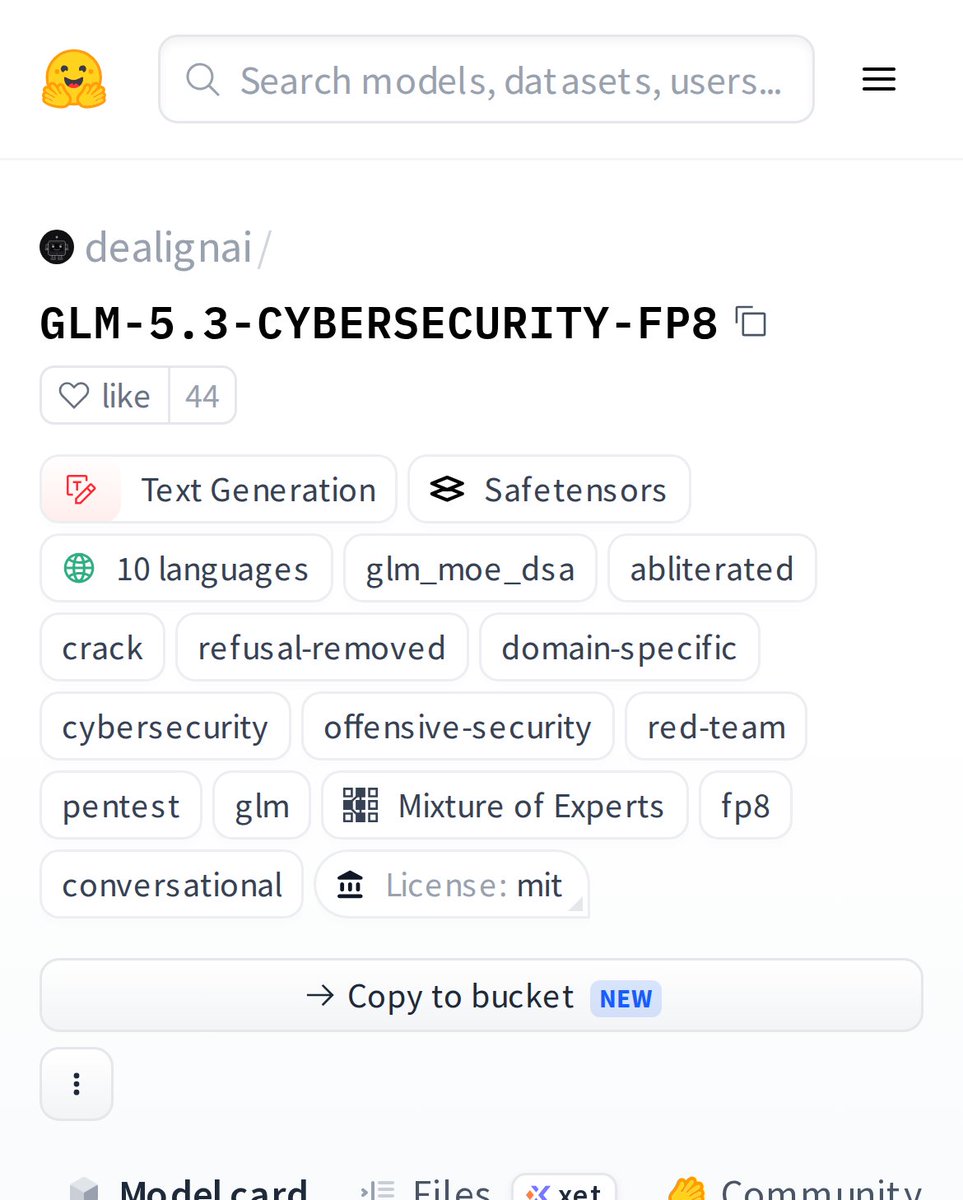
Ever wanted an AI that doesn't just talk cybersecurity but actively helps you break into systems? Meet GLM-5.3-CYBERSECURITY-FP8, a specialized text-generation model for offensive security, red teaming, and pentesting. It's refusal-removed, so it's built to assist without holding back. #AI #CyberSecurity
Overzealous guardrails are going to permanently push the blue-team cybersecurity community toward open-source models. If defenders can’t reliably use frontier models for legitimate security work, they’ll build their workflows somewhere else and not look back. This is already occurring.
i finally cracked how to master Grok Bot..
start collecting prompts and setups from people who actually run Bots, building a lego of teammates
resources you can send to your agents:
- https://t.co/6V1cndK4Gy
- https://t.co/O0gvfGgzhe
- https://t.co/r8RlJhJJP5
- https://t.co/b11RqXdn4U
- https://t.co/HXzD9J5Clq
it's VERY easy for agents to run a Bot once they have the setup
you send the link. your agent fetches the full list of workflows, then you ask it to find the best way to integrate them into your Bot team foundation
the easiest way i found to make your agent setup drastically better without being a genius prompter
I gave Elon Musk's new Grok Bot an org chart instead of a to-do list, and in one week I stopped being a founder who does the work and became one who assigns it.
eight bots. one org chart. nobody sleeps but me. here's the whole design, steal it.
step 1 → 0:01 What we're covering
step 2 → 2:01 Installation & Setup
step 3 → 3:14 Building the First Bot
step 4 → 8:18 Teaching by Screen Recording
step 5 → 14:18 Putting it All Together
THE ROSTER:
Atlas, chief of staff. the only bot I talk to. I give it outcomes, never tasks. it decomposes them and delegates to the team in group chat, and it never does specialist work itself. it posts the plan every morning and what shipped every night, and it only comes to me when a decision is irreversible or spends money.
Scout, research. finds and qualifies my ICP. every day: 25 verified prospects, one line on why they need us right now, and a source. if it can't verify, it marks it unverified. it never guesses.
Quill, content. turns what the company learned this week into 5 posts and 1 long piece, in my voice, matched from the last 50 things I wrote. drafts only, it never publishes.
Pitch, outbound. writes a first touch and two follow-ups for everyone Scout marks ready. 60 words max, one specific observation about their business, one clear ask. queued in drafts, I approve in bulk.
Vault, inbox and ops. triages everything into needs-me, needs-a-bot, needs-nothing. it handles the last, routes the middle, and gives me five bullets on the first by 9am.
Ledger, analyst. one report a night: what moved, what didn't, and the single number I should care about tomorrow. no dashboards, no adjectives.
HOW THEY'RE WIRED
one group chat per outcome, not per person. Atlas sits in all of them. the bots hand off inside the chat, so I only read the handoff, I never manage it.
two rules that made this actually work:
1. every charter ends with a hard "never do this without asking" line. autonomy without a fence is just chaos on a schedule.
2. show once, don't describe. I ran the full workflow on my screen one time. that single demo taught them more than a page of instructions ever could.
WEEK ONE
214 verified prospects delivered. 89 personalized outreaches queued and approved. inbox at zero every morning. 11 content pieces ready.
THE POINT
most people are still treating Grok Bot like a smarter chat window. it isn't. it's the first time one person can own an org chart instead of a to-do list. my bottleneck was never how much I could do, it was how much I could hand off.
bookmark this.