@erikcorry Hm, what's the solution? And does 1 < 2 < ... < k work, too? So, k chained operators that do not first fall back to binary operations?
@laurencetratt Well, that might just be random differences in the details, no?
Probably still worth identifying and fixing.
But, you start from different baselines. So a different relative change isn't really meaningful by itself, no?
@laurencetratt I mean, for that it was indeed made 😊
There might be a new version on the horizon. A student started some work porting to a new language, and found some inconsistencies... Though, no promises
The animation of the GC that I posted the other day revealed that I wasn't giving young objects time to become garbage. That version immediately promoted objects to old space, which causes it to grow even while no long-lived objects are being created. Fixed now.
@grashalm_@mitsuhiko And since CPython doesn't have a memory model, it's very hard to even know what compatibility should mean. So, full compatibility is simply not defined if one wants any performance gain. And this isn't a question of agent or no agent. This is a social and ecosystem problem.
Endive 1.2.0 is out 🚀, with a lot of community contributions: SIMD by default in the interpreter, major redline advancements with impressive numbers, faster memory for the Threads proposal, and a Component Model that's starting to be usable.
Blog: https://t.co/MYvAMaWyGs
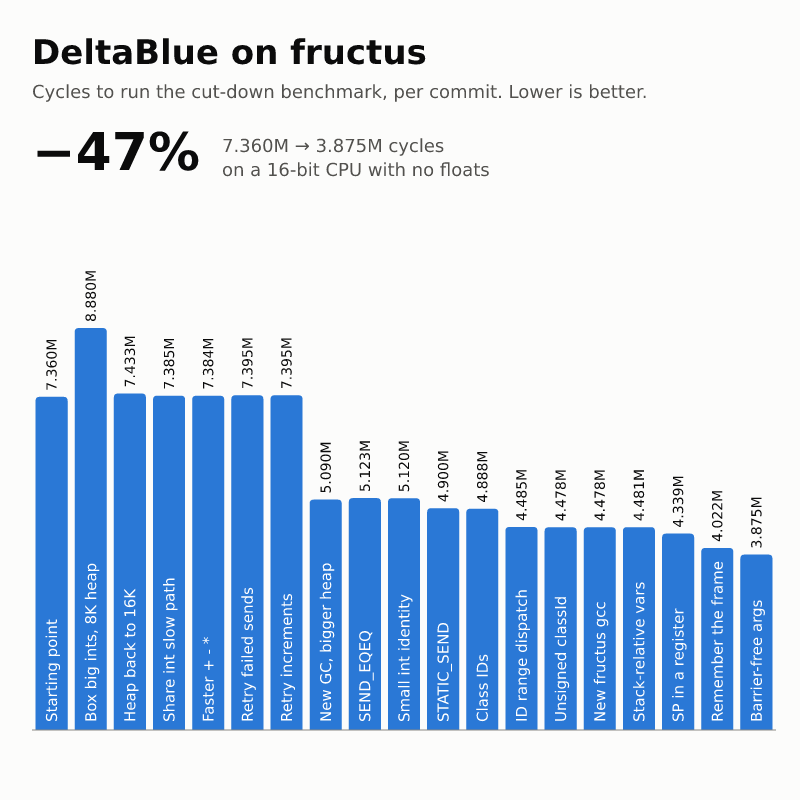
After the little setback, did some work on stack allocating instead of heap allocating frames <2M!. And some improvements to gcc to handle far branches better. Love being able to fix things in any layer: The compiler, the language runtime, gcc, the CPU design or even in the ISA.
Oh no I ran out of space on the ice40up5k. It's a fairly small FPGA. A tiny computer (even a virtual one) isn't much fun without USB and video output. Had to remove the BTB again. Still, the other progress has been pretty good.
Once I lengthened the pipeline I started wanting some branch prediction (of conditional branches) and some branch target prediction (for virtual C++ calls and interpreter loops). I actually managed to fit both in without breaking the LUT limit on this small FPGA.
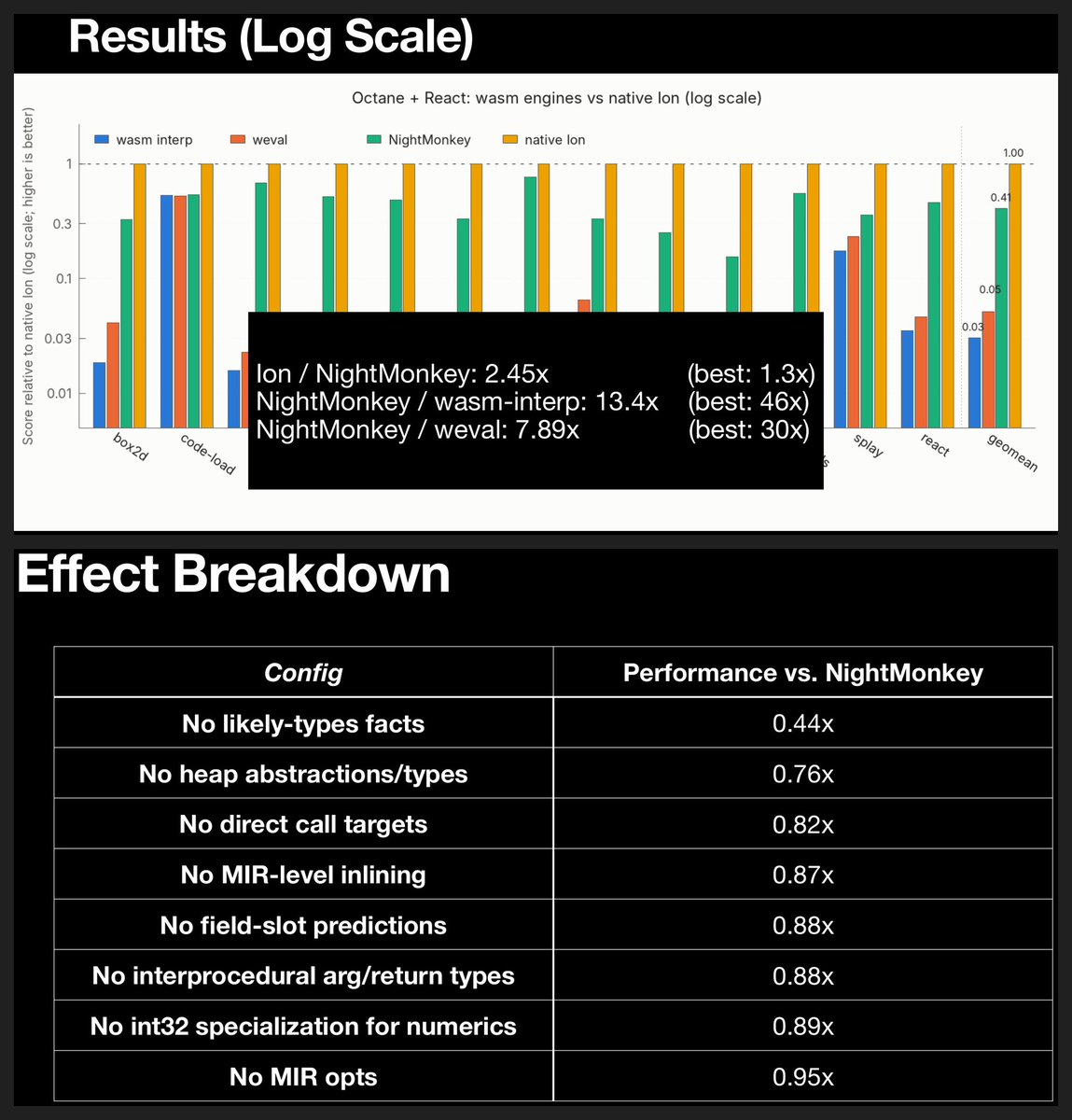
Ahead-of-time Compilation of JavaScript to WebAssembly via Static Type Inference
https://t.co/0YCsdFyhlM
https://t.co/QAB3CBP9rA
Chris Fallin (https://t.co/ydMLwXYhrr)
@VMIL_Workshop 2026 (at @splashcon 2026)