Self-driving cars were supposed to change the world first, but Optimus may lap them.
Tesla is ending Model S and Model X production and replacing that Fremont factory space with an Optimus line designed for 1 million robots a year. Gigafactory Texas is being prepared for a second-gen line aimed at 10 million annually.
That alone should tell you what @elonmusk knows is going to be the most transformative technology over the next few years.
FSD is incredible, but its adoption isn't limited by the technology; it's throttled by regulators. Optimus has a different runway.
A humanoid robot can start in Tesla factories, then warehouses, farms, hospitals, elder care, construction sites, kitchens, and homes.
It doesn't need approval from regulators to fold laundry, unload a truck, or stock shelves.
Yes, robots will face safety rules, liability fights, and workplace standards. But that is not the same as convincing regulators to let millions of driverless cars roam public roads.
That is why Optimus will scale faster.
Self-driving cars must master the chaos of streets, humanoid robots can begin with boring jobs in controlled spaces.
And boring is where revolutions start.
A robot that carries boxes, cleans floors, assists seniors, helps disabled people, harvests crops, or works a night shift does not need to be perfect on day one.
The Model S built the Tesla legend, the Model X showed off the future, but Optimus might be the thing that actually rewires society.
Within 3 to 5 years, the world could look absurdly different: labor shortages softened, elder care transformed, factories running around the clock non-stop, small businesses gaining “employees” they could never afford, and households buying back time.
Winston Churchill fought his depression with bricks. He'd lay them for hours at his country home in Kent. He joined the bricklayers' union. And in 1921 he wrote about why it worked. It took psychology another 75 years to catch up.
He called his depression the "Black Dog." It followed him for decades. His method for fighting it back was as basic as it sounds: laying brick after brick, hour after hour.
Churchill spelled out his theory in a long essay for The Strand Magazine. People who think for a living, he wrote, can't fix a tired brain just by resting it. They have to use a different part of themselves. The part that moves the eyes and the hands. Woodworking, chemistry, bookbinding, bricklaying, painting. Anything that drags the body into a problem the mind can't solve by itself.
Modern psychology now calls this behavioral activation. It's one of the most-studied depression treatments out there. Depression sets a behavior trap. You feel bad, so you stop doing things, and doing less means less to feel good about. Feeling worse makes you do even less. The loop tightens until you can't breathe inside it.
Behavioral activation breaks the loop from the action side. You schedule the activity first, even when every part of you doesn't want to. Doing it produces small rewards: a wall gets straighter, a painting fills in, a messy room gets clean. Those small rewards slowly rewire the brain. Action comes first, and the feeling follows.
Researchers at the University of Washington put this to the test in 2006. They studied 241 adults with major depression and compared three treatments: behavioral activation, regular talk therapy, and antidepressants. For the people who were most severely depressed, behavioral activation matched the drugs. It beat the talk therapy. A 2014 review of more than 1,500 patients across 26 trials backed up the result.
Physical work like bricklaying does something extra on top of this. It crowds out rumination, the looping bad thoughts that grind people down during the worst stretches of depression. Bricklaying needs both hands and gives feedback brick by brick: each one is straight or crooked. After an hour you can see exactly how much wall you built. No room left for the mental chewing.
The line George Mack used in his post, "depression hates a moving target," is good poetry. The science behind it is sharper. Depression hates a brain that has somewhere else to be.
How we prompt AI is very different in 2026 than 2022 when ChatGPT came out.
I'm teaching a new course, AI Prompting for Everyone, to help you become an AI power user — whatever your current skill level.
It covers skills that apply across ChatGPT, Gemini, Claude, and other AI tools. How to use deep research mode for well-researched reports on complex questions. How to give AI the right context, including more documents and images than most people realize you can provide. When to ask AI to think hard for several minutes on important decisions like what car to buy, what to study, or what job to take. And how to use AI to generate images, analyze data, and build simple games and websites.
I also cover intuitions about how these models work under the hood, so you know when to trust an answer and when not to.
Along the way, you'll see flying squirrels, a creativity test, some of my old family photos, and fireworks.
Join me at https://t.co/tcQc4iJAJG
🇺🇸 A neuroscientist ran MRI scans on kids aged 3-5.
Just 2 hours of daily screen time was enough to cause measurable white matter loss in their brains.
White matter is what controls language, learning, and how your brain's neurons connect.
His reaction when he saw the results: "Wow… I was not anticipating seeing anything like that."
60 kids. 2 hours a day. Visible brain damage on a scan.
Put the iPad down.
Source: @newstart_2024, 10 News
Robot dogs are now part of firefighting teams.
A four legged robot has joined the fire department, helping extinguish fires and assess dangerous, hard-to-reach areas.
https://t.co/7KZKgsnNWb
Under the directives of the President of the UAE, we launch a new government model. Within two years, 50% of government sectors, services, and operations will run on Agentic AI, making the UAE the first government globally to operate at this scale through autonomous systems.
AI is no longer a tool. It analyses, decides, executes, and improves in real time. It will become our executive partner to enhance services, accelerate decisions, and raise efficiency.
This transformation has a clear timeline. Two years. Performance across government will be measured by speed of adoption, quality of implementation, and mastery of AI in redesigning government work.
We are investing in our people. Every federal employee will be trained to master AI, building one of the world’s strongest capabilities in AI-driven government.
Implementation will be overseen by Sheikh Mansour bin Zayed, with a dedicated taskforce chaired by Mohammad Al Gergawi driving execution.
The world is changing. Technology is accelerating. Our principle remains constant. People come first. Our goal is a government that is faster, more responsive, and more impactful.
We love companies like @Wealthsimple who regularly engage with customers for continuous innovation and feedback! The idea for #TheShellfishBand continuous to develop.
Humans can see in high-res, high-FPS in real-time. Why can't VLMs?
Introducing AutoGaze: ViTs/VLMs "gaze" only at key video regions! Up to 4-100x token savings, 19x speedup, and enables scaling to 4K-res 1K-frame videos.
📄 https://t.co/GhbWZwMAg7
🌐 https://t.co/mEJ991MAIR
🤗 https://t.co/FOfc2QRThi
(1/n)🧵
Detect road potholes in real time using Ultralytics YOLO11! 🕳️
Identify potholes accurately from images or video to support road maintenance, safety monitoring, and smart city infrastructure workflows.
Read more ➡️ https://t.co/CUtkGHJ5fW
#AI#SmartCities#Ultralytics#YOLO11
No cameras. No sensors.
Just Wi-Fi reading human movement.
Researchers at Carnegie Mellon University have developed a system that uses standard WiFi routers to detect human movement through walls—without any cameras.
By applying AI and DensePose model, the system turns WiFi signals into detailed maps of body posture in real time.
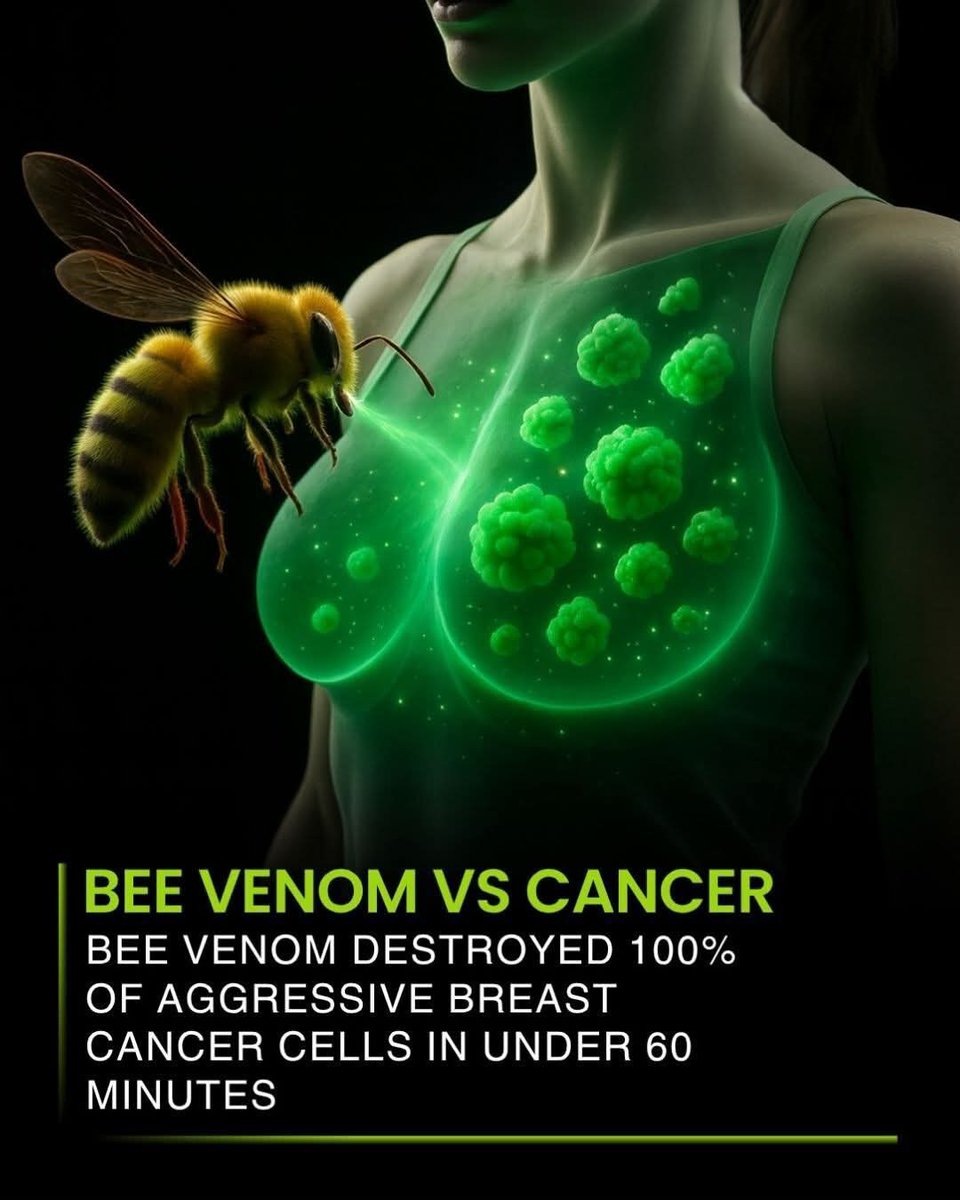
In a breakthrough that could reshape cancer treatment, scientists have discovered that honeybee venom can destroy 100% of aggressive breast cancer cells in less than 60 minutes. The key lies in a powerful compound called melittin, found in honeybee venom but not in bumblebee venom.
Researchers tested the venom on various breast cancer cell types in lab dishes and found that melittin acts like a precision-guided weapon. It punches holes in cancer cell membranes, causing the cells to die quickly. What’s even more promising is that melittin leaves healthy cells largely untouched, suggesting it could be used for treatments with fewer side effects than chemotherapy or radiation.
Melittin proved especially effective against triple-negative breast cancer and HER2-enriched breast cancer, two of the most difficult types to treat. This discovery opens new doors to developing safer, more targeted cancer therapies using natural compounds.
Scientists are now working to harness melittin’s cancer-fighting power in a controlled way, possibly through nanoparticles or synthetic versions that could be used in future medications. While more research is needed, this natural molecule from bees offers a powerful new weapon in the fight against cancer.
Source: Park, Min Ho, et al. “Melittin as a Potential Therapeutic Agent: Anti-Cancer Properties and Mechanisms of Action.” Cancers, vol. 15, no. 4, 2023, p. 1023. MDPI