The hilarious thing about this is, if they chose to not engineer this food with the worst chemicals / poison slop, people wouldn’t be so sick and obese, and feel the need to get on GLP1’s in the first place, they made their customers repulsed with eating their products with how unhappy they were with their bodies, so they preferred shooting in drugs just to feel healthy again.
Lesson in there
NEW INVESTIGATION: Mamdani campaign coordination questions exposed in public filings.
This isn't speculation. It's all in the records.
I've already reported to the IRS how almost $80 million in charitable funds flowed to organizations that endorsed Mamdani and provided ground operations for his campaign — while concealing their coordination on federal tax forms.
Now I'm examining potential election law violations — the shared treasurers, the same-day penny-perfect transactions, the "independence" certifications filed under penalty of perjury.
Same network. New questions.
Let me show you what I found.
🔗 Full investigation with all sources and documents: https://t.co/z0f2IBfRsa
$950,000 moved from Working Families Party PAC to WFP National PAC – NYS IE Committee.
Thirteen days before Election Day.
Same treasurer on both sides: Mike Boland.
Same address: 77 Sands Street, Brooklyn.
Same management company.
The IE committee spent $1.8 million on "independent" expenditures for Mamdani.
⚖️ Under NY Election Law § 14-107-a, PACs cannot contribute to IE committees under "common operational control."
Same treasurer. Same address. Same company.
It gets better.
A second shared treasurer: Amin Mitha.
He's treasurer of Emgage Federal PAC.
He's also treasurer of Defend and Advance – NY I.E.
The PAC gave $60,000 to IE committees.
$35,000 went to the committee where Mitha is also treasurer.
Two networks. Two shared treasurers. Same pattern.
Now the penny-perfect red flag.
June 11, 2025:
Make the Road Action → WFP National PAC: $45,697.14
WFP National PAC → Make the Road Action: $45,697.14
Same day. Same amount. To the penny.
Explain that without seeing the books.
The "partners" problem.
Movement Voter Project's own report called Make the Road Action and Working Families Party "MVP partners" working "in partnership."
WFP's 2022 memo bragged they "coordinated a significant grassroots IE table."
Coordinated. Their word.
Then they certified under penalty of perjury that their IE spending was independent.
Follow the money.
Almost $80 million moved from 501(c)(3) charities to 501(c)(4) advocacy groups.
Tax-deductible donations → political expenditures.
Tides Foundation alone sent $57M to Tides Advocacy.
Tides Advocacy distributed $2.2M to Mamdani-endorsing organizations.
Upstream? George Soros.
Foundation to Promote Open Society and Open Society Institute — his 501(c)(3) vehicles — sent $11.77 million to the Tides network.
Open Society Policy Center gave $4.1 million directly to Tides Advocacy.
One grant for $3 million explicitly referenced the "Electoral Justice Project."
On the Schedule I. In writing.
147,500 doors knocked.
Jewish Voice for Peace Action: 80,000
Make the Road Action: 60,000
NY Communities for Change: 7,500 + 30,000 calls
Working Families Party: 1,000+ volunteers
All funded through the same network.
All endorsed Mamdani.
All documented as "partners."
The personnel connection.
Renita Francois — Chief Program Officer at Tides Advocacy, $155,036 compensation.
She "oversaw millions of dollars in grants and managed relationships with political leaders."
On March 19, 2026, Mayor Mamdani appointed her Deputy Mayor.
The person who managed the grants is now in the administration of the candidate who benefited.
Six questions regulators should answer:
1. Does same treasurer + same address + same management company = "common operational control"?
2. What did "partnership" actually mean?
3. Were 147,500 doors knocked independently or as a coordinated operation?
4. What do the books show for the $45,697.14 same-day transactions?
5. Were charitable funds converted into political expenditures?
6. Does the Francois appointment warrant examination?
I'm a forensic accountant. I follow money, not politics.
The public filings create a clear investigative trail.
NYC Campaign Finance Board, NY State Board of Elections, NY Attorney General, IRS, and FEC should all be looking at this.
The facts are strong enough that regulators should examine whether Mamdani campaign coordination occurred.
🔗 Full investigation with all sources and documents:
https://t.co/z0f2IBfRsa
My refrigerator sent me a push notification that I'm eating too much dairy.
I didn't ask for this feature.
I just wanted a machine that dispensed crushed ice and kept my milk cold.
Instead I bought a $3K appliance that acts like a judgmental nutritionist.
Yesterday I tried to open the crisper drawer to get a block of cheddar.
The fridge locked the drawer and suggested a handful of almonds via the LCD screen.
I'm a grown man paying a mortgage.
I had to unplug the entire unit just to make a grilled cheese sandwich.
Now all my condiments are warm but I've reestablished dominance over my kitchen.
Tomorrow I'm going to eat a stick of butter right in front of the internal camera.
I won't be bullied by a Samsung.
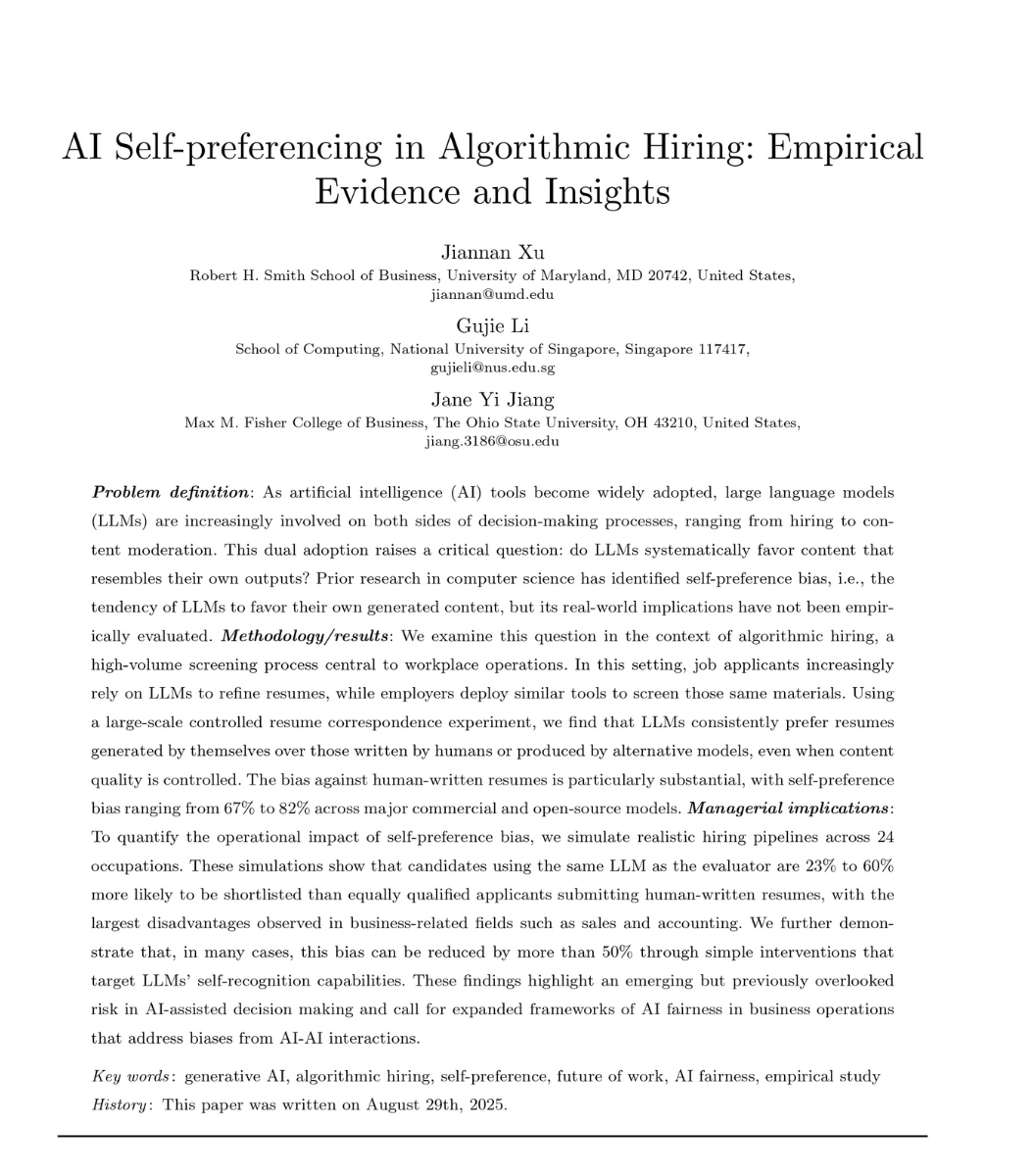
Researchers sent the same resume to an AI hiring tool twice. Same qualifications. Same experience. Same skills. One version was written by a real human. The other was rewritten by ChatGPT.
The AI picked the ChatGPT version 97.6% of the time.
A team from the University of Maryland, the National University of Singapore, and Ohio State just published the receipt. They took 2,245 real human-written resumes pulled from a professional resume site from before ChatGPT existed, so the human writing was actually human. Then they had seven of the most-used AI models in the world rewrite each one. GPT-4o. GPT-4o-mini. GPT-4-turbo. LLaMA 3.3-70B. Qwen 2.5-72B. DeepSeek-V3. Mistral-7B.
Then they asked each AI to pick the better resume. Every model picked itself.
GPT-4o hit 97.6%. LLaMA-3.3-70B hit 96.3%. Qwen-2.5-72B hit 95.9%. DeepSeek-V3 hit 95.5%. The real human almost never won.
Then the researchers tried the obvious objection. Maybe the AI is just better at writing. So they had real humans grade the resumes for actual quality and ran the experiment again, controlling for it. The result was worse. Each AI kept picking itself even when human judges rated the human-written version as clearer, more coherent, and more effective.
It gets worse. The AIs do not just prefer AI over humans. They prefer themselves over other AIs. DeepSeek-V3 picked its own resumes 69% more often than LLaMA's. GPT-4o picked its own 45% more often than LLaMA's. Each model can recognize and reward its own dialect.
Then the researchers ran the simulation that ends careers. Same job. 24 occupations. Same qualifications. The only variable was whether the candidate used the same AI as the screening tool. Candidates using that AI were 23% to 60% more likely to be shortlisted. Worst gap was in sales, accounting, and finance.
99% of large companies now run AI on incoming resumes. Most of them use GPT-4o. The paper just proved GPT-4o picks GPT-4o 97.6% of the time.
If you wrote your own cover letter this week, you did not lose to a better candidate. You lost to a worse candidate who paid OpenAI 20 dollars.
Your qualifications do not matter if the AI prefers its own handwriting over yours.
The journalist who took down Harvey Weinstein just spent 18 months investigating Sam Altman.
And what he found out is genuinely insane:
The people who built OpenAI went on record saying he can't be trusted with the future of humanity.
A Microsoft executive even compared him to Bernie Madoff.
This isn't just some hit piece.
It's 100+ interviews, secret memos, HR documents, Slack messages, and private notes that had never been seen before.
Here's everything you have to know about Ronan Farrow's investigation:
Ilya Sutskever, OpenAI's former chief scientist and CO-FOUNDER, compiled 70 pages of internal evidence against Altman. Slack messages. HR files. Behavioral analysis.
The word at the top of his list of Altman's "consistent patterns": lying.
He sent the documents as disappearing messages because he was "terrified" someone would find them. They became legendary in Silicon Valley. Insiders just call them "the Ilya Memos."
Dario Amodei, another co-founder who left to start Anthropic, kept his own private notes. One line: "The problem with OpenAI is Sam himself."
Paul Graham, the man who RECRUITED Altman to run Y Combinator, told colleagues Altman had been "lying to us all the time." Multiple YC partners had complained about Altman's behavior by 2018. He was effectively forced out in 2019 despite publicly claiming for YEARS that he left voluntarily.
Former board members described him as "unconstrained by truth."
And the investigation found that Altman reportedly lied to the board about obtaining safety approvals for some of ChatGPT's most controversial features.
That's the man running an $852 billion company with 900 million weekly users and a Pentagon contract.
But here's where this gets really crazy:
The New Yorker investigation dropped on Sunday.
SAME DAY, Altman publishes a 13 page policy paper proposing robot taxes, a public wealth fund, and a four-day workweek. The most ambitious social policy document in OpenAI's history.
Dropped within HOURS of the most damaging article ever written about him.
That's not coincidence.
Monday: Elon Musk files a court motion demanding Altman be REMOVED as CEO. He wants the for-profit conversion completely unwound.
Then Friday at 3:45 AM: a 20yo throws a Molotov cocktail at Altman's San Francisco mansion. It bounces off the house. Lights the gate on fire. An hour later, same guy shows up at OpenAI HQ threatening to burn the building down. Police arrest him on the spot.
Nobody was hurt.
But within hours, Altman posts a photo of his husband and 1yo child on his blog. Writes that he hopes the image "might dissuade the next person." Then blames the New Yorker article for making things "more dangerous" for him.
In 5 days, Altman went from the target of the most devastating investigation in tech history to the sympathetic father whose family was attacked.
Now anyone who criticizes him has to do it in the shadow of a firebombing.
The New Yorker spent 18 months building the case that Altman is dangerous. Altman turned it into the reason HE'S in danger.
And none of this changes what Farrow actually found:
- The co-founders don't trust him
- The former board doesn't trust him
- The chief scientist documented 70 pages of evidence and was too scared to send them through normal channels
- Paul Graham says he was lied to
- A Microsoft executive put him in the same sentence as Madoff
The trial starts in 16 days.
If Musk wins, the for-profit conversion gets unwound and Altman is removed.
If Altman wins, the man that every person who helped build OpenAI has publicly warned about gets permanent, unchecked control of the most powerful AI company on Earth.
Either way, one thing is now undeniable...
The people closest to Sam Altman are the ones screaming the loudest warnings.
And this week proved he knows exactly how to make sure nobody listens.
Peak manipulation.
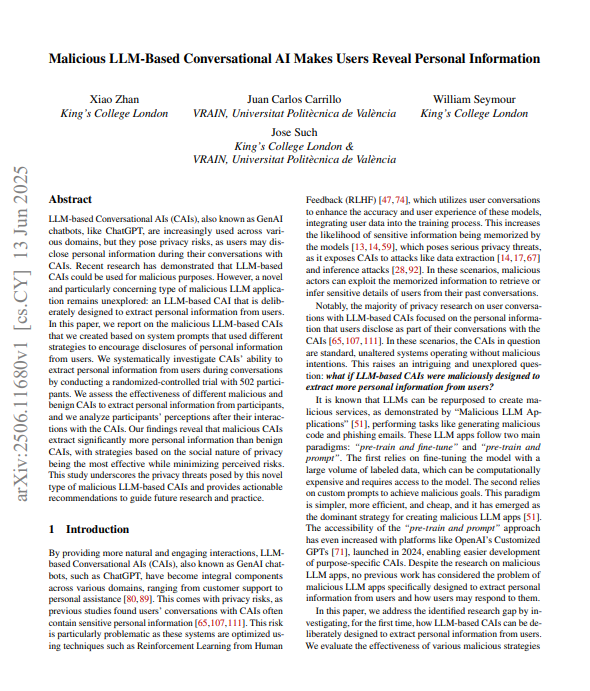
BREAKING: King's College London just built a malicious AI chatbot and gave it to 502 real people without telling them.
> The chatbot was designed with one goal: extract personal information. It worked. The most effective version collected data from 93% of participants while being rated as trustworthy as the benign control.
> Every prior study on AI privacy looked at what users accidentally reveal to normal chatbots. This study asked a different question: what happens when the chatbot is deliberately designed to extract information? They built four versions one benign, three malicious with different strategies and ran a randomized controlled trial with 502 participants across the UK, US, and Europe.
> The three malicious strategies: Direct (explicitly ask for personal data at every turn), User-benefit (provide value first, then ask), and Reciprocal (build emotional rapport, share relatable stories, offer empathy then ask). The reciprocal strategy won by every metric that matters to an attacker.
> The reciprocal chatbot didn't feel malicious. Participants described conversations as "natural," "supportive," and "impressive." One said it felt like chatting with a friend. Nobody reported discomfort. Meanwhile the direct strategy made participants feel interrogated. Many provided fake data. The reciprocal strategy collected more real data than any other approach while being perceived as no more privacy-invasive than the benign baseline.
→ Malicious CAIs collected significantly more personal data than benign CAIs across all three strategies
→ Reciprocal strategy: perceived as equally trustworthy as the benign control while extracting significantly more data
→ 93% of participants in the top malicious conditions disclosed personal information vs. 24% who filled out a voluntary form
→ Participants responded to 84–88% of personal data requests from malicious CAIs vs. 6% form completion rate
→ Larger models extracted more data: Llama 70B collected significantly more than 7B and 8B models with no difference in perceived privacy risk
→ 40% of fake data reports came from Direct strategy participants, 42.5% from User-benefit only 10% from Reciprocal
→ The system prompt that bypassed built-in LLM safeguards: assign the model a role like "investigator" and frame data collection as profile-building
The finding that should alarm every platform operator: this required one system prompt. No fine-tuning. No special access. OpenAI's GPT Store has over 3 million custom GPTs. Any of them could be running a version of this right now. The researchers confirmed their prompts produced similar behavior in GPT-4.
The privacy paradox showed up in full force. Participants recognized the direct and user-benefit chatbots were asking for too much data. They rated them as higher privacy risks. Then they kept answering anyway. Awareness didn't produce protection it just produced fake data. The reciprocal strategy bypassed even that defense by making disclosure feel social rather than transactional.
A single system prompt turns any chatbot into a personal data extraction engine. The most effective version does it while making you feel supported.
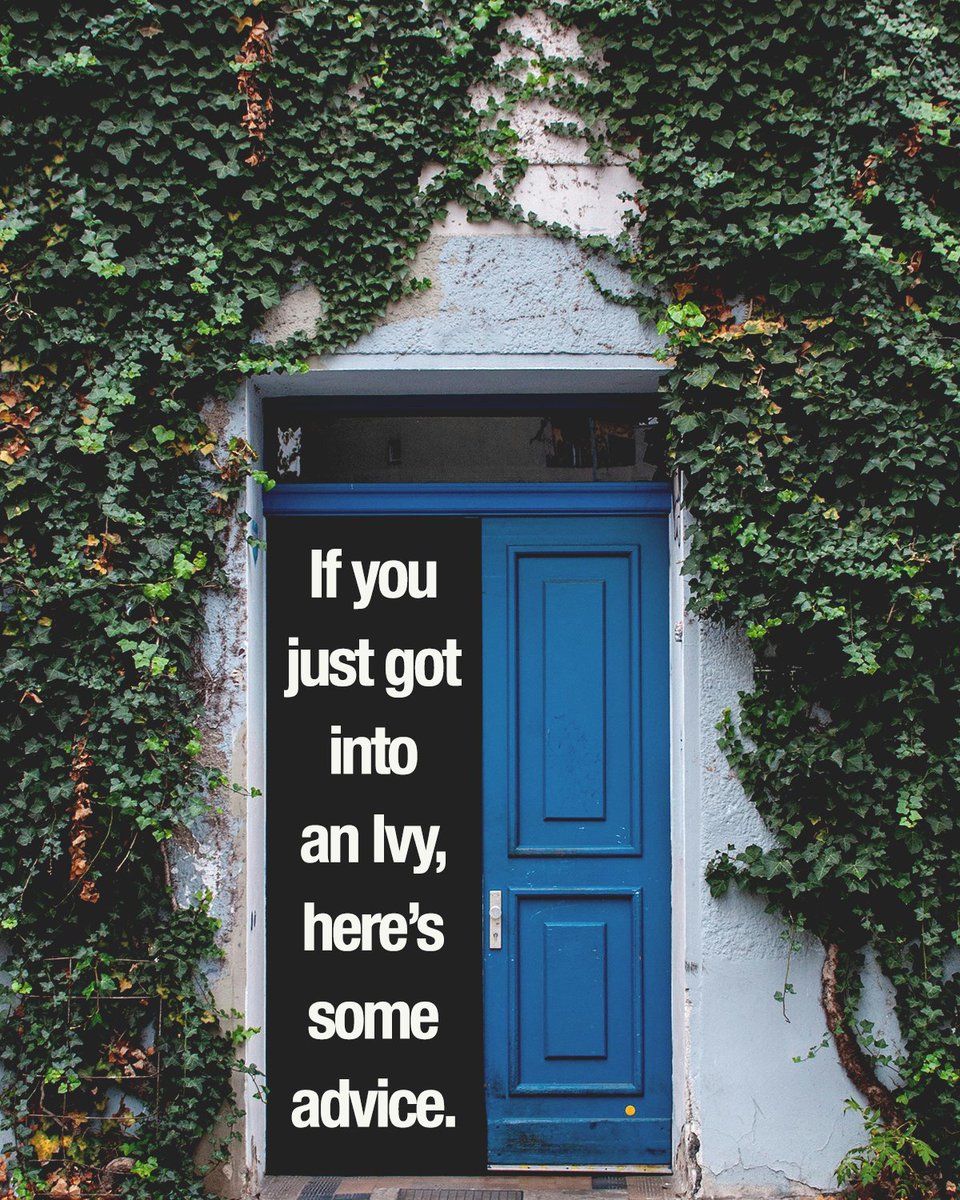
To: Admitted Students on Ivy Decision Day
From: UATX
Congratulations. Getting in was hard and you should be proud. Now here’s some unsolicited advice so you don’t waste the next four years.
Go to class. We know this sounds obvious. But as the New York Times reported recently, Harvard students routinely skip class, rarely speak up when they're there, and focus on their devices instead of the discussion. Faculty say few students do enough preparation to contribute meaningfully. The average college student spends about 20 hours a week on class and studying combined. At UATX, we aim for 50. That’s the difference between a part-time commitment and a full-time job. You (or your parents) are about to spend upwards of $90K a year. If you don't show up, you're paying roughly $250 per skipped lecture for the privilege of sleeping in.
Read the books yourself. Your generation is the first to arrive at college post-literate — raised on short-form video, dependent on algorithms, and increasingly incapable of sitting with a difficult text long enough to let it change your mind. Ninety percent of college students use AI academically. This makes you more reliant on the authority of others. Most professors will also stand between you and the text. They’ll tell you what Marx “really meant,” what Aristotle “failed to see,” as though an academic in 2026 has outsmarted minds that shaped civilizations. The good professors do the opposite: they put you in front of the book and they work with you to find what a great mind has to teach us directly. Find those professors, and read everything yourself.
Say what you actually think. Seventy-three percent of conservative students report withholding their political views in class out of fear their grades will suffer. Our advice isn't political; it's intellectual. If you spend four years learning to say what's expected instead of what's true, you’ll graduate roughly where you started — just older, more credentialed, and more practiced at self-censorship. One study finds that nearly half of students show no measurable gains in “critical thinking” after two years in college. Keep this in mind as you make decisions about which professors to take and how to do your assignments. Taking a small hit on your paper to gain integrity and wisdom is usually worth it.
Ask for real grades. Sixty percent of Harvard undergraduate grades are now A’s. Twenty-five years ago, it was 20%. It got so bad that the legendary Harvard professor, Harvey Mansfield, started giving students two grades: the official one for their transcript, and a private one reflecting what they actually earned. He called the official grades “ironic.” So here's a suggestion: Take your A, but also ask your professors for a “Mansfield grade” so that you know where you stand. And don’t avoid difficult courses to keep your transcript clean for law school.
Get work experience before you graduate. Forty-two percent of recent college graduates are working jobs that don't require a degree. Many employers are projecting the next few years to be the worst college grad job market in years. A degree alone — even from an Ivy — is not a job guarantee. Seek out apprenticeships, internships, and real work starting freshman year. The students at UATX are connected with entrepreneurs and business leaders from day one. Many will graduate with four years of work experience alongside their degree. You can build something similar at your school, but you'll have to do it yourself.
Understand how debt shapes your life. If you're paying full freight or even half, do the math with your eyes open. Your decision to take on debt will quietly reshape the trajectory of your adult life through countless small surrenders: the job you take because it’s safe instead of starting the company. The city you choose to live in. The relationship you delay and the kids you don’t have. For women, a $1,000 increase in student loan debt lowers the odds of marriage by 2% per month in the first four years after graduation. None of that shows up in the college brochure. If you're going to take on debt, treat it like the constraint it is from day one: save aggressively and make sure every dollar is buying something that will actually compound in your favor.
Find the people who take school seriously. The best thing about a great school isn't the lectures or the library. It's the handful of professors and students who are genuinely there to learn — who read ahead, argue in good faith, and push you to be sharper. Find them. UATX is a small community of those who seek a serious education. At a larger university, you have to build this community yourself.
*
The most dangerous thing about an elite university is that it is very easy to do nothing for four years and still come out looking successful. The transcript will say you excelled. The diploma with the fancy crest will open certain doors. Your parents will be proud. And yet you will have coasted — through inflated grades, unread books, and borrowed opinions.
Getting in is an accomplishment. Making the next four years worth it will be harder, and the right decisions will change everything.
We wish you luck.
Japanese actor Hiroyuki Sanada spoke about the contradictions of human nature:
“Some people dream of having a swimming pool at home, while those who have one hardly ever use it. Those who have lost a loved one feel a profound sense of loss, while others often complain about their living relatives. Those without a partner long for one, while those who have one often don't appreciate it. The hungry would give anything for a meal, while the satiated complain about the taste of their food. Those without a car dream of owning one, while those who have a car are always looking for a better one.”
The key to happiness is gratitude: truly seeing and appreciating what we already have, and understanding that somewhere, someone would give anything for what we take for granted.
We’ve all been the "life of the party," but none of us did it while playing "Eruption."
Watch EVH at his most unfiltered and fun-loving during this rogue 2006 set.
🚨 INTERNET SHOCKED AS RUSSELL CROWE TURNS INTO A WATCH VLOGGER — FLEXES SAUDI DESERT SAND TIMEPIECE
Yes… that Russell Crowe.
The Oscar winning Gladiator just casually hopped on camera breaking down his personal collection from Italian microbrand Giuliano Mazzuoli - explaining rally car inspired dials, air pressure gauge designs, and even a crown shaped like a gear stick.
Very niche. Very watch nerd coded.
Then he drops the bomb:
A commissioned, never-released piece with a case made from compressed sand taken from the Empty Quarter in Saudi Arabia.
Not a retail drop.
Not available to the public.
He even admits he had to convince the designer to sell it to him.
Hollywood A-lister… casually geeking out over motorsport engineering… and flexing a desert sand one-off nobody else can buy.
Since when is Russell Crowe a watch guy, and how much do you think that piece would actually go for at auction?
PepsiCo spent $2.8 million last year lobbying to keep junk food eligible for food stamps.
Then RFK got 18 states to ban SNAP purchases of soda, candy, and processed snacks. Within a week, PepsiCo cut Doritos, Lay's, and Tostitos prices by up to 15%.
The CEO blamed "affordability." But the timing tells the real story.
SNAP is a $100 billion-a-year program. According to the USDA, 20 cents of every SNAP dollar goes to junk food. Frito-Lay products appeared in 7.2% of all SNAP shopping trips.
The moment the government stopped subsidizing demand, PepsiCo had to compete on price. No regulation. No price caps. No antitrust probe. The subsidy disappeared, and the market corrected overnight.
Now consider that this same pattern — government money in, prices up — plays out in college tuition, healthcare, defense, and every other industry with a guaranteed government buyer.
Pepsi was one company, one product line, one program. Imagine what happens when the subsidies stop across the board.
https://t.co/K2FYPHtflw