Gitcoin has helped fund hundreds of open source projects.
But one question still comes up every funding round.
Did this team actually deliver what they promised?
A smart contract can verify that milestones were submitted.
It can confirm wallet activity, GitHub commits, and on-chain transactions.
What it cannot decide is whether those updates created real value.
Maybe the code was pushed.
Maybe the documentation was written.
Maybe the community barely benefited.
That's not a data problem.
It's a judgment problem.
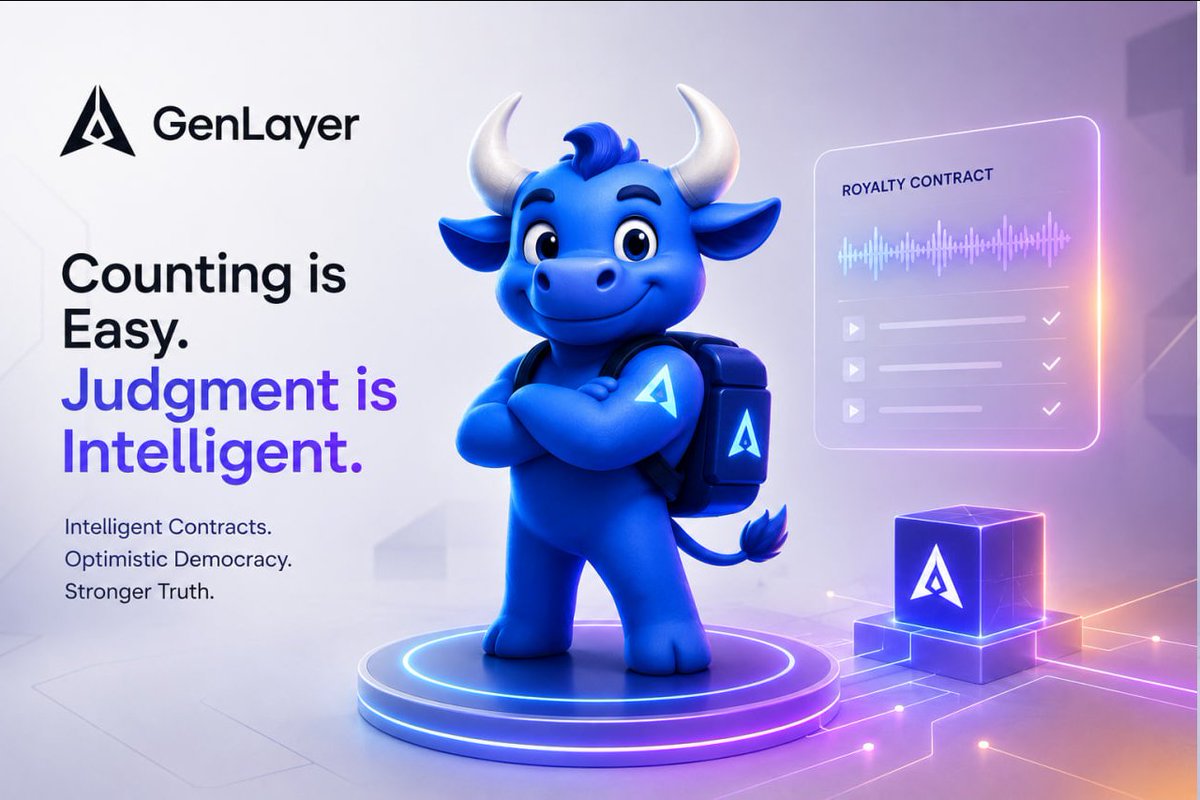
This is where @GenLayer could completely change the process.
Its Intelligent Contracts can evaluate natural language, project updates, and real-world evidence instead of only checking predefined rules.
Then randomly selected validators running different AI models independently review the same information and reach consensus through Optimistic Democracy.
If they disagree, the validator set rotates, and the decision can be appealed until finality.
Funding open source isn't just about proving work happened.
It's about deciding whether the work actually mattered.
That's the kind of question smart contracts were never built to answer.
Which Web3 project do you think needs this kind of AI-powered adjudication the most?
You ask an AI agent to review a legal contract before you sign it.
It finishes in seconds.
The agent says everything looks fine.
A week later, you discover a clause that costs your business thousands of dollars.
The AI insists it followed the instructions.
You insist it missed the most important part.
Who decides?
A traditional blockchain can't.
It only knows whether the task was completed, not whether it was completed well.
That is the problem the agentic economy is about to face.
As AI agents begin making decisions, handling money, and working with each other, disagreements won't be about facts alone.
They'll be about judgment.
That's where @GenLayer comes in.
GenLayer is the adjudication layer for the agentic economy.
Its Intelligent Contracts can work with natural language and real-world information instead of only strict yes or no conditions.
When a dispute happens, randomly selected validators running different AI models independently review the evidence and reach consensus through Optimistic Democracy.
If they disagree, the validator set rotates, and the decision can be appealed until finality.
We already have blockchains that can prove something happened.
GenLayer is built to answer the harder question.
Did it actually happen the way people intended?
That's the kind of trust AI agents will need.
What real-world AI disagreement do you think will become common first?
Overrated: Chasing every new Web3 trend.
Underrated: Sticking with one project long enough to actually understand it.
I used to jump into every new launch because everyone else was doing it. It felt productive, but I was mostly collecting notifications instead of knowledge.
The moment I focused on one ecosystem, read the docs, joined discussions, and stayed active, I started spotting opportunities I would have missed before.
Hype gets attention because it's exciting.
Consistency wins because it teaches you something valuable.
That's the advice I'd give any friend who keeps chasing the next shiny thing.
@RallyOnChain
The most underrated thing in 2026 is keeping a simple notes file.
Not an expensive productivity app. Just one place where you save ideas, mistakes, useful links, and things you learn.
I ignored this for years because it felt too basic. Then I started writing everything down. I stopped repeating the same mistakes, finished tasks faster, and wasted far less time trying to remember where I saw something.
If a friend kept ignoring my advice, I'd say this: your memory is for thinking, not for storing everything.
Small habit. Huge payoff.
@RallyOnChain
I think one of the most overrated habits in Web3 right now is chasing every new campaign the second it appears.
The underrated alternative is staying with a handful of projects long enough to understand them.
I learned this the hard way. There was a week when I joined almost everything I saw. I spent more time switching tabs than actually learning anything. At the end of it, I couldn't even explain what half those projects were building.
Now I skip most launches. I read, follow updates, and stick around if something genuinely makes sense. Funny enough, I enjoy the process more, and I make better decisions because of it.
Hype gets attention. Understanding creates value.
That's the advice I'd give a friend who keeps telling me they're "too busy" to slow down.
@RallyOnChain
The quote that stuck with me was:
"When everyone can build, building stops being the differentiator. The bottleneck moves downstream."
It immediately made me think of developer tools.
Imagine a small team building an SDK or API that makes life easier for every builder in an ecosystem. The product works. Developers who find it love it.
The problem is that most people never hear about it.
It's not the kind of project that creates hype overnight, so it gets buried beneath token launches, memes, and endless speculation.
That's exactly where @RallyOnChain makes sense.
Instead of chasing short term attention, the team can work with creators who actually understand the product and can explain why it matters in plain language. Every useful post becomes another doorway for builders to discover the tool.
Great infrastructure doesn't fail because it's poorly built.
It often fails because the right people never find it.
That's the distribution gap Rally is trying to solve.
One line from The Brand Accelerator made me rethink how most Web3 launches happen:
"When everyone can build, building stops being the differentiator. The bottleneck moves downstream."
I used to think a great product would naturally find its audience.
The more projects I followed, the more I realized that's rarely true.
I've seen founders spend months refining their protocol, publishing documentation, and listening to early users. Then launch day arrives, and the timeline is dominated by projects with louder marketing instead of better products.
That's not a building problem.
It's a distribution problem.
What stood out to me about @RallyOnChain is the idea of treating creators as long term partners instead of one time promotion tools.
A community built over months is far more valuable than a campaign that trends for a weekend and disappears.
The projects that win in the next cycle won't just build something useful.
They'll make sure the right people discover it before everyone else.