Gandalf did not move. And in that very moment, away behind in some courtyard of the City, a cock crowed. Shrill and clear he crowed, recking nothing of wizardry or war, welcoming only the morning that in the sky far above the shadows of death was coming with the dawn.
And as if in answer there came from far away another note. Horns, horns, horns. In dark Mindolluin's sides they dimly echoed. Great horns of the North wildly blowing. Rohan had come at last.
🟥 Czy Henry Nowak mógł przeżyć?
Dr Krzysztof Magier @DrMagier , lekarz pediatra i były konsul honorowy RP w Cowes, przeanalizował nagrania z policyjnej kamery nasobnej pokazujące śmierć Henry'ego Nowaka.
Dr Magier jest lekarzem prowadzącym oddział intensywnej terapii dziecięcej, z doświadczeniem w szkoleniach z medycyny pola walki oraz po specjalistycznym kursie leczenia ciężkich urazów (w tym ran postrzałowych i kłutych).
Nie zgadza się z opinią patologa i sędziego, że Henry Nowak nie miał żadnych szans na przeżycie i ze skucie go w kajdanki nic w zasadzie nie zmieniło. Wręcz przeciwnie – istnieje duże prawdopodobieństwo, że to interwencja policji przyczyniła się do jego śmierci.
Przeanalizował on raport z sekcji, który wskazuje na uszkodzenie żyły podobojczykowej jako główne źródło krwawienia i tłumaczy, gdzie leży problem.
U zdrowej osoby krwawienie żylne odbywa się pod niskim ciśnieniem i często samoogranicza się dzięki powstającemu naturalnie skrzepowi, a samo zbliżenie krawędzi rany i ucisk otaczających tkanek domyka żyłę na tyle, że spowalnia albo nawet zatrzymuje krwawienie.
Z nagrania z policyjnej kamery nasobnej wynika, że gdy policja przybyła na miejsce (prawdopodobnie 5-10 minut po zranieniu), Henry był na tyle przytomny, że mówił dość głośno. Nie był zatem jeszcze w stanie terminalnym. Po wykręceniu rąk do tyłu i skuciu za plecami najprawdopodobniej doszło do rozciągnięcia żyły, rozerwania skrzepu i gwałtownego nasilenia krwawienia. W ciągu zaledwie ok. trzech minut stracił przytomność i zmarł.
Osoby z podejrzeniem urazów wewnętrznych nigdy nie powinny być gwałtownie przemieszczane ani szarpane – takie działanie może zniszczyć naturalny skrzep i doprowadzić do masywnego krwotoku wewnętrznego.
Zamiast natychmiastowego wezwania zespołu ratownictwa medycznego i przekazania pacjenta w ręce ratowników, policja go skuła. Gdyby na miejscu jako pierwsi pojawili się paramedycy, szanse Henry’ego na przeżycie byłyby znacznie większe. "50%" - pisze dr Magier.
Ratownicy mogliby szybko założyć kroplówkę, podać płyny zwiększające objętość krwi krążącej oraz kwas traneksamowy stabilizujący skrzep, a w razie potrzeby wykonać dekompresję igłową (wkłucie grubej i długiej igły w płuco), bo problemem nie był tyle brak funkcji płuca, ale ucisk zalanego krwią płuca na serce i śródpiersie, który blokuje krążenie.
Co gorsza, incydent miał miejsce zaledwie kilka minut jazdy samochodem (2–3 minuty karetką na sygnale) od Southampton University Hospital – regionalnego Major Trauma Centre dysponującego pełnym zapleczem specjalistów, procedur i sprzętu. "Jestem przekonany, że gdyby Henry dotarł tam żywy, lekarze nie pozwoliliby mu umrzeć" - pisze dr Magier.
Podsumowując: agresywna interwencja policji, zamiast ratować życie, doprowadziła do śmierci przez nieodpowiednie postępowanie z ciężko ranionym człowiekiem, mimo że najwyższej klasy opieka była w zasięgu kilku minut. "Obawiam się, że Sędzia i patolog byli zbyt łaskawi dla policji" - pisze dr Magier.
As if I wasn't already entirely pissed off with the police already, I had the most insane interaction with 2 bully-boy coppers this morning.
I dropped home an elderly little old lady, who was taking some time gathering her things and trying to get out of the car. I was on double yellows, but had my hazards on - as I am allowed to do as per the council rules. When a police car came up behind me, and then drove around me to be window level, to tell me that, despite clearly being able to pass me, as he literally was, I was illegally parked and causing an obstruction, and I needed to park on the kerb.
I told him I wasn't parked a) at all, as I was offloading an elderly lady and b) wasn'tstopped illegaly, and I wouldn't be moving on to the kerb because that *would* be illegal as I would then be obstructing the pathway, whereas, I was legally allowed to drop of and pick up, on double yellows. He told me he would arrest me. I told him to try it. He then drove off - proving I wasn't obstructing traffic.
I finished helping the old lady and drove off.
The officers were waiting for me around the corner, put on their lights, pulled me over and demanded to see my licence and insurance before lecturing me about my attitude and demanded I show them some respect.
They could have waited patiently like most people do, or they could have gone around me as they eventually did. Instead they threatened to arrest me for laws I wasn't breaking, simply because they didn't know the law, and then tried to intimidate me afterwards because they realised they were totally wrong about the law, and we're too immature to apologise. They were fully prepared to try and make me loose my job and my lifelong out of nothing but pure spite, ego and vengeance because they made themselves look stupid.
None of that had to happen. Luckily I filmed the entire thing. Utterly disgusting behaviour. This inherent arrogance in the police has to stop.
🚨NEW: Henry Nowak's father *directly* calls out the disgusting behaviour of Hampshire police.
"Instead of being treated as a dying victim, the police arrested him for assault"
"That was the last thing he heard"
Hampshire police are a DISGRACE!
RELEASE THE FOOTAGE!
A very sad announcement.
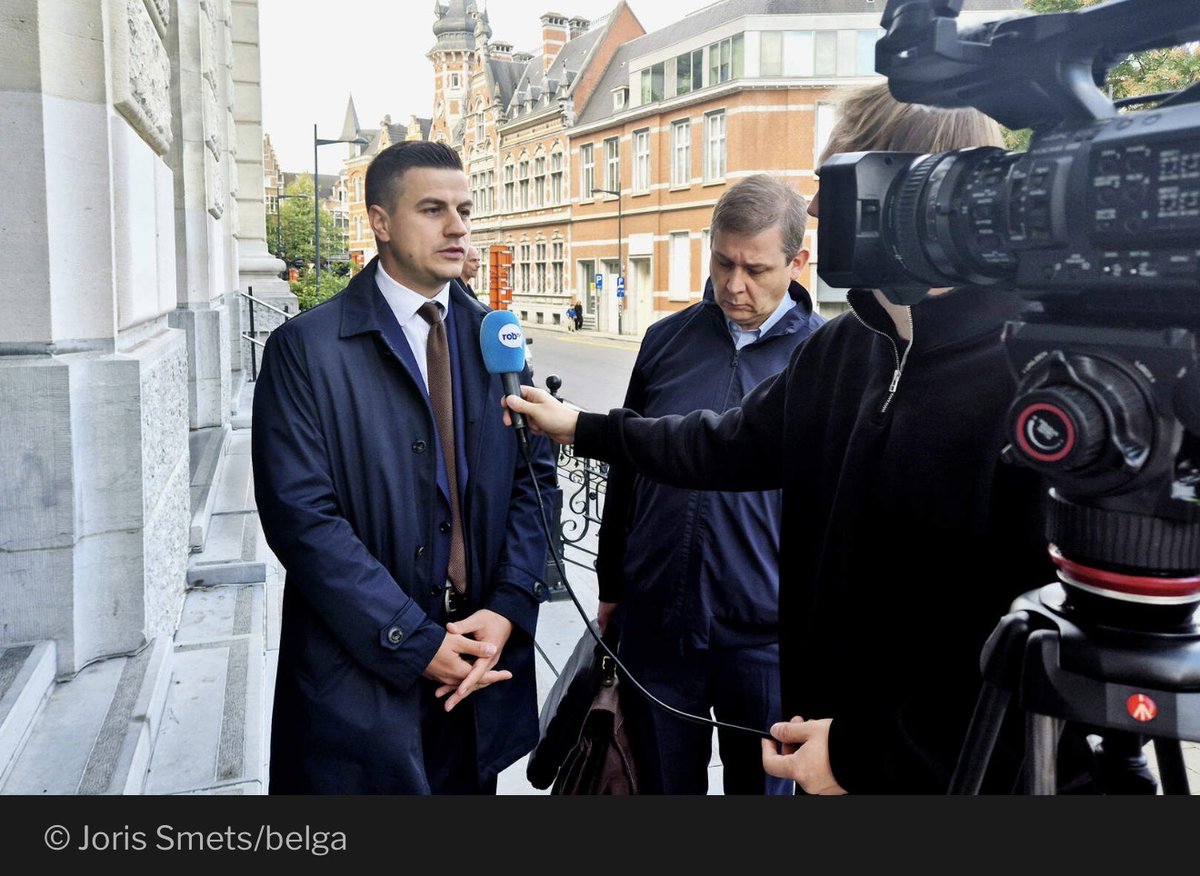
I have just been convicted a second time for 'hate speech' and it is only due to a technicality that I could not immediately be sent to jail —to the judge's frustration.
In an ironic turn of events it's actually thanks to my previous prison sentence (for memes in a private group chat) that I am now still free —in a physical sense, at least.
Call me naive but I didn't think they would take it this far, given that this precedent criminalises many of the arguments used by even the most moderate politicians critical of mass migration.
In February 2024 I gave a lecture at Catholic University Leuven wherein I linked mass migration to crime and a deterioration of our quality of life. Every single point I made was 100% the truth and based on scientific evidence.
Cynically, even the judge that convicted me admits as much by writing in his verdict: “Even if all of the statements made by Van Langenhove are based on scientific evidence and statistics, it makes no difference to the criminal intent. Van Langenhove is not charged with spreading false information. He is charged with presenting facts in a way that incites hatred against persons on the grounds of one or more of the protected criteria in the Anti-Racism Law.”
That's a lot of words just to say he wants to send me to prison for speaking the truth.
Even the regime media write: "It did not matter to the court that Van Langenhove was quoting scientific sources. The judge argued that Van Langenhove's main message was that a big part of the societal problems like insecurity, housing shortages and lowering educational standards are due to mass migration."
You may think the regime media are being sympathetic to me in the first sentence, but in reality they are warning people: even if you speak the truth, if you go against our narrative, we will crush you in every way possible.
Both the public prosecutor and the judge did not present a single real argument as to how or against whom I would have incited hatred. So even if I would accept their crazy, dystopic law, I still did not break it.
The only argument they present is that I created a "hostile atmosphere of us versus them” in regards to migrants. But even this silly argument (which is not even a punishable offence) is not true. To me, the deadly disease is self-hatred and one of its worst symptoms is replacement migration. My enemy is thus NOT the migrants themselves but those orchestrating the mass migration.
Sadly, in Belgium, evidence is not needed and ‘vibes’ are enough to put someone in jail.
Given the fact that I have another court case coming up in September and that I have a dozen active criminal investigations for hate speech, time is running out for me. I have already paid more than €420,000 in legal fees and there is no ending in sight. I have been in an intense battle of attrition for eight years and must now regroup to make sure I can still win.
If you want to help me, you can do so via the links below. If you can help in other ways, please contact me via DM.
If you live in a country that still has free speech, never let them touch it, however noble they make the motives sound, because this is where it leads to.
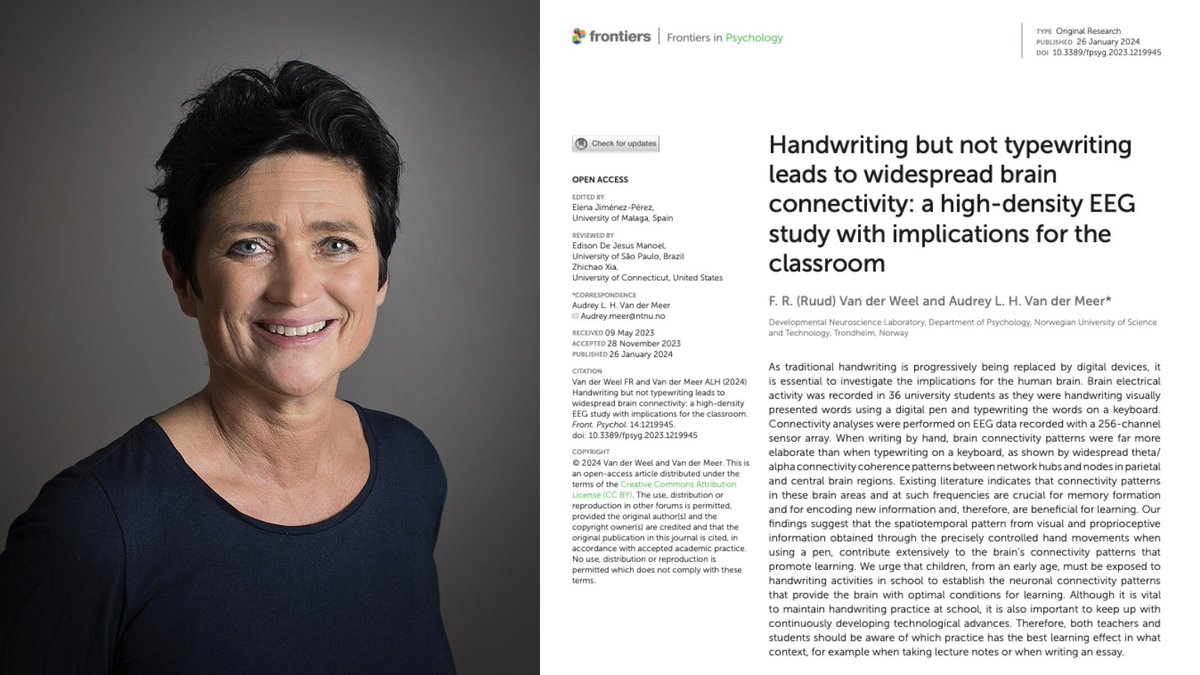
A Norwegian neuroscientist spent 20 years proving that the act of writing by hand changes the human brain in ways typing physically cannot, and almost nobody outside her field has read the paper.
Her name is Audrey van der Meer.
She runs a brain research lab in Trondheim, and the paper that closed the argument was published in 2024 in a journal called Frontiers in Psychology. The finding is brutal enough that it should have changed every classroom on Earth.
The experiment was simple. She recruited 36 university students and put each one in a cap with 256 sensors pressed against their scalp to record brain activity. Words flashed on a screen one at a time.
Sometimes the students wrote the word by hand on a touchscreen using a digital pen, and sometimes they typed the same word on a keyboard. Every neural response was recorded for the full five seconds the word stayed on screen.
Then her team looked at the part of the data most researchers had ignored for years, which is how different parts of the brain were communicating with each other during the task.
When the students wrote by hand, the brain lit up everywhere at once.
The regions responsible for memory, sensory integration, and the encoding of new information were all firing together in a coordinated pattern that spread across the entire cortex. The whole network was awake and connected.
When the same students typed the same word, that pattern collapsed almost completely.
Most of the brain went quiet, and the connections between regions that had been alive seconds earlier were nowhere to be found on the EEG.
Same word, same brain, same person, and two completely different neurological events.
The reason turned out to be something nobody had really paid attention to before her work. Writing by hand is not one motion but a sequence of thousands of tiny micro-movements coordinated with your eyes in real time, where each letter is a different shape that requires the brain to solve a slightly different spatial problem.
Your fingers, wrist, vision, and the parts of your brain that track position in space are all working together to produce one letter, then the next, then the next.
Typing throws all of that away. Every key on a keyboard requires the exact same finger motion regardless of which letter you are pressing, which means the brain has almost nothing to integrate and almost no problem to solve.
Van der Meer said it plainly in her interviews.
Pressing the same key with the same finger over and over does not stimulate the brain in any meaningful way, and she pointed out something that should scare every parent who handed their kid an iPad.
Children who learn to read and write on tablets often cannot tell letters like b and d apart, because they have never physically felt with their bodies what it takes to actually produce those letters on a page.
A decade before her, two researchers at Princeton ran the same fight using a completely different method and ended up at the same answer. Pam Mueller and Daniel Oppenheimer tested 327 students across three experiments, where half took notes on laptops with the internet disabled and half took notes by hand, before testing everyone on what they actually understood from the lectures they had watched.
The handwriting group won by a wide margin on every question that required real understanding rather than surface recall.
The reason was hiding in the transcripts of what the two groups had actually written down.
The laptop students typed almost word for word, capturing more total content but processing almost none of it as they went, while the handwriting students physically could not write fast enough to transcribe a lecture in real time, which forced them to listen carefully, decide what actually mattered, and put it in their own words on the page.
That single act of choosing what to keep was the learning itself, and the keyboard had quietly skipped the choosing and skipped the learning along with it.
Two studies. Two countries. Same answer.
Handwriting makes the brain work. Typing lets it coast.
Every note you have ever typed instead of written went into your brain through a thinner pipe. Every meeting, every book highlight, every idea you captured on your phone instead of on paper was processed at half depth.
You did not forget those things because your memory is bad. You forgot them because typing never woke the part of the brain that would have made them stick.
The fix is the thing your grandmother already knew.
Pick up a pen. Write the thing down. The slower road is the faster one.
It seems to me that local election results in Britain today tend to confirm the political and social dynamics in the country that I have diagnosed:
Rejection of the establishment parties signals precisely the loss of confidence in government and perception of elite illegitimacy that I see as central. Voters in traditional heartlands are punishing the parties that presided over high migration, cultural change, and economic pressures.
Reform’s the current vehicle for native discontent and its platform directly channels the tripartite divide. Gains in working-class northern and Midlands seats show the cross-class, regional backlash I expect against asymmetric multiculturalism and native downgrading.
Polarisation and fragmentation, the splintering of the vote illustrates the breakdown of the old two-party system and the rise of identity-driven politics linked to civil conflict preconditions. This is voters mobilising along the exact cultural/national vs. post-national fault lines I highlighted.
Gains in ex-industrial towns alongside continued pressure in more rural/suburban Conservative areas echo what I said about the rural-urban cleavage and the vulnerability of ‘global cities’ as flashpoints.
As I’ve said. ‘all the ingredients for civil war… in abundance’ and that process is probably already irreversible.
Basically, what we see is continued electoral revolt against the parties seen as responsible for the very policies driving demographic and cultural change, which is exactly the kind of precursor dynamic I spoke about—normal politics expressing, but not resolving, the underlying instability.
One could argue that what is occurring partially disconfirms my thesis: grievances are still being channeled peacefully through the ballot box rather than barricades or violence, suggesting democratic institutions are absorbing pressure and that civil war remains a distant or avoidable prospect.
Reform’s success might even be seen as a safety valve that could lead to policy shifts (tighter borders, cultural retrenchment) and avert escalation.
That, however, is a false promise.
Electoral mobilisation by the disaffected is an early symptom, not a cure because the structural drivers (mass migration, elite refusal to acknowledge cultural incompatibility, economic/cultural decline) are too deeply embedded for conventional politics to fix them.
If Reform wins seats but cannot deliver meaningful change—or if mainstream parties double down—the pressures will only intensify, which is what I continue to expect.
The results do not show organised violence, but they vividly illustrate the loss of social cohesion and legitimacy that makes such violence more likely over time.
In short, the elections demonstrate the very political realignment and elite disconnect that, in my analysis, set the stage for the deeper conflict that is coming.
Whether that conflict remains low-level and political or turns violent will depend on whether the underlying issues (particularly migration and multiculturalism) are honestly addressed—about which prospect I am deeply skeptical.
The results do not prove civil war is imminent tomorrow, but they make my line of reasoning harder to dismiss as alarmism.
A Parliament of Charity Workers and Lobbyists. In a Time of War.
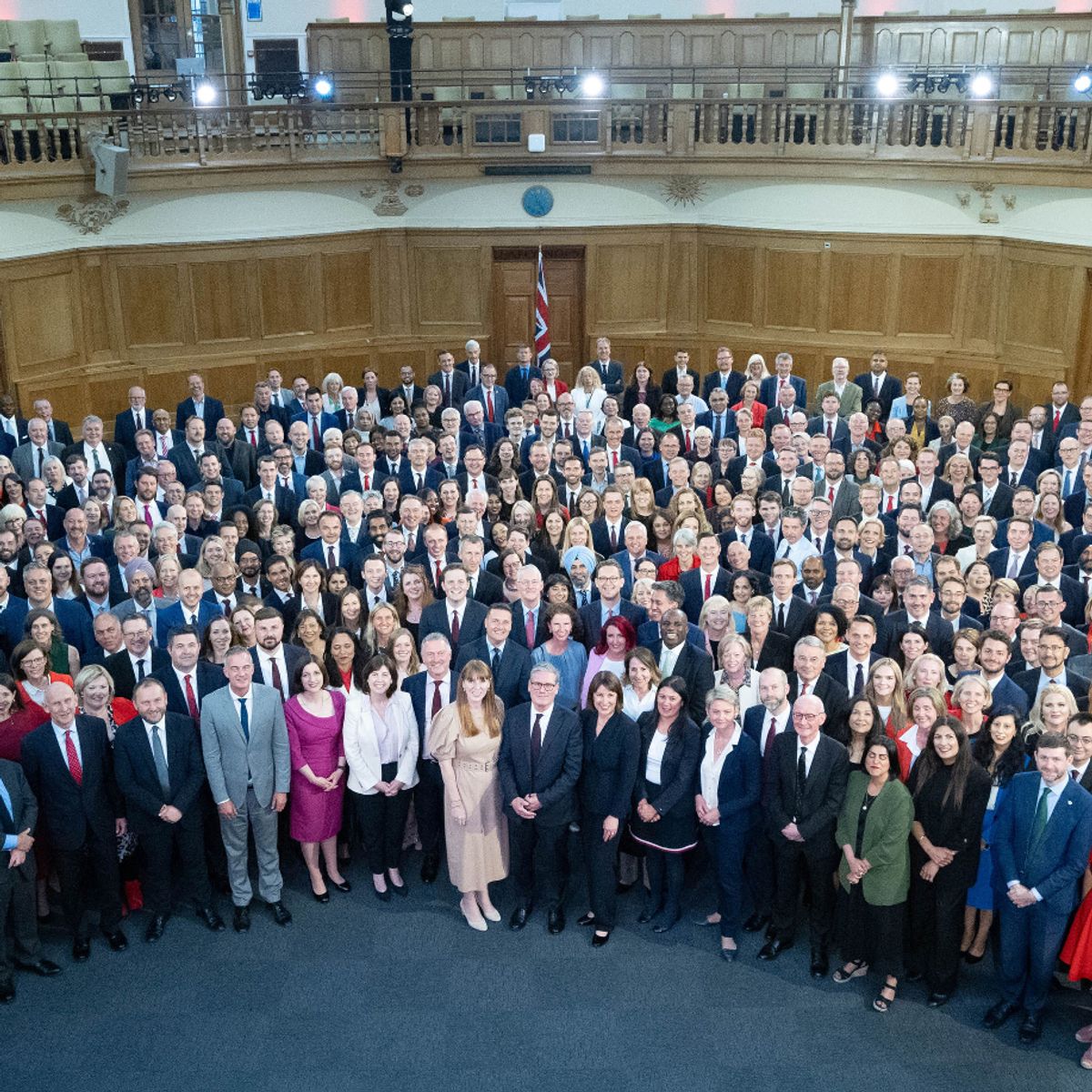
Of 238 new Labour MPs elected in July 2024, 72 worked in the charitable sector, 72 were political employees and 70 worked in communications or lobbying. Roughly ninety percent have never worked in defence, manufacturing, engineering, medicine or law enforcement. A parliamentary source quoted in the Sunday Times put it plainly. If only we had the same number with defence or military experience, maybe we'd be in a different place.
Maybe. But the problem runs deeper than defence spending. It runs to the question of what kind of person ends up in parliament, what professional formation shapes their instincts, and whose interests they are constitutionally equipped to represent.
Charity sector workers are trained to see the world through the lens of vulnerable groups, international obligations and institutional compassion. Political employees are trained to manage narratives and avoid uncomfortable truths. Communications and lobbying professionals are trained to advance the interests of whoever is paying them. Not one of those professional backgrounds prepares you for the question of how to defend a sovereign nation, manage a border, hold a foreign state accountable or protect a citizen from an Iranian proxy group that is firebombing Jewish ambulances on British streets.
The parliament that responded to the Golders Green firebombing by debating the language used to describe it is a parliament staffed by people whose entire professional lives have trained them to manage perception rather than confront reality. The government that rolled out an anti-Muslim hostility definition while twenty Iranian backed terrorist plots were being planned on British streets is a government whose instinct is accommodation rather than accountability. The thirty six MPs who wrote to the Parliamentary Commissioner demanding Nick Timothy's investigation were not all acting from professional instinct. Several have documented histories of antisemitic language or associations. Others represent constituencies where the Muslim vote is the primary electoral consideration.
The Sunday Times source suggests the problem is defence spending priorities. It is that. But it is also the Trafalgar Square response, where Keir Starmer reached for Tommy Robinson rather than engaging with a theological argument he knew he could not answer. It is the Attorney General deploying his Jewish identity to provide cover for a false equivalence he knew to be false. It is the parliamentary machinery mobilised to silence the people naming what is happening while the people doing it operate without consequence. All of it flows from the same source. A political class whose professional formation is compassion, accommodation and message management, governing in a moment that requires clarity, resolve and the willingness to say plainly what the evidence shows.
Britain is not short of intelligence assessments. MI5 has thwarted twenty Iranian plots. The Walney report documented Iranian influence operations in the charitable sector. The security services know what is happening. The problem is not knowledge. It is the absence of the professional formation, the instincts, the language and the willingness that would allow the people in power to act on what they know.
Ninety percent of the new Labour intake came from charities, political offices and communications agencies. They were never going to see it coming. And even now that it has arrived, on the streets of Golders Green, in the WhatsApp groups of the Green Party, on the Embankment where death to America was chanted on a Sunday afternoon, they are still reaching for the tools their professional lives gave them. Compassion. Accommodation. Message management. And the instruction not to take the bait.
"Ninety percent of the new Labour intake came from charities, political offices and communications agencies."
Chloe woke up at 6:45am and immediately felt proud of herself.
She had, after all, not eaten a single animal product in four years. The planet was healing. She could feel it.
6:52am - Applied her morning SPF. The SPF contains beeswax. Chloe does not know this. Moving on.
7:10am - Breakfast: a smoothie containing avocado. The avocado was grown in Michoacán, Mexico, on land where a pine forest was until 2019. It required approximately 320 litres of water to produce. It was flown to the UK. Chloe sprinkled hemp seeds on top. The hemp seeds came from China. Chloe felt connected to the earth.
8:00am - Got dressed. Polyester leggings, derived from crude oil. A bamboo top that was processed using carbon disulphide in a Taiwanese chemical plant. Trainers with a recycled plastic upper that sheds microplastics into waterways with every wash. Chloe's outfit today had a higher carbon footprint than a ribeye steak. Chloe does not know this either.
9:30am - Posted on Instagram about choosing compassion. The phone was manufactured in a Shenzhen factory using cobalt from the DRC, where mining operations have displaced local communities and killed an unknowable number of small mammals, reptiles, and insects. The algorithm served Chloe an ad for oat milk. Chloe liked it.
12:00pm - Lunch: tofu stir-fry. The soy was grown in Brazil. Brazil produces more soy than almost any country on earth. The primary reason is soybean oil: one of the most widely used industrial and culinary oils on the planet. The soymeal left over after oil extraction is fed to livestock as a byproduct. Chloe is aware of the livestock connection and finds it outrageous. She has not looked into why the soy was grown in the first place. The answer is the oil. The oil is in her salad dressing.
1:30pm - Drove to the garden centre. The car runs on petrol. Chloe has a Just Stop Oil sticker on the bumper. This is not being commented on further.
3:00pm - Bought a monstera. The monstera was grown in a Dutch greenhouse using natural gas heating. Chloe put it next to the pothos that is slowly poisoning the neighbourhood cats.
6:00pm - Dinner: pasta with cashew cream sauce. The cashews were processed in Vietnam, often by workers in conditions that would prompt significant commentary if they were in an abattoir.
8:00pm - Watched a documentary about factory farming. Wept. Posted about it. Caption: "We have to do better."
Chloe is, by every measure she has chosen to measure by, doing brilliantly.
By some of the others, the picture is more complicated.
Chloe has not chosen to measure by those.