Dear friends, good morning!
For the BBC, Vikas Pandey, India Editor came all the way down to Kochi to spend time with me.
https://t.co/foWrFt9zsh
He visited my home, spoke to my family and friends, and then spent two whole days with me in my outpatient department at Rajagiri Hospital, watching me diagnose and treat patients and interact with their family.
This report is the culmination of that visit and I am very glad for this opportunity. I hope you will like this read.
Loved and loathed: The making of India's viral liver doctor
https://t.co/foWrFt9zsh
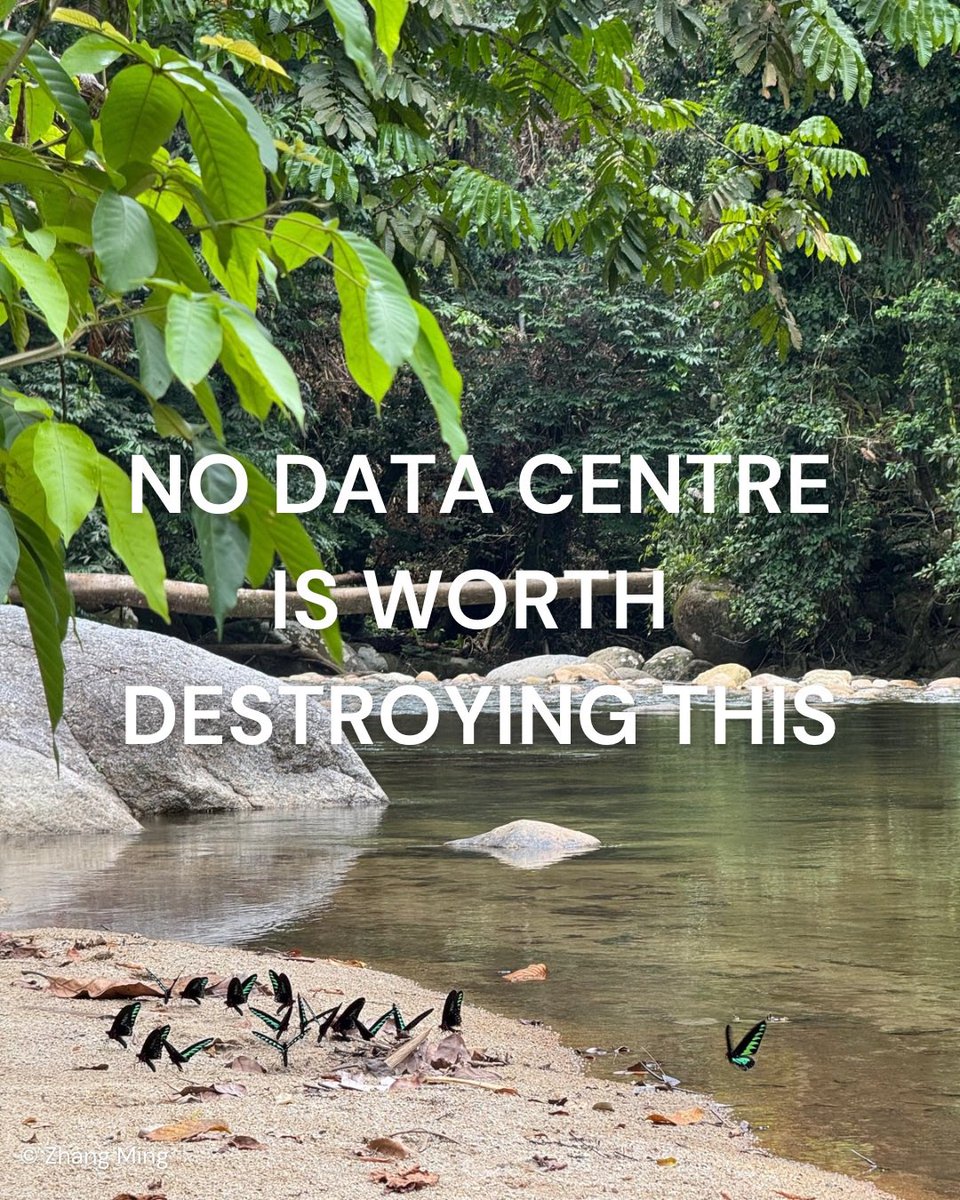
Malaysia wants to become a regional hub for AI & data centres. A data centre can use up to 25.5 million tonnes of water annually. This amount can support 300,000 people every single day.
Nothing can replace our freshwater ecosystems once they are destroyed & drained.
Everyone is angry at this.
Not just the Malays. The Chinese, the Indians, the indigenous tribes and myself included as an East Malaysian.
And we should be.
A family of four from Terengganu, a father, a mother, a 73-year-old grandmother and a 10-year-old girl, were on their way somewhere on Monday afternoon near Simpang Renggam, Johor.
It looked like a regular day but they never made it home.
Two brothers of Chinese origins, 19 and 22 years old, were racing on that same road in a Mercedes Benz A250 and a BMW 530e.
When the BMW lost control, it crossed into the opposite lane and hit four other vehicles.
According to news reports, the 22-year-old driver also died when his car entered a ravine.
Five people died in total. No amount of money can bring back those five lives.
I’ve seen people make this a racial issue online. I understand the anger.
But to me this is a road safety failure.
And somewhere, it’s also a parenting failure.
Because two young men shouldn’t be racing luxury cars on a public road. Something along the way went very wrong. So wrong… 😔
This is a classic case of cause and effect.
Every day we see drivers like this on our roads. Speeding, weaving, treating the highway like a circuit.
Many don’t see the importance of road safety until it happens to them or to someone they love.
The scary part is no matter how careful we are, some people are careless.
We used to have real road safety campaigns in this country. In the 80s and 90s, it was everywhere, on TV, on radio, in schools.
It shaped how a generation thought about driving.
I feel the culture is gone. And we’re paying for it with lives.
I won’t be surprised if something like this happens again in a few months. Because nothing has really changed.
I don’t know when Malaysia will become a country that is able to reduce its road accident rate.
To the families who are affected, words are not enough. May they rest in peace. Deepest condolences. 😔
Tapi kamera tu rakaman sabtu lepas. Ni dah bertemu sabtu semula. Macam mana lah keadaan Jaslinda. Dia pendaki berpengalaman, harap dia ada survival skills dalam hutan especially cari air.
@foldthecheseee R & A r going through a divorce but its yet to be finalised. A has the kids and blocks R from contact. R is unhappy and they start fighting on socmed. R starts dating K and makes it public that hes happy. The internet bullies them. They break up publicly.
மக்களின் அன்பும் ஆதரவும் கிடைப்பது வரம். நண்பர் விஜய் மீது தமிழ்நாடு பெரிய நம்பிக்கை வைத்திருக்கிறது. தமிழக அரசியலில் புதிய அத்தியாயத்தை தொடங்கவிருக்கும் அவருக்கு என் மனப்பூர்வமான வாழ்த்துகள்.
His name is Arunachalam Muruganantham.
He was born in 1961 in Coimbatore, Tamil Nadu. His father died in a road accident when he was a child. His mother worked as a farm labourer to keep him in school. At 14, he dropped out to support her.
In 1998, he married Shanthi. One day, he saw her hiding a dirty rag she had been washing and reusing during her menstrual cycle because sanitary pads were too expensive.
He decided to make her affordable ones.
He made a pad from cotton and handed it to her. The feedback was devastating. He went back to experimenting. He needed volunteers to test each prototype. Medical students were too embarrassed. He tested the pads himself.
He built a uterus from a football bladder filled with animal blood and wore it under his clothes. He walked, ran and cycled to test the absorption. His clothes began to smell. The village concluded he was mad.
His wife filed for divorce. His mother left. His neighbours ostracised him.
He kept experimenting alone.
For years, he could not figure out what commercial pads were made of. Then one day, a courier arrived while he was out. His dog tore it open. Inside were samples from an American supplier. He examined the material closely.
Pine bark wood pulp. That was the secret.
He spent four years building a machine to process it. Commercial pad making machines cost Rs 35 million. He built one for Rs 65000.
He took it to IIT Madras in 2006. Out of 943 entries in the National Innovation Foundation competition, his machine came first. The President of India presented him the award.
Multinational corporations offered to buy the patent. He turned every one of them down. He sold the machines exclusively to women’s self help groups. Today, over 1300 units operate across 23 states employing thousands of women.
Five years after she filed for divorce, Shanthi saw him on television receiving the award. She called. She came back.
He held no grudge.
TIME magazine named him one of the 100 most influential people in the world in 2014. Padma Shri in 2016. A documentary inspired by his work won the Academy Award for Best Documentary Short in 2019.
He still lives in a modest apartment. He said if you get rich you have an apartment with an extra bedroom. And then you die.
Follow for stories India deserves to remember.
I stopped wearing white coat routinely because every Tom (Homeopathy), Dick (Ayurveda) and Harry (Naturopathy) on social media started to wear one as a tool for false authority/credibility.
Recently an Ayurveda graduate with the IQ of a sterile rolled gauze piece came wearing one ONLINE to debate me on science and pseudoscience.
In India, the white coat is soon becoming a sign to mask professional inferiority complex or a desperate, beggarly appeal for recognition in medical and health for pseudoscience peddlers and legalized quacks because the government here has messed up the medical hierarchy (even letting physiotherapists use the title of Dr.).
So lose the coat. Doesn't matter anymore.
"Am I better off overseas or should I have stayed back home?"
- By an Indian who migrated to the US for a living (replug)
We come to the USA with monetary and career goals. This process takes a minimum of 4-5 years, including completing a degree, OPT, securing a stable job, etc.
Then we fight to protect the life we have built. This involves dealing with the H1B visa process, the green card backlog, and other related challenges.
During this time, we often get married and have children.
The next decade is about stabilization and achieving a semblance of a normal life: fighting for a green card, buying a home, and building a network of friends.
Meanwhile, our parents in India keep getting older. Cousins get married at inconvenient times. "Hey, your marriage is in March? My kids will be in school, I can't make it." Grandparents pass away when we have H1B stamping issues and can't travel. Fathers have heart attacks while our companies are laying off employees at a fervent pace.
We miss some or all of these events. India doesn’t care. Life goes on for them. Nephews and nieces grow up not knowing us well. They probably know us as the "uncle and aunt who bring phones" every couple of years.
Our children lack the meaningful extended family we had. No grandparents, uncles, aunts, or cousins. We become their entire world. Your spouse often becomes your only friend in a foreign land. She, too, is as confused as you are. When you argue with her for two days, who can she talk to about it? There's no one to share with.
The friends network you built will soon be beset with jealousy and complaints. Soon, you realize people are not as innocent as they seem. Class and divisions start to appear based on who got a green card first, who bought a big house, who has a Tesla, who became a manager, who has a furnished basement, and so on.
You will be caught in existential questions. Will my son or daughter bring a girl/boyfriend home at age 16?
You will turn to culture and home. You will involve yourself in Regional(Telugu/Kannada/Tamil) Community, Indian associations, temples, volunteering, etc. You will change your political beliefs based on your situation. You either become a liberal, thinking all is fine, or you become a conservative, thinking I should resist all this.
You go to India and find that you don't belong there. All your relatives have changed. You have changed. Uncles and aunts have died. Nephews and nieces are unrecognizable. The streets and city that you grew up in are unrecognizable.
You come back and slip into your known world, keeping on working, never knowing the answer to the question: "Am I better off here or should I have stayed back home?"
The answer to this question remains unknown.
People don’t understand how famous Michael Jackson was. Nobody else came close. He was known in every 3rd world country as well as the west. He couldn’t PA at nightclubs or restaurants like other celebs. No sitting court side at NBA games or ring side at boxing events. Why? Because fans would just cause chaos and shut the place down. People don’t understand that level of fame.
The whole world tuned in to watch the thriller premier, before social media and YouTube etc. He could sing, dance, choreograph, hardly did interviews, aura was another level, world leaders would ask to meet him. Roads shut down when he was staying at hotels etc.
Nobody before or since can compare, stop these lame comparisons. People used to faint when they saw him in person. It was insane and unheard of. There will only be one Michael Jackson and never again will we witness such talent and aura. Never.
An MIT professor taught the same math course for 62 years, and the day he retired, students from every country on earth showed up online to watch him give his final lecture.
I opened the playlist at 2am and ended up watching three of them back to back.
His name is Gilbert Strang. The course is MIT 18.06 Linear Algebra.
Every machine learning engineer, every data scientist, every quant, every self-taught programmer who actually understands how AI works learned the math from this one man. Most of them never set foot on MIT's campus. They just opened a free playlist on YouTube and let him teach.
Here's the story almost nobody tells you.
Strang joined the MIT math faculty in 1962. He retired in 2023. That is 61 years of standing at the same chalkboard teaching the same subject to 18-year-olds.
The interesting part is what he did when MIT launched OpenCourseWare in 2002. Most professors were skeptical. They worried that putting their lectures online would make their classrooms irrelevant. Strang did not hesitate. He said his life's mission was to open mathematics to students everywhere. He filmed every lecture and gave it away.
The decision quietly changed how the world learns math.
For decades linear algebra was taught the wrong way. Professors started with abstract vector spaces and proofs about field axioms. Students drowned in the abstraction. Most never recovered. They walked out believing they were bad at math when they had simply been taught in an order that nobody's brain is built to absorb.
Strang inverted the entire curriculum.
He started with matrix multiplication. Something you can write down on paper. Something you can compute by hand. Something you can see. Then he showed his students that everything else in linear algebra eigenvectors, singular value decomposition, orthogonality, the four fundamental subspaces was just a different lens for understanding what the matrix was actually doing under the hood.
His rule was strict. If a student could not explain a concept using a concrete 3 by 3 example, that student did not actually understand the concept yet. The abstraction was supposed to come last, not first. The intuition was the foundation. The proofs were just confirmation that the intuition was correct.
The second thing Strang changed was the classroom itself. He said please and thank you to his students. Every single lecture. He paused mid-derivation to ask "am I OK?" to check if anyone was lost. He never used the word "obviously" or "trivially" because he knew exactly what those words do to a student who is one step behind. He treated 19-year-olds learning math for the first time the way he treated his own colleagues. With patience. With respect. With the assumption that they belonged in the room.
For 62 years.
The result is something that has never happened in the history of education. A single math professor became the default teacher of his subject for the entire planet.
Universities in India, China, Brazil, Nigeria, every country with a computer science department, started telling their own students to just watch Strang's lectures. The University of Illinois revised its linear algebra course to do almost no in-person lecturing. The reason was honest. The professor said they could not compete with the videos.
His final lecture was in May 2023.
The auditorium was packed with students who had never met him before. He walked to the chalkboard, taught for an hour, and at the end the entire room stood and applauded. He looked confused for a moment, like he genuinely did not understand why they were cheering. Then he smiled and waved them off and walked out.
His written comment under the YouTube video of that final lecture was four sentences long. He said teaching had been a wonderful life. He said he was grateful to everyone who saw the importance of linear algebra. He said the movement of teaching it well would continue because it was right.
That was it. No book promotion. No farewell speech. No legacy management.
The man whose teaching is the foundation of modern AI just thanked the audience and went home.
20 million views. Zero ego. The entire engine of the AI revolution sits on top of math that millions of people learned for free from one quiet professor in Cambridge.
The course is still on MIT OpenCourseWare. Every lecture, every problem set, every exam, every solution. Free.
The most important math course of the 21st century is sitting one click away from you. Most people will never open it.